Sign up for our newsletter to be notified of new posts!
Ed: Below is an adapted excerpt from Orville Schell’s new book Inside China’s Secret Prisons: An Undercover Exposé and Its Lasting Legacy (Columbia University Press, September 2026). The book revisits a 1991 investigation into China’s reform-through-labor camps (劳改队) for the CBS 60 Minutes documentary “Made In China,” and explores how similar camps still exist today, notably in Xinjiang.
In 2021, just after the death of my wife, Baifang, I was looking through some boxes of old papers when I chanced upon a yellowing manuscript. As I began leafing through it, I immediately recognized it as the long-form piece I had written for The New Yorker, for which I was China correspondent from 1975 into the mid-1990s. The manuscript chronicled a project I had worked on for nearly a year with an investigative team from the CBS News program 60 Minutes and Wu Hongda (Harry Wu), who had himself been imprisoned in this system for 19 years. Our assignment had been to document the prison camp system that arced across the People’s Republic of China (PRC), held many political prisoners and was reported to be illegally exporting goods made in prison factories with forced labor into the United States.
Uncovering this relic from three decades ago made me feel a little like an archaeologist stumbling on an ancient text hidden in a long-sealed tomb. The article was drawn from a journal I had kept throughout the nine-month 60 Minutes investigation into China’s vast “reform-through-labor camp,” or laogai, system (劳改队系统) that was aired by CBS in the fall of 1991.
After the broadcast, I had set to work writing a narrative piece for The New Yorker about this dangerous and exciting but often hair-raising investigation. However, it was not until after the magazine had edited my draft that I fully came to my senses and realized that identifying myself so closely with this cloak-and-dagger investigation drawing back the veil on China’s prison and forced labor systems would provoke the wrath of the Chinese Communist Party (CCP). Fearful of the consequences not only for my own career as a China writer but also for the future of my Chinese-born wife, her Beijing-based parents and our many friends still living in China, I decided, after much agonizing, to withdraw the piece from publication.
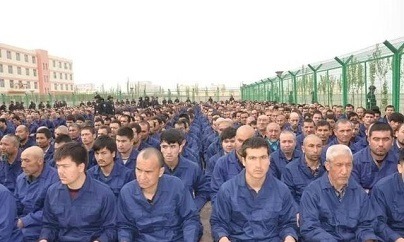
When I first rediscovered this lost-and-found manuscript, I expected to quickly conclude that after three decades, its shelf life would have long since expired. However, as I began leafing through its pages, several things surprised me. First, the saga still made for a really exciting story. Second, because a new global debate over yet another generation of goods made with forced labor had erupted in the United States, the issue of prison labor was more relevant than ever. This was especially true of goods made in China’s westernmost region, Xinjiang, which had a land mass four times the size of California and was home to an estimated 12 million Uyghur Muslims. Now thousands of them were reported to be under detention in a newly built network of high-tech prison camps, many of which had attached production facilities. These new camps had engendered a whole new wave of antagonism over the still divisive issue of prison labor and were once again bedeviling U.S.-China relations.
Thirty years ago, I had considered following the Czechslovakian President Vaclav Havel’s admonition to speak truth to power, publishing this piece on China’s reform-through-labor camp system as planned, and letting the devil take the hindmost. However, in the end, the downside risk loomed so large that I yielded. Now, however, the situation had changed. My life’s partner was gone, so I no longer needed to worry about her welfare. Her parents still live in Beijing, but they were so elderly the Party did not care about them. Being older myself, I no longer needed to be so concerned about having my own career damaged. And since my children were now grown, I did not need to be so mindful of maintaining a connection to their mother’s birthplace for them. So, even if it meant banishment forever, I decided to go ahead.
A new global debate over yet another generation of goods made with forced labor had erupted in the United States.
China’s prison camp system was made up of a bewildering archipelago of penal facilities at almost every level of government in every part of the country. They included ordinary jails (监狱), administrative detention centers (拘留所), general detention centers (看守所), Central Commission for Discipline Inspection detention centers (留置所), reform-through-labor detachments (劳动改造队), and reeducation-through-labor detachments (劳动教养队) [technically abolished in 2013], to name only some of the major categories of prisons that the Party maintained for people it viewed as social and political malefactors.
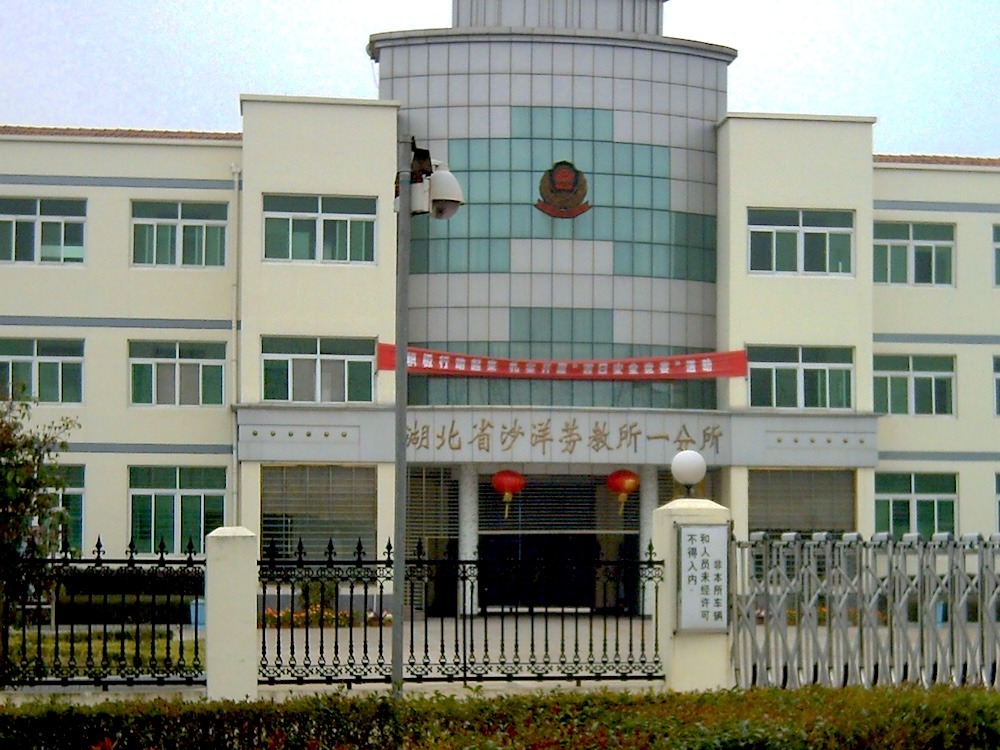
In the reform-through-labor universe, there was one last murky category known as “forced job placement” (留场就业), a term used for inmates who had finished their formal reform-through-labor sentences but no longer had homes to return to because they had been imprisoned for so long, their families and friends had renounced them, forgotten them or died. With no place to go, these inmates were allowed to continue working in their old prison camp enterprises as poorly paid laborers, but to live on the outside.
Although China’s laogai system had been borrowed from Stalin, it also had its own Chinese characteristics that distinguished it from its Soviet counterpart. One element that made it unique was the way it combined punishment with both “thought reform” (思想改造) and “labor reform” (劳动改造). A Peking University publication I found at UC Berkeley explained the logic of combining forced labor with thought reform: “Except for those who must be exterminated physically due to political considerations, human beings must be utilized as a productive force with submissiveness as a prerequisite.” It went on to note that “the fundamental policy is: Forced labor is the means, while thought reform is the basic aim.”
In other words, forced labor and thought reform — more commonly referred to in the United States as “brainwashing (洗脑)” — formed a kind of yin and yang relationship with each other. They were complementary processes designed to collectively purge a prisoner — whether a criminal or political prisoner — of whatever wrong behavior or “incorrect political thinking” they were seen as being afflicted by. The practice of brainwashing was perfected early in Mao’s revolution as a companion therapy for political miscreants who stubbornly resisted the tonic effects of imprisonment and forced labor and therefore required an even deeper “rectification of thought” (思想整顿).
A criminal reform handbook issued by the Ministry of Justice in 1988 explained the rationale for forced labor this way: “The [prison] system organizes criminals in labor and production, thus creating wealth for society.” Then, it noted that by “representing the working class and the working people of our country,” China’s reform-through-labor system “exercises dictatorship over a minority of elements who are hostile to socialism, thus safeguard[ing] our socialist system.”
China’s prison camp system was made up of a bewildering archipelago of penal facilities at almost every level of government in every part of the country.
The reform-through-labor system underwent some reassessment in the early 1980s, when leaders like Xi Jinping’s own father, Xi Zhongxun, a revolutionary veteran, was brought out of political exile to help revive the National People’s Congress in the wake of the Cultural Revolution. In 1981, Xi Zhongxun was put in charge of the Congress’s Legislative Committee, where one of his assignments was to look at the institutions of China’s reform-through-labor system, the very system in which he himself had been imprisoned.
Xi Zhongxun’s take was somewhat surprising. He concluded that while many laogai inmates might have done some wrong things, many were also victims of what he called “leftover poisons” from the Anti-Rightist Campaign, the Great Leap Forward and the Cultural Revolution, when those in charge of the camps had prioritized force and abusive tactics over the rights of inmates. A subsequent Ministry of Public Security conference on the laogai system called for a new policy that would include a modicum of “revolutionary humanism,” even going so far as to speak of the need for leaders to run camps more “like parents treating a sick child rather than disciplining unruly students.”
While Xi abjured from totally rejecting the notion of reform-through-labor, in one speech he observed: “After prisoners are sentenced and they are laboring at a laogai facility, if you do not treat them as people, if you abuse and humiliate them, or even engage in a fascist dictatorship, wouldn’t that also be the influence of leftism?” “Leftism” and “rightism” were two erroneous, if nebulous, tendencies that kept manifesting themselves in Party history, causing many to be grievously punished.
Implementing a rule of law did make some halting progress in China during the 1980s. However, the laogai system continued unchecked. Moreover, many of the reforms that were implemented were set back by the political crackdown that followed the Beijing Massacre in 1989. The ensuing retrenchment not only served as the death knell for more meaningful political reforms but gave hard-line conservative veterans in the Party cause to insist that the laogai system still had utility and should remain.
I vividly recall coming upon my first prison camp in China, on a trip I had made to Qinghai province in 1981. As part of his “reform and opening” agenda, paramount leader Deng Xiaoping began opening up many long-closed Tibetan ethnic areas to foreign mountaineering and trekking groups as a way of earning much-needed foreign currency. Since I had always been interested in China’s historically fraught ethnically Tibetan region, I joined an expedition attempting to summit Qinghai’s 20,610-foot-high Mt. Amne Machin (阿尼玛卿山), one of the few remaining peaks of consequence on the planet that was still unclimbed.
During our weeks in Qinghai, we drove for days on arrow-straight dirt roads that lanced across vast expanses of alpine grasslands and deserts sparsely inhabited only by pastoral Golok nomads. Never had I seen a more desolate but also strangely beautiful landscape. The starkness of Qinghai’s treeless mountains, barren grasslands and endless deserts marked the province as a place of fathomless remoteness, emptiness and isolation. It was precisely these qualities that made it a perfect place for prison camps. Even if an inmate somehow managed to escape the confines of a prison, it was all but impossible to escape the hostile surrounding wilderness. So, like Xinjiang, Qinghai became a favored place to send ideological criminals with long sentences. Soon prisons became one of the province’s most important industries.
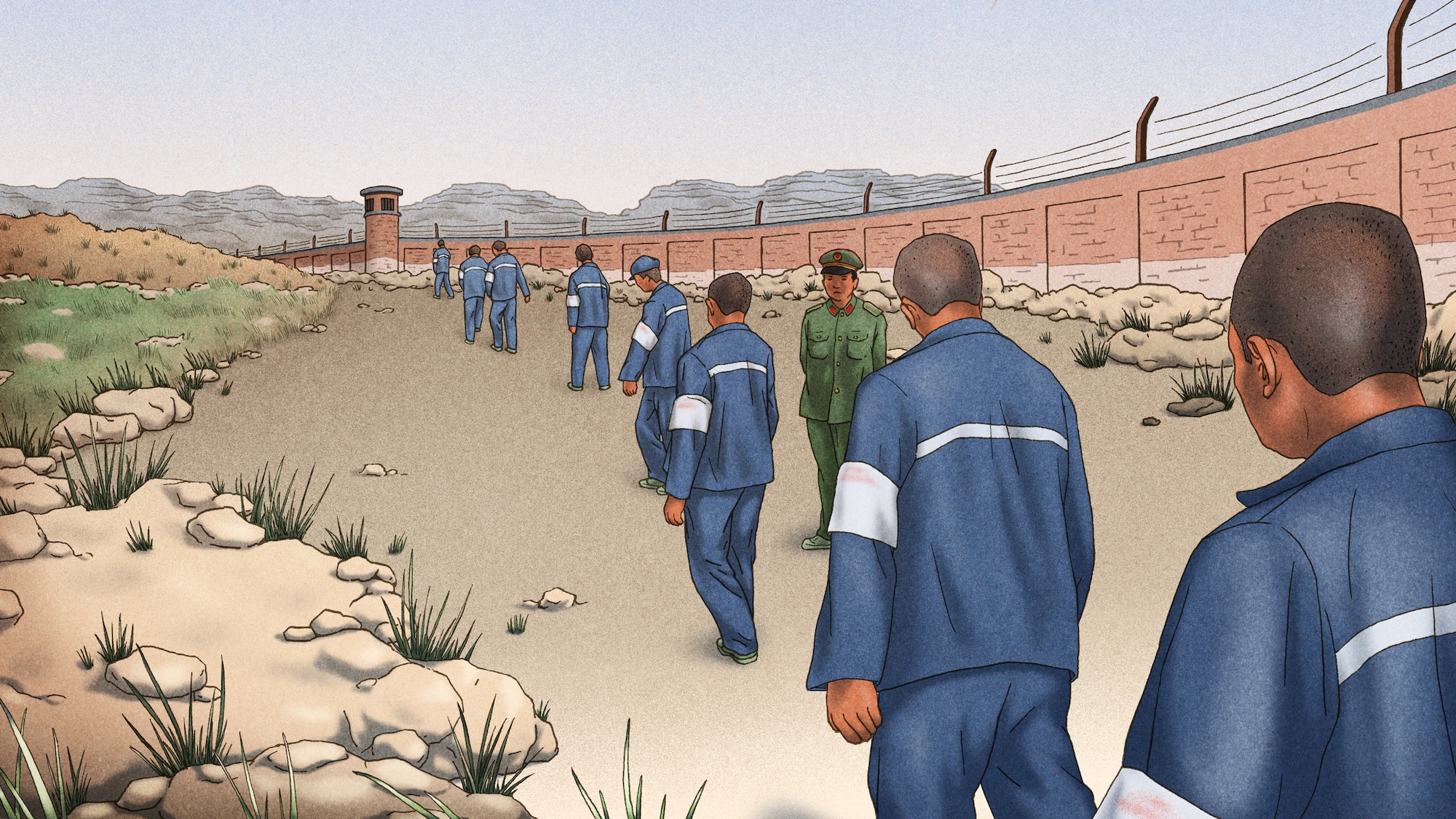
We had been driving across a vast flat stretch of grassland when the outlines of a fortress-like rampart rose on the horizon before us like a distant ship on a calm sea. Only as we drew nearer did I see that it was, in fact, a compound ringed by stamped-earth walls, fringed with barbed wire and turreted guard towers. As we passed, a long file of prisoners with shaved heads and wearing faded blue uniforms appeared trudging down the road. When I asked our Chinese Mountaineering Association guide if they came from a nearby reform-through-labor camp, he just squeezed his eyes closed and shook his head, as if such a question was too forbidden to be addressed openly to a foreigner.
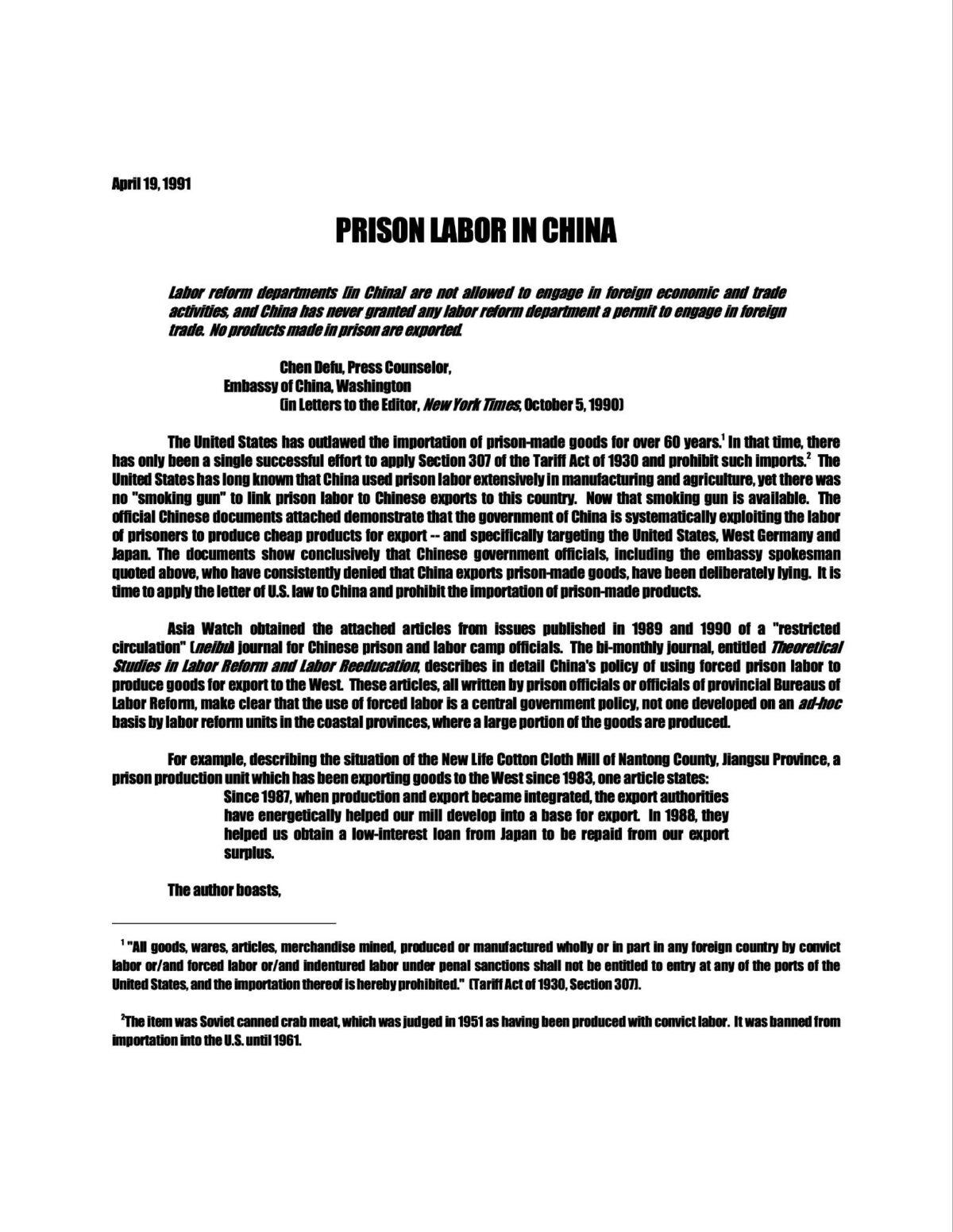
In 1991, Human Rights Watch (HRW) released a report, “Prison Labor in China,” that should have ended all debate as to whether Chinese prisons factories and farms sought to sell goods and commodities produced with forced labor on global markets. HRW researchers had gained access to a restricted-circulation journal published for Chinese prison officials that, in the most upbeat language imaginable, extolled China’s prisons as playing a key role in a burgeoning export drive. Ding Banghua, an official in a provincial prison bureau, was even quoted as raising the question of whether reform-through-labor enterprises could and should develop “a foreign-oriented economy.”
“The answer must be affirmative,” Ding jauntily responded. “Some enterprises have already done so with flying colors,” he continued. “After 30 years and more of hardship getting started and vigorous development, labor reform enterprises throughout the country have great potential for … earning foreign exchange.” Then Ding candidly acknowledged that “nearly every province has its own sizable community of labor-reform enterprises.”
Despite such brazen official self-admissions, Chinese officials still regularly insisted that goods made with forced labor were not being exported to the United States.
I vividly recall coming upon my first prison camp in China, on a trip I had made to Qinghai province in 1981.
After almost a year of work, our 60 Minutes “Made in China” segment aired on CBS in the fall of 1991. Newsweek ran a cover story; The Washington Post, Business Week, The World Journal, the BBC, Voice of America and many other media outlets extensively covered the story. Senate Majority Leader George Mitchell asked for a meeting, and a congressional committee announced its intention to hold hearings on products made with prison labor.
Beijing’s reaction to having its darkest interstices exposed by an American television network was predictable. Wu Jianmin, China’s Foreign Ministry spokesman, charged 60 Minutes with having “confounded black and white” and attacked the program as “notorious for vilifying China” and for revealing its “extreme hatred for the social system which the Chinese people have chosen.”
Despite Beijing’s criticisms, the program went on to win an Emmy, an Alfred I. duPont–Columbia University Silver Baton award and other plaudits. However, despite all the publicity the program generated, Beijing was still granted unconditional Most-Favored-Nation (MFN) trade status. Evidently many in Washington, including President George H.W. Bush, continued hoping that more engagement would somehow encourage China’s leaders into accepting a closer and more open relationship with the United States and the world. Soon the Clinton administration, which came into office in 1993, was paving the way for China to be admitted into the World Trade Organization as well. In a 2000 speech, President Clinton himself justified U.S. support:
Membership in the W.T.O., of course, will not create a free society in China overnight or guarantee that China will play by global rules. But over time, I believe it will move China faster and further in the right direction, and certainly will do that more than rejection would. … So if you believe in a future of greater openness and freedom for the people of China, you ought to be for this agreement.
In the 1990s, despite their two very different political systems, the United States and China continued to seek ways to coexist and avoid conflict. Things were not perfect, but despite all the points of divergence — ideology, political imprisonment, dumping, intellectual property theft, Taiwan — it was still possible to imagine that increased interaction might lead to greater convergence. Even in the wake of the 1989 Beijing Massacre, when all seemed lost, Deng Xiaoping and then CCP General Secretary Jiang Zemin succeeded in managing the U.S.-China relationship in ways that enabled both sides to remain hopeful that certain aspects of “reform and opening” might continue to haltingly help improve rather than deteriorate U.S.-China relations. As late as 2009, such efforts enabled President Barack Obama to hope, “The rise of a strong, prosperous China can be a source of strength for the community of nations.”
However, as China fell under the sway of Xi Jinping’s leadership in 2012, his devotion to a Leninist political model for China and to an increasingly hostile Cold War-like vision of U.S.-China relations rendered Obama’s hope more and more a pipe dream. It became increasingly clear, at least to me, that a society that had undergone a revolutionary upheaval as deep, long, and violent as China’s could not expect to easily escape the enduring influences of that experience. Even when a visionary pragmatist like Deng Xiaoping mounted the political stage, waved his figurative wand of reform, and proclaimed a bold new societal direction, the gravity of Mao’s revolutionary past remained inescapable. China under Xi, like Russia under Putin, was a living demonstration of how difficult it can be for countries and their societies to escape their pasts. “What’s past is prologue,” Shakespeare famously proclaimed. China’s past and its deeply rooted system of authoritarian rule seemed unlikely to be eclipsed anytime soon.
Nonetheless, Westerners were drawn to the promise that “peaceful evolution” (和平演变) offered the prospect of a slow and nonviolent transition from the past to a different and less tumultuous present and future for China. However, Xi Jinping did not share that fantasy. For him, “peaceful evolution” implied not a gradual and pacific passage to a more stable and open future, but the dismantling of China’s one-party state and the end of the CCP’s unilateral rule. This scenario was exactly what Xi viewed as having led to the catastrophic downfall of the Soviet Union in 1991, and he was not about to preside over a similar self-immolation of his own centralized autocratic control. As good Leninists in China were coming to recognize, Deng Xiaoping’s policies of “reform and opening,” if left unchecked, would lead not just to a form of “peaceful evolution” but to the demise of the CCP and the PRC, just as glasnost and perestroika had ineluctably led to the demise of the CPSU and the USSR.
As a result, Xi eschewed reform and instead moved to strengthen the CCP. An important piece of his Party-strengthening agenda was not only keeping its penal institutions and reform-through-labor system functional, but strengthening them with the latest technologies. Never again would the Party allow the social latitude to roam unmonitored around the countryside exposing the darkest side of what Xi had come to call “the China story (中国故事).” Nowhere in China was the reimposition of Party mechanisms and updated forms of imprisonment more in evidence than in Xinjiang.
In the 1990s, despite their two very different political systems, the United States and China continued to seek ways to coexist and avoid conflict.
After three decades of hoping, perhaps naively, that China might somehow permanently temper its revolutionary past, as I reread my New Yorker manuscript, I found myself still confronting as a China scholar the questions of political imprisonment and forced labor that, once again, had started bedeviling China’s relations with democratic countries.
However, making matters more complicated was the reality that during the glory days of “engagement” and the reckless adoption of globalization as a win-win strategy, these very democracies had become so dependent on supply chains “coupling” them to China that “decoupling” — because of prison labor or other thorny political issues — was no longer an easy matter. Making the situation even more intractable was the reality that some of the natural resources and manufactured goods supply chains that China controlled, and that we and other countries needed most, were now enmeshed with prison and forced labor issues, especially in Xinjiang. Polysilicon, photovoltaic cells, solar panels, batteries, electric vehicles, wind generators, cotton goods and critical minerals were all commodities that China had a lock on but the rest of the world urgently needed.
Xinjiang’s sandy deserts provided more than 45% of the world’s solar-grade silicon, and more than 92% of solar cell manufacturing was being done in China. Seven of the world’s top ten solar panel producers were now based in Xinjiang, giving China a choke hold over the global supply chain. And China had acquired several other choke holds over critical renewable energy sources, technologies, rare earths and critical minerals on which Beijing leaders had a near monopoly. This created choke points that both sides could use as political levers in what became an increasingly punitive struggle as the worlds of competitive global trade and radically differing political ideologies and systems collided.
In our own 60 Minutes investigation, we had discovered how tanned yak hides sourced in Qinghai province were first sent to Hong Kong before being transshipped to Korea and turned into finished goods there, entitling them to be marketed in the United States with “Made in Korea” labels. Now the Chinese government was engaging in a new kind of subterfuge to thwart foreign efforts to block such goods from entering their countries.
In 2024, the European Union passed legislation designed to block goods made with forced labor in China from entering EU markets. However, in recognition of how difficult it would be for businesses to comply with the law, it delayed implementation until 2027. Even if some new sophisticated forms of detection were developed by then, Chinese officials would most certainly push back with the kinds of denials and disavowals offered up in 1991 by the vice minister of the Ministry of Foreign Economic Relations, Tong Zhiguang, when he was grilled by Ed Bradley on 60 Minutes.
By 2026 so much had changed since our 60 Minutes program aired, one might have expected that China’s Leninist system, too, would have undergone a metamorphosis. But the assumption, or hope, that China’s “dictatorship of the proletariat” would somehow be politically transformed by the Party’s own regimen of “reform and opening” had turned out to be overly optimistic. So, starry-eyed liberal Westerners may be forgiven for feeling disappointed. After all, we were inclined to believe that history had a felicitous direction. Had not Martin Luther King, Jr. oracularly proclaimed: “The arc of the moral universe is long, but it bends toward justice”?
Such hopes grew out of the work of people like the 19th-century German philosopher Georg Wilhelm Friedrich Hegel, who believed that history had a teleology, an understandable direction. In his view, history would inevitably bring about a gradual realization of greater freedom as the World Spirit (Weltgeist) did its dialectical dance through time. Karl Marx not only borrowed Hegel’s assumption, but went one better. He proclaimed that history’s dialectical march forward was a form of “historical determinism” that would ultimately, and inevitably, bring about communism. Americans, well-known for both their optimism and naivete, borrowed elements of both of these rather Pollyannaish views of history to allow themselves to imagine that history’s development through time was a form of ineluctable progress. President Bill Clinton liked to proclaim that the United States was on “the right side of history,” as if he, on behalf of America, had divined its direction. It was a nice dream — but only for those not accustomed to nightmares. ∎
Excerpted from China’s Secret Prisons by Orville Schell © 2026 Columbia University Press. Used by arrangement with the Publisher. All rights reserved.

Orville Schell is the Arthur Ross Director of the Center on U.S.-China Relations at Asia Society, and co-publisher of the China Books Review. He is a former Professor and Dean at the University of California, Berkeley, and author of over ten books about China. He is a regular contributor to The New York Review of Books, The New Yorker, Foreign Affairs and other publications, and has traveled widely in China since the 1970s.