Sign up for our newsletter to be notified of new posts!

When we think about China, it can be tempting to think of a homogenous monolith — Han ethnicity, imperial edicts, the mass line. It’s easy to discount the ethnic and cultural diversity that has made up the itself somewhat made-up notion of the Middle Kingdom, and religion is no exception. Not many people think of China as an Islamic nation, yet Islam has been an important patch on the Chinese quilt for over a millennium, with native-born Chinese Muslims playing a prominent role in the nation, despite often being persecuted and seen as a foreign element — as many still are today.
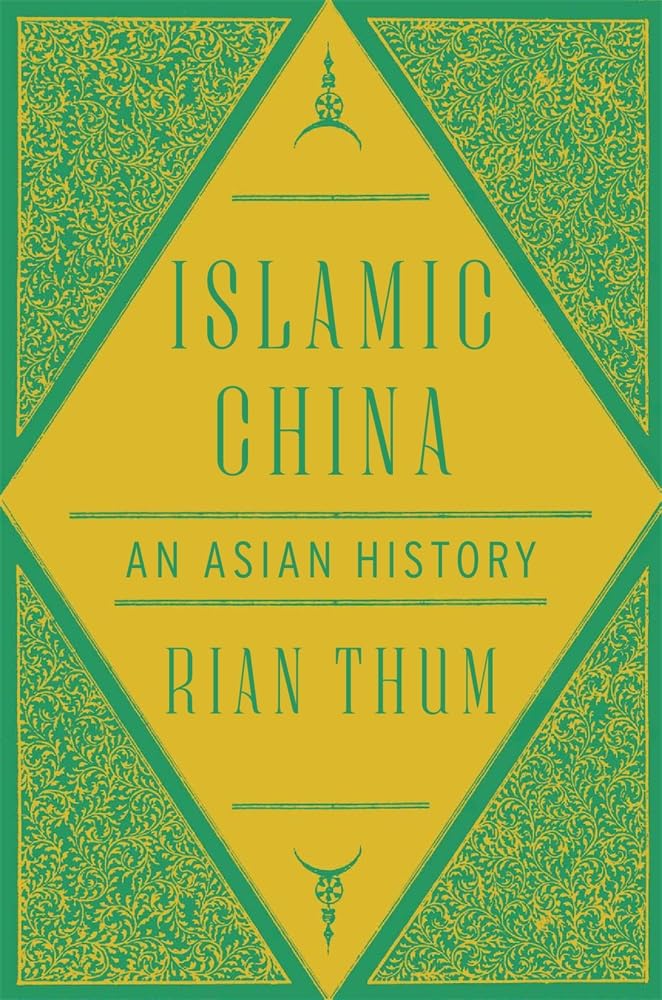
In his new book Islamic China: An Asian History (Harvard University Press, November 2025), the scholar Rian Thum tells the interlinked stories of a score of Chinese Muslims, both famous and obscure, across multiple ethnicities, sects and centuries. He traces this history through the Ming, Qing and Republican eras to argue that global Islam has been an important part of China’s story, and vice versa. We’re delighted to be joined by Thum on the podcast to weave this tapestry for us, and to tell us what relevance Islam’s history in China has on its present:
Guest

Rian Thum is Senior Lecturer in History at the University of Manchester. He is the author of The Sacred Routes of Uyghur History (2014), winner of the Fairbank Prize for East Asian History, and of Islamic China (2025), as well as contributing to The New York Times, The Washington Post, The Nation and other publications.
We have some essays on Chinese Islam which would look very exotic if they were read in Mecca, because they use a lot of Confucian philosophical notions.
Rian Thum
Transcript
Alec Ash: You write in your introduction that a goal of the book is to, quote, “make the Muslims of China unsurprising, even ordinary.” Tell us what you mean by that and why they are seen as surprising or unordinary.
Rian Thum: Many of your listeners won’t be surprised to hear that there are Muslims in China. And yet there is a persistent approach to explaining the history of Muslims in China that regards them as surprising. There is some notion out there that Islam and China are somehow mutually incompatible. And this is something that pervades both popular opinion and a lot of academic work.
Of course, for people who grow up in a Muslim village — say, in Yunnan — and grow up as Muslim and as Chinese, they are not surprised by their own existence. They’re not surprised that Muslims exist in China and have for many centuries. And so what I wanted to do with this book was tell the history of Muslims in China from that perspective — the perspective in which it’s just the natural order of things that of course there would be Muslims in China, and that one could be both Muslim and Chinese at the same time.
One of the places where we see this idea of Islam being a surprising part of Chinese culture is in the state discourse as well in China today, where Islam is officially considered a foreign or non-Chinese religion — despite the fact that if you look at Buddhism, which also originally came from outside of China, it’s seen as a Chinese religion. So I wanted to think about the history of Muslims and Islam in China as though Islam were a Chinese religion, which in fact, historically, we can say it is.
And to situate this in context, China has always been a melting pot of different groups and beliefs. Its religions have long been syncretic, if that’s the right word — non-exclusive, mixed together even. So why exactly is it wrong, or to use your term in the book, “essentialist,” to argue otherwise? And how does that essentialism creep into discussions of Chinese Islam?
Yeah. I argue in this book against reliance on the idea of syncretism or mixing of religious traditions as a way of explaining the exchange of ideas and different traditions. And the reason for that is: if you want to label a tradition as syncretic, as a mix of two things, you posit two pure versions of those things.
So it’s often argued that certain forms of Islam in China are syncretic because they mix Chinese philosophy or Confucianism with Islam — which posits a pure form of Islam, and the idea that the true Islam would have no truck with Confucianism, and a pure form of Confucianism which would have no Islamic elements involved.
It’s a way of understanding — from the thousands or tens of thousands of versions of Confucianism — plucking some out and saying they’re strange or curious, or from the thousands of forms of Islam, plucking one or two out and saying they’re a sort of odd, impure form that is compromised, and Chinese Islam is not a fully Chinese religion and it’s not a fully Islamic religion either. It’s not to argue that there is no exchange of information or tradition or beliefs. It’s rather to say that when we frame it as a mix of two coherent wholes, we get ourselves into some intellectual and philosophical problems that manifest themselves ultimately, often in racist ways.
I see. So Islam is also much newer than those other religions you mentioned. Muhammad’s revelation was in 610 CE, and the Arab conquests just a couple of decades later. So before we continue, can we step back a little? Can you give us just a quick potted history of when and how Islam makes it to China and takes hold there?
Yeah, so Islam makes it to China and takes hold there again and again over 1,400 or 1,300 years. It’s not entirely clear when the very first Muslims came to China, but it would have been quite soon after the time of the Prophet Muhammad himself — perhaps within a couple of generations. By the Tang dynasty, we have documentation of a Muslim born in China who passes the imperial exam. So very quickly we have the establishment of communities of Muslims who are multigenerational in China and who are engaged not just in their own communities but with the state.
And over the next thousand-plus years, there is a constant connection between China and Muslim-majority parts of the world, which means that new forms of Islam are constantly coming into China. So some highlights, some big moments where we get big changes, would include the Mongol invasion of China and the establishment of the Mongol Yuan dynasty, during which the Mongols relied heavily on Muslim administrators that they imported from the Near East, Iran and Central Asia.
Is that because of the conquests in the West with the Golden Horde? Because the Mongols were more influenced by Tibetan Buddhism in their own religion, no?
Right. The Mongols themselves were more influenced by Tibetan Buddhism, but they trusted the administrators whom they brought from conquered lands of Iran and Central Asia. So that would be the Chagatai realm and the Ilkhanate parts of the Mongol Empire, whom they brought to China to act as administrators — roughly, we can say, because they didn’t fully trust the Confucian Chinese indigenous administrators. And that resulted in an influx of a lot of highly educated Muslims who put down roots in China.
That’s a kind of wave of large-scale immigration into China and immigration of people who became elites within the Yuan dynasty.
It’s funny, I lived in Dali for three years during the pandemic, and I was amazed to learn that so many of the Hui Muslims who still live in Dali trace their ancestry to Kublai Khan’s army when it invaded Dali to found the Yuan dynasty in the 1200s. And then later, of course, it was Muslims in the Du Wenxiu (杜文秀) clique who ruled Dali for so many years.
Yeah, that’s right. And this is really common in Yunnan. A very large number, or large percentage, of Muslims in Yunnan, which is a province that’s got a large population of Muslims and a lot of Muslim-majority villages and valleys, it is really common for people to attribute their own family lineage histories to the arrival of Mongol rule and to claim an ancestor who was, for example, a Yuan governor of Yunnan.
So you’re saying it was a slow and steady process of migration and cultural and religious osmosis. But forgive me for the other primer question: A re we talking about the Hui, the Uyghurs? What is the difference between, and origins of, these ethnicities which the layperson such as myself identifies as Muslim, but perhaps they’re not all Muslim?
Today, if we look at the present, the Muslim population of China is dominated by two ethnic groups. So we’re looking at 20-something million people. Over 10 million of them are of the Hui ethnic group, and over 10 million of the Uyghur ethnic group. The Hui are people who, in most cases, are Chinese speakers who tend to have a lot of their cultural material resemble Han Chinese; the main difference is that they are Muslim and they understand their origins to be in ancestors from Muslim countries.
The Uyghurs, on the other hand, are speakers of a Turkic language. They are brought into Chinese civilization by conquest, by the Qing conquering the eastern part of Central Asia in the 18th century.
Now, this rather simple division of the Muslims in China, of course, ignores a bunch of other ethnic groups like the Dongxiang, Salars, Kyrgyz, Kazakhs. But it’s much less simple if we look further back in history. So the ancestors of the Hui are, in fact, many of them Han people who converted to Islam. And then there are all of the different groups of people who came and settled in China. Many of them would be merchants; some of them would be proselytizers. This includes people from Turkic backgrounds, Persians, Arabs, probably a lot of people from Southeast Asia. A lot of those identities have been lost over time.
And there is a long, messy history between, say, a person from Bukhara or from Iran arriving as an administrator in Yuan China and being a Persian, for example, and then their descendants becoming this thing we now call Hui — which is a 20th century creation in the way it stands today, which is to say a group of people who are culturally Chinese and by religion Muslim.
But looking historically, we’re really talking about a constant confusion. You would have, at any one time period, foreigners who are Muslims living in China. You would have some people whose ancestors two generations ago came from abroad. And you would have some people whose family had been in China for centuries. And they would have different identities and different senses of their connection to China and their connections abroad.
You mentioned that Buddhism and Islam both got going, or really flourished, in China at around the same time — in the Tang dynasty, seventh, eighth century — with texts and teachers and ideas moving into China from its southern and its western borders. So why is it then that Buddhism is sometimes seen as more natively Chinese, coming from India, but Islam is still often seen as alien, as foreign, despite, as you said, these sort of old origins within China?
There’s no definitive answer to this, but I would point to two phenomena. One is that Buddhism was, at many points in Chinese history, taken up as a kind of state religion. It was practiced by emperors of various dynasties. And this is partly because China was so often conquered by these northern steppe-based kingdoms that then set up their own dynasties, and they tend more often to have interest in Buddhism.
So there is a long history of the state, from time to time, being very invested in Buddhism. And a good expression of that is, say, all of these Buddhist grottoes in North China — for example, the big Buddhist carvings in Datong. These are state-supported efforts to integrate Buddhism into the Chinese sphere. And we don’t have any clear case of a Chinese emperor ever practicing Islam. So I think that’s one big factor.
Another factor is there is a bit of a time difference here. Buddhism does come in earlier and is even getting state support in certain periods before Islam really takes root in China. And we see texts written in Chinese about Buddhism already at the times of the first printed books in China. For example, the first printed book in the world — the oldest complete printed book in the world — is a Buddhist text printed in China. We don’t have writing in Chinese about Islam until the late Ming and early Qing.
So I think part of it is just that Buddhism has a bit of a head start, quite a substantial chronological head start, and Buddhist texts have been circulating in Chinese long enough for people to start seeing it as an ordinary or unremarkable part of the religious landscape.
So, your book is an academic work, in some ways as concerned with methodology and terminology as story, but I could see how deeply inflected it is by your own research, reading, love of finding and digging up old books, and also travel to these regions. We don’t have the time to get into too much detail, but I thought you could pick one individual from your chapters. We talked about maybe the Yunnanese Muslim scholar, Ma Lianyuan, who starts the book. Just introduce him to our listeners to give us a snapshot of a Muslim thinker in and out of China, to give us a little bit of an “open sesame” of some of these individuals.
Yeah. This is an academic book, but I try to write it in a way that would be accessible and interesting to non-academic readers. And if you start with Chapter 1 — if you skip the introduction, which has a lot of heavy academic, theoretical stuff as is required of an academic book’s introduction — if you just start at Chapter 1, it really begins on a very narrative basis and only moves into the more academic, theoretical stuff in the later chapters.
And the book starts with the story of this scholar named Ma Lianyuan (马联元), who’s a very interesting figure because he saw a need for something in the world and he took matters into his own hands to achieve it. So this is a guy who was the son of a religious leader. He lived in Yunnan, not far from Dali, which we mentioned earlier.
And he grew up, he came of age just before a major rebellion happens in Yunnan — a rebellion that led to the establishment of an independent Islamic state in Yunnan. This is in the 1850s and 1860s. And he was given an Islamic education, which I’ll describe a bit more in a minute.
And a lot of Muslim scholars were, according to Ma Lianyuan’s own writings, quite excited about this Islamic state because their teaching would then become the basis of the government, of the state, the basis of society in a way they hadn’t enjoyed under the non-Muslim Qing before. But Ma Lianyuan was disappointed, because he said all of our scholars now — they’re going into government, or they’re working in the military, and they’re going after worldly power and glory.
And he says he was so disgusted by this that he decided to go with his uncle on the hajj to Mecca. And he goes on the hajj and stays in Mecca for quite some time. He studies with various scholars there. And when he comes back, he finds his homeland in ruins. And this is because the Qing have reconquered — have conquered this Islamic state.
And he’s horrified to find that the Islamic education system has been dismantled, and he’s concerned that the youth of the next generation won’t be able to know the basics of Islam. So what he does is he starts teaching himself. He sets up a school, he starts teaching, but he also goes about publishing all of the basic books that people need to learn Islam.
And the reason this is so interesting and important for me is that a lot of these books that people were — that Ma Lianyuan himself used to learn Islam — were only circulating in manuscript form before Ma Lianyuan’s time. Part of this is because these basic educational books were in Persian, and there was no print industry that could handle Persian-language printing. China in the 19th century is a world of printed books, and there were printed Chinese books about Islam, but there were no printed Persian books about Islam.
And Ma Lianyuan is interesting because he actually takes that step of developing an industry to print books in Persian so that the Islamic education — which happened, the common basic education happened in the Persian language — so that this could happen in his region and he could restock all the educational books in Yunnan and create a new generation of people who knew about Islam.
And you found some of those books, didn’t you? In a sort of antique dealership in a village in Dali.
That’s right. These books haven’t been paid much attention to. They are not represented in foreign collections. Paris has a great collection of Islamic Chinese books. Tokyo has some great collections. But they’re really not represented very well. And so in order to find all of Ma Lianyuan’s various publications, I had to spend a lot of time just tooling around Yunnan, going to mosques and antique dealers, and photographing copies that I found there.
Wow. There’s a worse way to spend a summer. I’m so interested in how Islam is presented to Chinese audiences and whether it’s inflected with a Chineseness, if that’s not the wrong question. But you also mentioned in your book other scholars who promote a sort of more Confucianist Islam, and a scholar Wang Daiyu (王岱舆) who rewrote the five pillars of Islam, or translated them. Could you tell us a little bit about that, with a view to answering that question of whether Islam is changed at all when it’s explicated to Chinese audiences?
Yeah, the — this is a longstanding question in the history of Islam in China: How do we characterize the various forms of Islam? And how do we characterize the developments in Islamic thought that bear markers of borrowing or taking advantage of ideas that are floating around in China that aren’t present elsewhere, that are unique to China or unique to East Asia?
So we have, in China, many different forms of Islam, and they range from forms of Islam which would not really look out of place in other parts of the world. This would include, for example, much of Ma Lianyuan’s teachings — the person whose story we just told. When he made a second hajj to Mecca, later in life he stopped in India and he published books in Arabic in India which look like any other book published in India in Arabic.
So we have some forms of Islam, Chinese forms of Islam, which look unremarkable elsewhere. On the other extreme, we have some expositions of Islam, some essays on Islam, which would look very exotic if they were read in Mecca, for example. And some of them have been read in Mecca, because they use a lot of Confucian terminology and Confucian philosophical notions.
These forms of Islam — or expressions of Islam is probably the better way to put it — emerge in the 17th century with a series of writers who seem to be motivated by explaining their teaching, teaching Islam to the non-Muslims around them. So if you can imagine yourself being a scholar who’s invested a lot of energy into understanding the philosophical complexities of Sufism, Islamic mysticism, which is extremely sophisticated and difficult to penetrate. If you can imagine investing a whole lot of that and then noticing that all of the people regarded around you in a big city like Nanjing, as scholars, as impressive intellectuals, are Confucians, and you’re not really — your deep knowledge is not really appreciated.
It happens that some of those scholars who were deeply philosophically invested in Islam decided, “I want to engage with the philosophical mainstream, and I think these Confucian thinkers who are so highly regarded in my society, I think they would benefit from understanding the complexities of Islamic philosophy.”
And so they start writing books about their debates with Confucians and Buddhists, and they start writing expositions of the Islamic faith in Confucian terms that a Confucian philosopher can understand. And what’s fascinating about this is that over the centuries, eventually Muslim thinkers — Chinese Muslim thinkers — will also start reading these books and learning about Islam themselves through these Confucian ideas. And so these are the kinds of books that have led people to talk about a very Chinese form of Islam.
And you’re making a distinction in the book between the history of Islamic China and the history of Islam in China — in that you also discuss Chinese Islamic communities outside of China: Central Asia, Southeast Asia, South Asia, as far as Yemen. So it sounds like there is a form of Chinese Islam in these diasporic groups as well.
Yeah. I wanted, in this book, to get away from a nation-bound history of Islam in China — a sort of artificial history of Islamic communities that ends where the borders of China end — and to think of it instead as the history of communities that saw themselves as both Chinese and Muslim.
And listeners may have noticed by now that a lot of the stories we’re dealing with cross borders. These individuals who are major thinkers, and the new ideas that come and go among Chinese Muslim communities, often involve travel across Eurasia.
If we look at the people who consider themselves both Chinese and Muslim, we find out a lot of them are, in various periods, have actually not been in China. And that’s because many Chinese Muslim communities are engaged in international trade. Some are communities of people who leave during periods of warfare. For example, the Chinese Muslims of Kyrgyzstan today are mostly the descendants of people who left after the uprisings in the 1860s.
And so if you want to have an account of all those communities who have seen themselves as Chinese and Muslim at the same time, it actually turns out to be quite a bit bigger geographically than, say, the People’s Republic of China today.
So speaking of the rest of the world, let’s talk about Zheng He (郑和), perhaps the most famous Chinese Muslim. This is the Ming dynasty admiral and explorer in the early 1400s who sailed the ocean blue and brought back trinkets for the Yongle Emperor. He was a Hui Muslim. He performed the hajj in Mecca. So the fact that Zheng He rose so high in the Chinese court, does that show how accepting the Ming court was of his background or beliefs? What do we learn from his story, or the role that Islam has to play in it?
Yeah, I think there are several things we can learn. I don’t talk too much about Zheng He in this book because he is a little before the period that I focus on. He’s an interesting case because the Ming — at least the early Ming — is most famous in the history of Islam in China because of a reaction to the Yuan period, where Muslims were officials who were seen as foreign officials who were lording foreign power over the indigenous Chinese.
And there’s a reaction when the Mongols are kicked out and the Ming is established, in which Muslims have to be taken down a few pegs. And there are even edicts that the emperors put out which are designed to force the Muslims to integrate in Chinese society. There are periods where they’re forced to marry non-Muslims, with the idea that they’ll be assimilated.
But despite this, Muslims have some traditions and patterns of professions and scholarship that are useful to the state. So there continues to be a lot of Muslim astrologers, astronomers who are in charge of keeping the calendars. And Zheng He is an example of the usefulness of Muslims in interacting with foreign states.
So if you’re going to have a mission to go around the Indian Ocean, it’s probably useful to have a Muslim with an Islamic education. We don’t know if he had that, but if he did, it would have been useful because so much of the trade in the Indian Ocean at that time period is run by Muslim traders, and so many of the kingdoms around the Indian Ocean are Muslim-majority kingdoms.
One of the most famous things that Zheng He does in people’s visual memories of the history of China is: his and other missions bring back giraffes. Among the trinkets that are brought back to the Ming court are giraffes, which are called qilin (麒麟) — which is translated into English often as “unicorn.” And people often think of these giraffes as coming from Africa, which of course they do ultimately. But one of the most famous of these giraffe-giving incidents — the giraffe actually comes from the Sultanate of Bengal. So it actually comes from a Muslim ruler.
And if you look at the pictures that are drawn of the giraffe by the court painters in the Ming, you’ll see that the handlers of the giraffe are Muslim handlers who come from the Sultanate of Bengal, who’s presumably regifting a giraffe that he received that ultimately came from East Africa.
So when we think about the Zheng He voyages, we’re really talking about, in many cases, the interaction of a Chinese Muslim admiral with multiple Muslim states around the Indian Ocean.
There you go. The long arm, or the long neck, of the Chinese state. What kind of prejudice did Muslims face in China, both from ordinary people and in the system? And just to give an overview, did that wax and wane in different historical periods, or has it been a constant?
It has waxed and waned in different periods. And we just mentioned the move from Muslims being sort of high officials to being hated foreign overlords in the Ming. We don’t yet have a good history of anti-Muslim prejudice in China, and that, I think, would be a very interesting topic of discussion. Because while anti-Muslim sentiment is a constant throughout the last thousand years, the way that sentiment is framed changes over time.
For example, in the 19th century, we get the emergence of a very strong notion of Muslims as fierce and warlike. And this comes from the experience of Muslim rebellions or inter necine warfare in Muslim communities in the northwest that happens in the 18th century, and then again in the 19th century. And some of that has stuck around to the present.
Of course, more recently we get anti-Muslim sentiment that’s tied to Western Islamophobia and the global war on terror.
Earlier — if we go back earlier — there are anti-Muslim sentiments that are tied to the beef trade. Because in the Ming and Qing, there were many periods in which the state outlawed the slaughter of cattle. This is connected to religious ideas in the imperial state. And Muslims were given an unofficial pass on this. And so there developed in some cities specialized beef butcher zones, which were handled by Muslims. The idea being they can’t eat pork — they’re in a bind if they can’t slaughter beef. So they would be allowed to get away with doing illegal slaughter of cattle.
This is why the main Muslim neighborhood in Beijing is Oxen Street (牛街) because it’s named after this association of Muslims with the beef industry. And then that becomes part of the sort of derogatory language about Muslims. And if you read the famous Qing novel “The Scholars” (儒林外史) there’s a scene in there where the Muslims rebel, and there’s a whole lot of subtle anti-Muslim stuff in there, making jokes about them and beef. And they actually murder one Muslim by piling beef on him.
So the ideas of how Muslims are bad, or how you make fun of them, have changed over time. But there has been a constant anti-Muslim sentiment in China.
So when you look at what’s happening to Islam inside China today — the repression of Islamic faith and identity in Xinjiang, not letting citizens grow a beard or go to prayers or fast in Ramadan — how does your historical perspective and learning impact your view of this new round of suppression and sinicization of Islam? Is this different from what happened before? A different beast?
Yeah, it’s both different and connected to longer patterns. It’s different in that so much of the anti-Muslim policy is inspired by Western Islamophobia, specifically the idea that Muslims are uniquely prone to terrorism — something which is empirically not true around the world, but which is widely believed. And that is really a deep part of the Chinese state’s repression of Muslims today.
But the idea that Muslims are inherently foreign, and that certain kinds of Islamic practices or ideas or even architectural forms are somehow naturally appropriate to the Middle East but not appropriate to China — that’s a very old idea. And unfortunately, it’s an idea that I think has some resonance in some Western scholarship about Islam in China.
And this goes back to the syncretism discussion we had earlier, where people describe Muslims by reference to their origin in the Middle East. How do we explain why there are Muslims in China? It all goes back to the first ones who came in the seventh or eighth century — ignoring the fact that most Muslims today are descendants of people who came far later than that. And then having the idea that the true Islam is the one that’s in the Middle East.
The Chinese government thinks this too and has now decided that there is a spectrum of Islam, from a “Chinese-ified” Islam to an “Arab” Islam. And the more a person’s Islamic practice, or just the form of their mosque or the language they use, aligns with their view of the Middle East, the more pressure they’re going to put on those communities. Whereas communities that use Confucian terms are allowed to practice more freely.
And I think this should make us cautious about models of understanding Islam in China that pose some forms of Islam as more authentically Islamic and some as assimilated or synthesized or “Chinese-ified,” because that is the intellectual architecture of the Chinese state’s approach.
Now, I should say a few words practically about what we’re talking about here. It’s very much ethnically differentiated. So for the Uyghurs, we have of course the famous construction of internment camps for Uyghurs, where a million or more of the 11 or 12 million Uyghurs were placed in internment camps. Most of those people have now been transferred into prisons, or into forced labor, or returned to their homes. There are still probably about half a million people in some form of imprisonment. Most mosques are still closed for Uyghurs. And Uyghur children are being raised mostly in boarding schools where they’re not allowed to learn their religion or their mother tongue.
For Hui, the situation is a bit better. There is an attack on Arabic-language schools. And there are a lot of mosques being shut down. A lot of mosques have had their minarets removed. There’s a purge of books. It’s very difficult for Hui people to get books in other languages now. But it’s very much, again, driven by the idea that the Hui are more truly Chinese. So again, we see this idea of Islam as a foreign religion, and the less foreign it looks, the more appropriate it is.
Yeah. My first trip to China in 2007, I was teaching English in Qinghai province, and I remember going to the Dongguan Mosque in Xining and also the old home of Ma Bufang (马步芳) — the Muslim warlord who ran the region in the Republican era. And this is Hui, not Uyghur. But when I went back a few years ago, the mosque’s dome and minaret had been removed, and the Ma Bufang old home museum had been closed. And it really felt like even the history of Islam in this region had been whitewashed.
Yeah, absolutely. And this removal of what the Chinese state thinks of as “Arab” architectural features — which, by the way, are often more South Asian than Arabian — the scale of this is absolutely enormous. We’re talking about thousands and thousands of mosques. It must have cost quite a lot of money.
And there’s also a common phenomenon in China where, you know, if a local official’s not sure about whether something is problematic or not, they just err on the safe side. And you’ll get things like the local museum to Ma Bufang being closed. That could be because of an actual intentional state policy, or just because everyone knows Islam and Muslim history are dangerous things, and so it’s better just to be safe and close this down.
Unfortunately, that’s a pattern happening in America as well as China these days.
True. That’s absolutely true.
So, last question, Rian. You’ve engaged with this region for a long time, not least in your previous book, The Sacred Routes of Uyghur History (Harvard University Press, 2014). In your own travels there over the decades, what’s a location or an experience that left a lasting impact on you?
I would say one that stands out is participating in shrine rituals in the Uyghur region for the first book, of course. I have several exciting moments for this book where I found a book that I’d been chasing for many years. It’s always exciting when a library door suddenly opens and you see a whole bunch of books that have been eluding you for a long time.
But yeah, I think one memory that just really stands out strong is just kneeling in the sand of the Taklamakan Desert with other pilgrims, saying prayers in front of the grave of a Muslim martyr, while the wind is just whipping sand across everyone’s faces. It’s quite uncomfortable, actually. But I was really impressed by how much people were devoted to this kind of worship — that they were willing to kneel on these sand dunes in such inclement weather.
So there you go — finding the numinous, both in the desert but also in the joy of tracking down a book that you’ve been looking for.
Yeah. That’s right.
Rian Thum, thank you so much for coming on the podcast.
Thank you so much, Alec. I really enjoyed the conversation. ∎

Alec Ash is a writer focused on China, and editor of China Books Review. He is the author of Wish Lanterns (2016), following the lives of young Chinese in Beijing, and The Mountains Are High (2024) about city escapees in Dali, Yunnan. His articles have appeared in The New York Review of Books, The Atlantic and elsewhere. Born and educated in Oxford, England, he lived in China from 2008-2022, and is now based in New York.