Sign up for our newsletter to be notified of new posts!
Listen to the audiobook clip of this edited excerpt, courtesy of Penguin Random House:
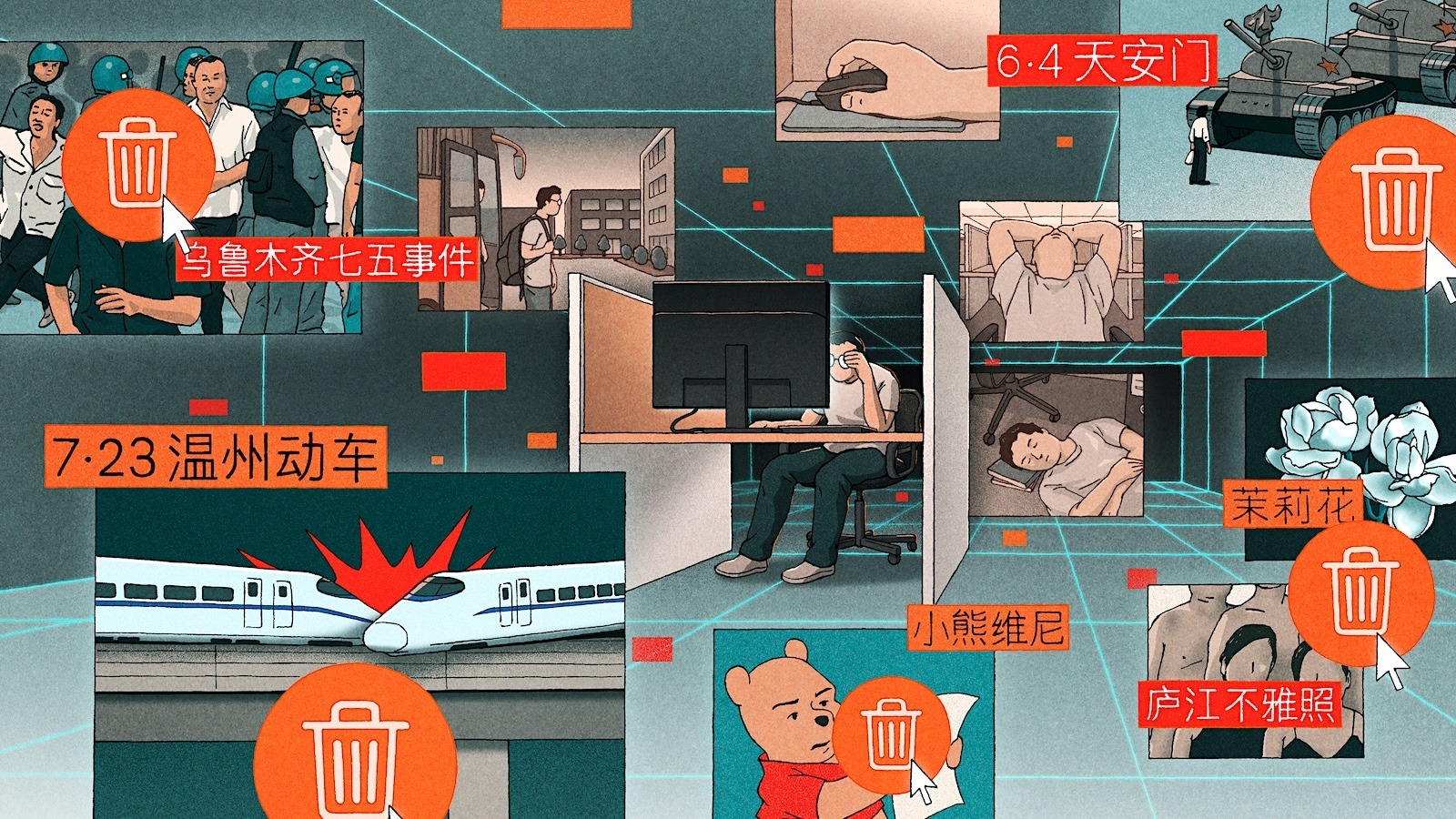
In 2011, Liu Lipeng, whom I would come to know later by his English name, Eric Liu, started training to be an internet censor for the Chinese social media platform Weibo. Every morning at 5 a.m., he rolled out of bed and caught the company bus to work. He slept straight through his commute — which took more than an hour from Tianjin’s city center to the Haitai industrial park, a barren plot in the city’s southwestern suburb — waking up just as they pulled up in front of his office. After the morning briefing, where his boss delivered the day’s directives, he sat at his cubicle and logged on to Weibo’s backend, the behind-the-scenes system responsible for managing the user interface.
The system had already flagged posts with sensitive keywords. Highly sensitive phrases like “Tiananmen massacre” were highlighted in red and automatically blocked; milder words like “government” appeared in orange. His job was to read each flagged post, decide whether it crossed lines, and if so, delete it. Then on to the next post. Read and delete.
When people think of the Great Firewall of China, the image that comes to mind is typically its most tangible layer: the piece of software that filters traffic passing through the global web, blocking IP addresses deemed forbidden. This feature had been in place since the early days of the Ministry of State Security’s Golden Shield Project, which was completed in 2006. Most netizens adapted to it as nothing more than an annoying inconvenience, like traffic or air pollution. In 2010, the Berkman Center for Internet & Society at Harvard University estimated that less than 3% of the population used circumvention tools, such as virtual private networks, to “jump the wall” and access the unfiltered web in countries that censor their cyberspace, like China. Most people couldn’t be bothered. They switched to homegrown alternatives — Baidu, QQ and Weibo — which met their needs as well as, if not better than, foreign platforms like Google, Facebook and Twitter.
Since its advent, the Great Firewall evolved from a list of blocked websites into a complex, multifaceted system of online censorship and control. At the top of the chain of command, an overlapping set of state organs known by a mouthful of initialisms — among them, the State Internet Information Office (SIIO), the State Council Information Office (SCIO), the State Administration of Press, Publication, Radio, Film, and Television (SAPPRFT), and the Ministry of State Security (MSS). All had the power to lay out broad rules of what could and could not be said. Collectively, they were dubbed by internet activists in China “the Ministry of Truth,” a name borrowed from George Orwell’s novel 1984.

At the very bottom of the chain of command was Eric, a recent college graduate with spiky black hair, who spent so much time in front of a computer that he started wearing glasses — gold-rimmed, Harry Potter–style round frames that he would wear well into his thirties. As part of a team of 120 Weibo editors, Eric worked as one of China’s many rank-and-file censors, hired by social media companies to maintain the bricks of the Great Firewall according to the shifting whims of the Party’s various ministries. Weibo’s censorship department was based in Tianjin because it was cost-effective and convenient. Located next to several universities, the industrial park guaranteed low rent and a supply of cheap, college-educated labor. Only a half-hour bullet train away from Beijing, the city was accessible to the company’s upper-level management and internet security officials. Several other internet companies — including Douban, Tencent and ByteDance — followed in Weibo’s footsteps and set up their censorship operations in Tianjin, giving it its unofficial nickname: Shandu, or “Censorship City.”
The various state organs from the Ministry of Truth passed orders to social media companies in the form of censorship directives: instructions on new sensitive keywords to remove from posts, or on how to silence negative news events — accidents, natural disasters, protests — that might spark social instability. For example, when a deadly flash flood hit Beijing, they issued the following directive:
Reduce the volume of reporting on the Beijing flood. Insist on positive reporting. Do not make critical reports or commentary.
They issued directives to extinguish scandals, in particular, those involving government officials. When nude photographs surfaced of men who appeared to be local officials in Lujiang County, Anhui, engaging in a lively, four-person hotel room orgy, authorities instructed:
All websites must stop following and hyping the so-called “Lujiang Indecent Photos Incident.” Interactive platforms must quickly remove all related photos.
But the Party’s greatest fear was of calls to gather. A Harvard study analyzing hundreds of thousands of censored posts found that the primary goal of Chinese internet controls was not to suppress criticism of the state but to silence comments that spurred collective action. This explained why calls for patriotic action were censored, while some critiques of government policies remained untouched. When angry nationalists called to boycott French retailer Carrefour after the Olympics torch relay was disrupted in Paris, authorities urged websites to monitor posts closely. Unchecked nationalist fervor risked sparking social unrest, diplomatic tensions and criticisms against China’s leadership for perceived weakness against outsiders.
The Party viewed collective action as the greatest threat to its rule and grew alarmed in early 2011 over its potential spread. On February 21, the State Council Information Office ordered:
Immediately delete the phrase “A nice bunch of jasmine” and related information.
Authorities issued the directive after anonymous posts on Chinese social media called for a “Jasmine Revolution,” inspired by the revolt in Tunisia and the unfolding Arab Spring. The words “Jasmine,” “Egypt” and “Tunisia” were blocked from social media sites. Offline, domestic security officials fanned out across the country. Videos of President Hu Jintao singing “Mo Lihua,” a Qing dynasty ode to the flower, were scrubbed from the web. In Beijing, police issued a jasmine ban at flower markets around the city.
Aside from these directives, there existed no official, centralized blacklist of keywords. Companies were wholly responsible for censoring their own content, creating their own keyword databases, and updating them to accommodate new directives. Failure to follow the changing rules resulted in companies’ being fined, suspended or shut down entirely. In 2009, Sina Weibo beat out its competitors, such as Fanfou, Jiwai and Digu, to become the largest microblogging platform, because it was better at following the rules. During riots in Xinjiang that summer, many providers failed to censor information quickly enough and were shut down, while Weibo posted information provided only by official media outlets and emerged as victor. As a method of control, the directives always reminded me of the vague “educational decrees” issued by the tyrannical High Inquisitor of Hogwarts, Dolores Umbridge, in the Harry Potter series, which students blindly scrambled to interpret. (Educational Decree Number Forty-One, for example, forbade students from discussing “the upsetting events of last year.”)
In fear of falling foul of regulators, platforms therefore often preemptively censored their content to avoid stepping over an ambiguous red line. They were constantly on the lookout for “upsetting events,” hot spots of netizen solidarity, new blasphemous euphemisms. Human ingenuity was just as crucial to the growing power of Chinese netizens as it was to the Great Firewall’s continued survival. Eric Liu learned that he could not only delete a post but hide a post (in such a way that it cannot be searched), make a post private (so it is visible only to the author), and ban a user (kick them off the platform altogether). As netizens honed their skill at evading censorship, Eric learned to become a better censor.
Since its advent, the Great Firewall evolved from a list of blocked websites into a complex, multifaceted system of online censorship and control.
Eric joined Weibo because he had no better options. Before joining, he had never used or even heard of Weibo. He had just graduated from Tianjin Agricultural University — a “mediocre student” at an “obviously mediocre university,” he told me, with a degree in human resources management (a “useless field of study”). He wanted to find a job that would let him stay in Tianjin, where he was born and raised and three generations of his family lived together. His parents worked at state-owned enterprises — his father, as an electrician at a railway company; his mother, as an administrator at a construction firm — and enjoyed steady salaries, good health care, and solid pensions. His paternal grandfather, a veteran who fought for the Chinese People’s Volunteers during the Korean War, secured a good reputation for his family. Growing up, Eric was neither ambitious nor rebellious. He was an introverted boy who spent most of his free time watching Japanese cartoons and playing video games with his cousins. He jumped the Firewall for the first time in college, with a free VPN called GoAgent, to watch banned Hong Kong and Hollywood films, going through IMDb’s Top 500 movies one by one.
His first year out of college, he took a job that his aunt found him, working for his juweihui, or “neighborhood committee.” Since Mao’s era, such committees functioned as the lowest rung of governance, taking charge of miscellaneous civil affairs, such as sorting household garbage and mediating conflicts between neighbors. Eric spent his days doing whatever the committee leader ordered him to: cleaning windows, shuffling papers, conducting meaningless inspections. The work was stultifying. Realizing that he would rather die than continue working there, he started looking for a new job. So when he saw a listing for a new internet company on a recruitment site, he jumped at it:
Job Title: Weibo Editor
Job Location: Tianjin
Educational Experience: College Degree
Job Requirements:
1. College Degree, Can Read English, Male
2. Familiar with using the Computer and the Internet
3. Can work with a team, innovative
Job Responsibilities:
1. Ensure the company’s informational security
2. Thoroughly check all of Sina’s blogs, posts, and discussion forums for harmful information
3. Communicate with the technology department to correct these problems every day
After submitting his application, he was invited to the office for an interview, alongside a dozen other applicants. He filled out a quiz of basic questions, identifying the name of China’s president, the premier, key cities and geographical regions. One question required a longer response: “What are your thoughts on Weibo users discussing Sino-Japanese relations?” It was a controversial topic, he wrote, but as long as it created traffic and did not violate any rules, online discussion was fine. A few days later, he got the job.
It soon became clear that his job, despite being at an exciting new internet company, was excruciating. The labor of censorship was at once crucial and tedious. On average, each editor processed 3,000 posts per hour. A 40-person team processed three million posts every 24 hours; divided into four teams, they alternated shifts, completing a 10-hour day shift and a 14-hour night shift every four days. Like Eric, most team members were recent college graduates, willing to put in long hours for low pay: a monthly salary of 3,000 yuan ($490), roughly the same wage as a local carpenter. His entire team was made up of men. According to his managers, women did not have the stamina to handle night shifts.

At the office, there wasn’t any chatter; employees rarely socialized. All day, all he heard was the whirring of mouse wheels scrolling, scrolling, scrolling, and every now and then, a pause, followed by a definitive click — the sound of a post being deleted, disappeared. The office was unremarkable: cramped cubicles separated by yellow dividers, identical laptops. A banner across the ceiling read, “The big eyes of Chinese people around the world.” The only anomaly was the lights — bright fluorescent tubes switched on 24 hours a day to keep employees productive. Sometimes, when Eric got sleepy during a night shift, he’d sneak in a quick nap on the floor next to an empty cubicle. A myth circulated among Weibo users that posts made between 3-4 a.m. would remain untouched.
Eric grew apathetic toward his work, but it was a stable source of income, just enough to make a living. Most of his colleagues did not use Weibo, did not have Weibo accounts, and did not care who posted what, where and when. They just went through the motions with a clinical detachment: commute to work, commute home. Day shift, day shift, day shift, night shift. Read and delete. He spent his days slumped in front of his computer, face numb with fatigue — until one evening at around 8:30, on July 23, 2011. Hundreds of miles south, in the city of Wenzhou, two bullet trains heading south collided, and Eric Liu was jolted from his stupor.
There existed no official, centralized blacklist of keywords. Companies were wholly responsible for censoring their own content.
Earlier that evening, a lightning storm struck. The Harmony Express was then the world’s largest and fastest high-speed railway, but it still had teething issues. Lightning hit a metal box beside the tracks, damaging the signaling system and leaving the signal stuck on the color green. Railway staff failed to notice the error in time and adjust. After experiencing a signal failure, Train D3115, carrying over 1,000 passengers, stopped for seven minutes, then moved at a slow speed on the tracks as a safety precaution. Behind it, train D301, carrying 558 passengers, continued at full speed, unaware of the train ahead of it, and collided into its rear. Four coaches fell off the viaduct they were traveling over. The crash killed 40 people and injured nearly 200. It was the third-deadliest high-speed rail accident in human history.
One of the first Weibo posts went up several minutes after the crash, posted by a university student on her journey home from Beijing:
20:47 p.m.: Help! High Speed Train D301 derailed near Wenzhou South Station! Children are crying in the car! We can’t find any crew members! Help us please!
Over the next 10 hours, the student’s post was reposted more than 100,000 times. Millions of users across the country logged on to Weibo to survey the scene. At 21:35, the first eyewitness report was posted, by a fashion photographer who lived near the crash, and she included a photo of the wreckage. By midnight, citizen journalists were flocking to the site, gathering information about the missing and the dead and coordinating blood donations for the injured.
Li Jianzhong, Male, on Hangzhou–Fuzhou Train Car 15. His family is extremely worried. Please contact over QQ.
Mrs. Chen is looking for her husband, Mr. Zhuo Huang. During last night’s incident, he was on the first car of D301. Her son and niece have been found. Please dial.
Mrs. Zhang Binglian has not found her daughter since the accident. Her daughter’s name is Huang Yuchun. 12 years old, white T-shirt and jeans, 1.50 meters tall, short hair, big front teeth, fair-skinned. She was sitting in Car 3, Seat 11. Please get in touch with this number.
The next day, the Party’s Central Propaganda Department immediately attempted to quell public anger and cover up the incident, issuing directives to all media organizations: “Do not question. Do not elaborate. Do not associate.”
Weibo users clamored for answers. Why was the train behind not aware that there was a train in front? Why was the rescue effort halted so soon? Why had a list of victims not been made public? Why were there photos emerging on Weibo of government workers burying the wreckage near the crash site? Infuriated, someone posted a public poll on Weibo with the question: “For what reasons do you believe that the train was buried?”
Poll Results:
To fill the pond (yesterday’s news report): 607 (1%)
Better rescue (QQ morning news pop-up): 506 (1%)
Prevent leakage of technology (city newsflash report): 429 (1%)
Destruction of evidence!!!!!!!!: 61,382 (98%)
Some newspapers parroted the Party line. But the boldly independent Southern Metropolis Daily trampled all over official rhetoric, publishing a scathing article titled “What Friggin’ Miracle?” “In the face of such a terrible event and its incompetent handling by the Ministry of Railways,” the piece began, “we can only express our views by asking — what the fuck?”
In Weibo’s Tianjin office, all employees had to work overtime. As new posts continued to pour into their backends, so did new censorship directives. They were meticulous and precise.
Regarding the 7.23 Wenzhou high-speed train incident. 1. Release death toll only according to figures from authorities. 2. Do not report on a frequent basis. 3. More heartwarming stories are to be reported instead, i.e., blood donation, free taxi services, etc. 4. Do not investigate the causes of the accident; use information released from authorities as standard. 5. Do not reflect or comment.
Eric was overwhelmed by the volume of posts, scrambling to delete them. Their team was much too small and ill-equipped to manage the onslaught of grievances flooding their servers by the thousands, then the millions.
So powerful was the wave of public anger that it pushed the leadership to act. A week after the crash, Premier Wen Jiabao visited the site, vowing to investigate the root cause of the accident. “If corruption was found behind this, we must handle it according to law, and we will not be lenient,” he said. The government admitted to “serious design flaws” and a “neglect of safety management,” punished officials for corruption, and in 2015 sentenced former Railway Minister Liu Zhijun to life imprisonment for bribery.
For a government that rarely atoned for its errors, the Wenzhou train crash was a watershed moment. Both domestically and abroad, people applauded Weibo’s emancipatory potential, predicting the arrival of a free-speech revolution. “In Baring Facts of Train Crash, Blogs Erode China Censorship,” read a New York Times headline that summer. They called it the Weibo Spring, a moment of civic awakening similar to the Beijing Spring, which had taken place more than two decades before, but even more so to the Twitter-fueled Arab Spring then unfolding, toppling governments across the Middle East.
China faced many of the issues that were plaguing Middle Eastern countries in upheaval — deepening inequality, rampant corruption, a lack of political transparency — and its people were now equipped with the digital tools that enabled them to speak truth to power. New users continued to flood Weibo, its user base swelling to the size of the United States’ population in 2012. Stemming the flow seemed impossible. The Great Firewall could not hold back the deluge of the people’s voices.
For a government that rarely atoned for its errors, the Wenzhou train crash was a watershed moment.
Something had shifted in Eric, too. When he got the job, he saw himself as just an editor at a social media company, nothing more — just making sure users stayed safe, protecting them from dangerous content. But now? Now it was clear he was deleting far more than he’d expected: news of disasters, evidence of corruption, voices demanding truth and justice. He wasn’t sure how he was supposed to feel about it anymore.

As a child, Eric always admired his grandfather — for his sharp tongue, his refusal to hold back. Grandpa Liu spoke his mind. Sometimes, when the mood struck him, he’d even rail against Chairman Mao, calling him a slaughterer, until Eric’s grandmother would panic, hissing at him to shut up before he got them all in trouble. To her, Grandpa’s loquaciousness was a vice. But Eric loved listening to him rehash stories from the past.
There was one story, from when Eric’s grandfather was fighting in North Korea during the war, when he spotted a dead soldier sprawled on the road — someone from his hometown. It was the body of a former Nationalist, incorporated into the army, not a Communist. “Leave him,” his superior ordered. But Grandpa refused — everyone deserved a proper burial. In another story, during the Cultural Revolution, he saw a mob of Red Guards beating up a child — a boy no older than eight. “Leave him alone!” he shouted, giving the boy just enough time to slip away before jumping on his bike to flee.
Maybe Eric wasn’t as bold as Grandpa Liu. But like him, he just wanted to be a good person, to follow his conscience and do the right thing. As he sat at his desk listening to the whir of scrolls and clicks, to the insidious tune of erasure, something shifted. Even as the uproar of the news cycle cooled and work returned to normal, he felt uneasy. Sometimes, the act of deleting a post made him so uncomfortable that he would read it and, even knowing that a post had crossed a red line, let it go through. ∎
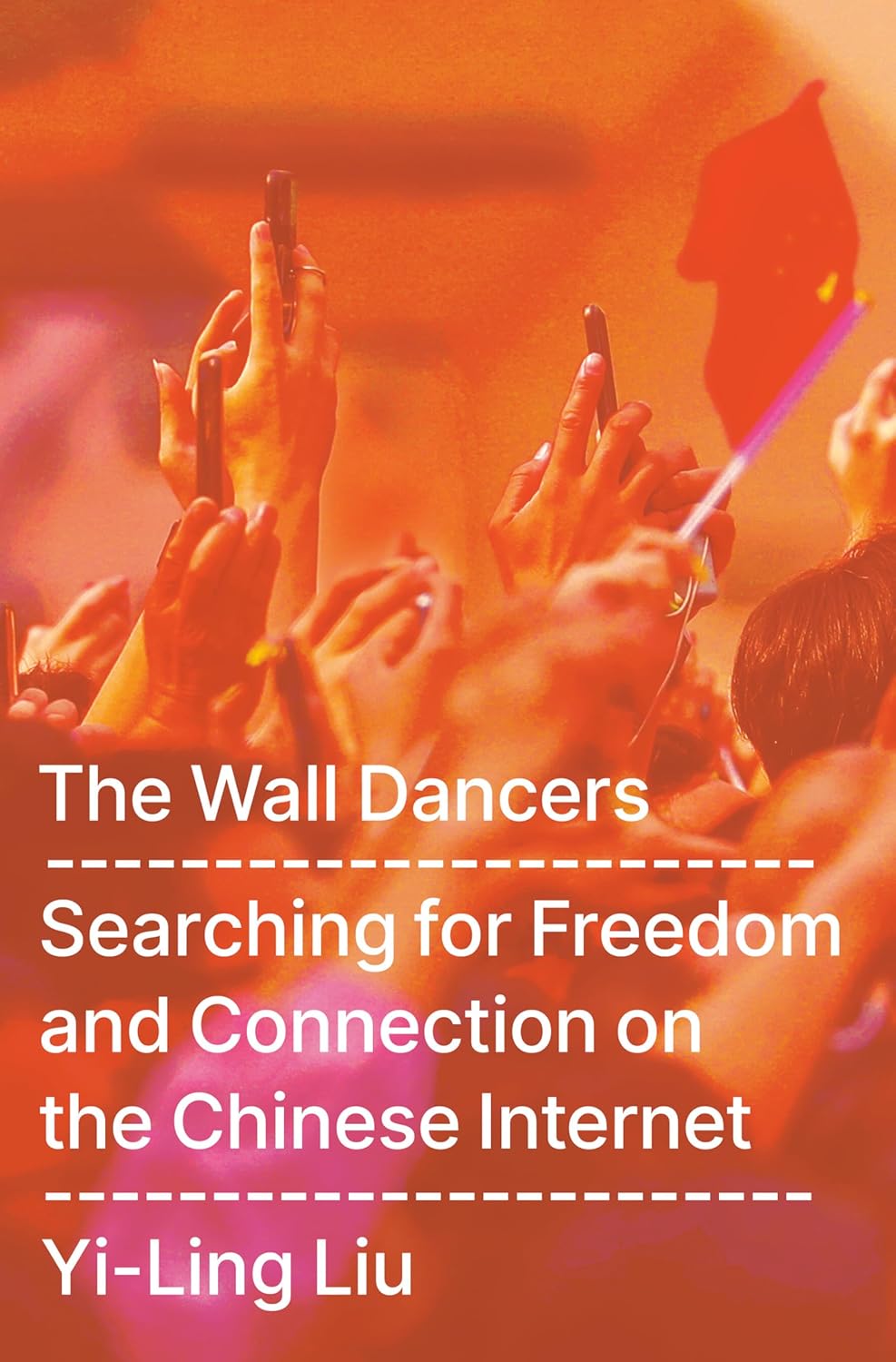
Adapted from The Wall Dancers by Yi-Ling Liu. Copyright © 2026 by Yi-Ling Liu. Published by arrangement with Alfred A. Knopf, an imprint of The Knopf Doubleday Group, a division of Penguin Random House LLC.
Audio excerpted with permission of Penguin Random House Audio from The Wall Dancers by Yi-Ling Liu, read by Jen Zhao. Yi-Ling Liu ℗ 2026 Penguin Random House, LLC. All rights reserved.

Yi-Ling Liu is a writer and editor covering Chinese society and technology. Her work has been published in The New Yorker, Harper’s and WIRED, and she is the author of The Wall Dancers (2026). Liu was the China Editor at Rest of World, and a recipient of the Matthew Power Literary Reporting Award. She is currently based in London, as a journalist-in-residence at the Tarbell Center for AI Journalism.