Sign up for our newsletter to be notified of new posts!
Reviewed: Red Dawn Over China: How Communism Conquered a Quarter of Humanity by Frank Dikötter (Bloomsbury Publishing, February 2026).
On October 9, 1911, a bomb exploded in a basement in the Chinese treaty port of Hankou. The detonation was accidental, but it drew the attention of the police, who discovered a list of those involved in an underground revolutionary plot to overthrow the Qing Dynasty. The rebels realized that they needed to act quickly, and the following day they launched their revolt. Within 24 hours, the city of Wuchang across the Yangtze River was in their hands, setting off provincial uprisings across the country that became known as the Xinhai Revolution (辛亥革命). On January 1, 1912, China became Asia’s first republic, ending over two millennia of imperial rule.
The first provisional president of China was Sun Yat-sen, leader of the Tongmenghui (同盟会), a nationalist party founded in exile that later became the Kuomintang (国民党). Yet in March 1912, Sun ceded the presidency to the military strongman of China’s north, Yuan Shikai. Yuan’s desire for unilateral power led to conflict with the Nationalists, and the assassination in March 1913 of Song Jiaoren, the leading candidate for prime minister after China’s first (and only) elections. By the end of 1915, Yuan had declared himself China’s new emperor — only to die of uremia the next year. In the aftermath, provincial military leaders (or warlords) ruled China from 1916 to 1928, during which the nation saw seven heads of state and 25 separate cabinets.
This politically fragmented landscape saw an extraordinary ferment of ideas about China’s future. One of the new political ideologies proposed was Bolshevism (the term “Communism” would not come until later), named after the October 1917 storming of St. Petersburg’s Winter Palace by Lenin and his “Bolsheviks” that ended Tsarist rule. There was a concerted effort by Soviet Bolsheviks to internationalize their revolution, particularly after the creation of the Comintern (Communist International) in March 1919. In China, operatives from Moscow cultivated contacts at Peking University, such as the librarian Li Dazhao (whose 25-year-old assistant was Mao Zedong) and Chen Duxiu, dean of the university and editor of New Youth (新青年) magazine — who by February 1920 had become convinced that “nothing short of the establishment of a Soviet State will save China.”
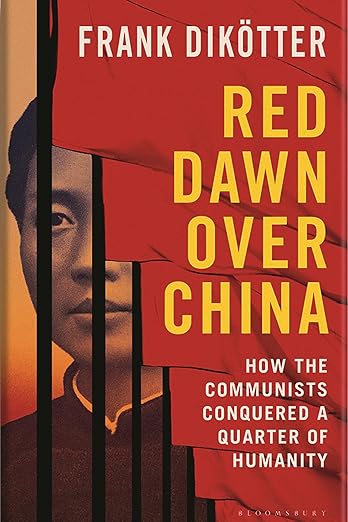
It is here that Frank Dikötter’s new history, Red Dawn Over China: How Communism Conquered a Quarter of Humanity, picks up the story, delivering a brisk, dense account of the tactics by which the Chinese Communist Party (CCP) came to rule the nation by 1949. Neither Chen nor Li attended the First Party Congress of the CCP, which took place at the Bowen Girls’ School in the French Concession of Shanghai on July 23, 1921. The lavish museum that now stands on the site presents this meeting as a keystone in the building of the revolution, but only a dozen Chinese delegates were present, including Mao Zedong, alongside representatives of the Comintern. “They squabbled over numerous issues,” Dikötter writes, “but on one subject were agreed: membership was small.” Nationalism — spurred on by the injustice of the last 70 years of Chinese history — was in the vanguard; Bolshevism seemed to have made little impression on Chinese politics so far.
The marginality of the Communist Party is one of Dikötter’s recurrent themes. In his preface, he recounts how in the industrial city of Wuxi, near Shanghai, the Party had just 25 members in 1929. “Only after 1945 did the Party begin to grow meaningfully,” he writes. Yet Dikötter argues that existing literature on the CCP’s victory in the Chinese Civil War (1927-49) is dominated by the fairy tale that:
the country [was] wracked by an unholy alliance of “imperialist powers” and “reactionary forces,” the Communists mobilise the “peasants” by taking the land from the rich and distributing it to the poor, then they gradually unite the people in their fight against the Japanese invader and the fascist Nationalist Party, their arch enemy led by Chiang Kai-shek.
Dikötter acknowledges variations in this narrative, but notes that “at heart it follows the historical vision of the Chinese Communist Party.” The reality, he asserts, is that communism was marginal in China for much of the Republican period. There was no grassroots revolution, and the Party relied not on ideological appeal but on the systematic use of violence. Dikötter presents violence not as an unfortunate by-product but as the engine of the communist revolution, masked by an increasingly elaborate rhetoric of reform and the purging of those who dissented. He characterizes the CCP as embodying a morally bankrupt pragmatism. “They excelled,” he writes, “in a very traditional pursuit of power, prevailing over their opponents through the amoral application of military strategy … feign, lie, deceive, retreat, hit, run, sabotage; view everything as a means to achieving the end.” Documents such as Mao’s essay On New Democracy (1940), promising pluralism, civil liberties and protection of property, are treated as calculated fiction.
Some readers might sense here the construction of an orthodoxy that Dikötter can productively attack. He is right to challenge a teleological story of Communist inevitability, but Western historiography has long acknowledged that the Party’s rise was uneven, its authority resting not solely on ideological appeal but also on coercion and organizational discipline. The Communist movement itself was never ideologically monolithic: throughout the 1920s and 1930s there were persistent debates over tactics, relations with the Nationalists and Soviets, and the permissible limits of violence. Dikötter’s argument seems intended less to revise contemporary scholarship than to correct CCP propaganda: a streamlined version of Chinese history that has possibly spilled into popular misunderstanding of the era.
Dikötter presents violence not as an unfortunate by-product but as the engine of the communist revolution, masked by an increasingly elaborate rhetoric of reform and the purging of those who dissented.
In the years after the First Party Congress of 1921, an uneasy alliance developed between the Nationalists and the Communists, known as the First United Front. Communist Party members were encouraged to join the Nationalists, while retaining their CCP membership; Li Dazhao and Chen Duxiu were two of the first to join. Yet early in 1925, when Sun Yat-sen died, his funeral was symbolic of the emerging conflict between nationalist and communist factions: the Soviet advisors wished to display his body in a glass catafalque, similar to the one housing Lenin. “A compromise was reached,” Dikötter writes, “as two funeral services were held in Beijing.”
One of Dikötter’s key aims is to establish the significance of Soviet influence in China in the first half of the 1920s. “By the summer of 1926,” he writes, “Moscow had successfully created entire armies in China, equipping, training and directing them by means of a huge staff.” Their influence deepened through arms, funding and political penetration, while strikes and anti-foreign protests — also influenced by Soviet advisors — spread across the treaty ports. China remained politically fragmented, its nominal Beiyang government based in Beijing while the real power was dispersed among warlords. Moscow, hedging its bets, also provided arms and strategic advice to one of them, General Feng Yuxiang. The United Front looked likely to break apart.
That same July, Chiang Kai-shek launched the Northern Expedition from Canton (now Guangzhou), seeking to simplify the situation by crushing the warlords and reunifying China under Nationalist rule. His army initially faced little resistance, but its success worried Moscow, which began to stir up China’s population and agitate against imperialist powers. One letter (partially burned and not entirely legible) encouraged “all and any measures including looting and mass…[acre?]” in order to provoke foreign (ideally British) intervention and begin an international conflict. China’s cities saw increased communist targeting of the foreign population, culminating in the Nanjing incident of March 1927, when anti-foreign riots prompted British and American gunboats to bombard the city and reinforced Chiang’s determination to restore order.
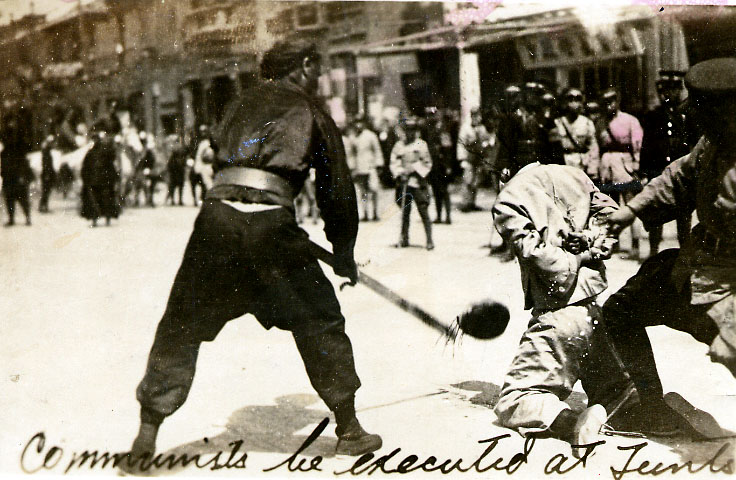
Clashes between the Nationalists and Communists intensified, and in 1927 the First United Front fractured violently on the streets of Shanghai. After Chiang Kai-shek moved to disarm Communist armed union pickets in Shanghai, a rally of over 100,000 people gathered on April 13, shouting “Down with Chiang Kai-shek” and “Return weapons to the workers.” Nationalist army troops fired into crowds, and 42 people were killed, according to one local report. Hundreds of activists were arrested as the Shanghai Commune — the city’s short-lived Communist governing body — was shut down. Similar raids and arrests followed in other cities, including Canton, while Chiang formally established a Nationalist government in Nanjing.
Dikötter presents these events not as the mythic slaughter of thousands, as the CCP asserts, but as a decisive coup to expel the Communists from the Nationalist movement. In Beijing, the warlord Zhang Zuolin executed leading Communists such as Li Dazhao. Wuhan briefly remained a leftist stronghold, celebrated as the “Moscow of the East,” but economic paralysis and shifting military loyalties undermined its influence. When the warlord Feng Yuxiang, armed by Moscow, aligned himself with Chiang and urged Soviet advisors to depart, the final support for the United Front evaporated. By July 1927, when the Wuhan government severed relations with the Communists, the CCP was forced into retreat and reinvented itself as an underground, rural insurgency.
One of Dikötter’s key aims is to establish the significance of Soviet influence in China in the first half of the 1920s.
In November 2021, during a plenary session, the CCP issued a formal “Resolution on the Major Achievements and Historical Experience of the Party over the Past Century,” declaring 1927 as the end of the first phase of the Party’s story. The next phase is described thus:
The shift from attacking big cities to advancing into rural areas was a new starting point of decisive importance in the Chinese revolution. Led by Comrade Mao Zedong, soldiers and civilians established the first rural revolutionary base in the Jinggang Mountains [western Jiangxi province], where the Party led the people in overthrowing local despots and redistributing the land.
Up until this point, the Communist Party had been a mainly urban political force, but in the countryside they had attempted to foment a peasant revolution. However, the notion of a rural uprising was hamstrung by the lack of an enemy to rise against. “The very term ‘landlord’ was an alien concept,” Dikötter writes, “imported from Russia via Japan in the late nineteenth century. […] No junkers [landed aristocracy], no squires, and nothing even vaguely equivalent to serfdom existed.” The main rural distinction, he observes, was between locals and outsiders. “No magic solution, least of all revolution, existed to solve in a single stroke the immensely complicated problems of the countryside.”
Dikötter argues that the CCP’s depiction of this period is vainglorious and false. Instead, he contends, the Party suffered a series of near-existential crises, and sustained its rule over small rural areas of China only through a reliance on violence. The Hailufeng Soviet (海陆丰苏维埃), a Communist-run proto-state in Guangdong province, provides a model: at a meeting inaugurating the Soviet in November 1927, each of the 300 delegates was encouraged to kill at least ten reactionaries. “But that is not enough since more will still be left behind,” its leader Peng Pai told the audience. “If I do not kill today, tomorrow I will be killed, so it is better to kill a thousand innocents than to let a single guilty one escape.” By the end of December, one estimate put the death toll at 10,000.
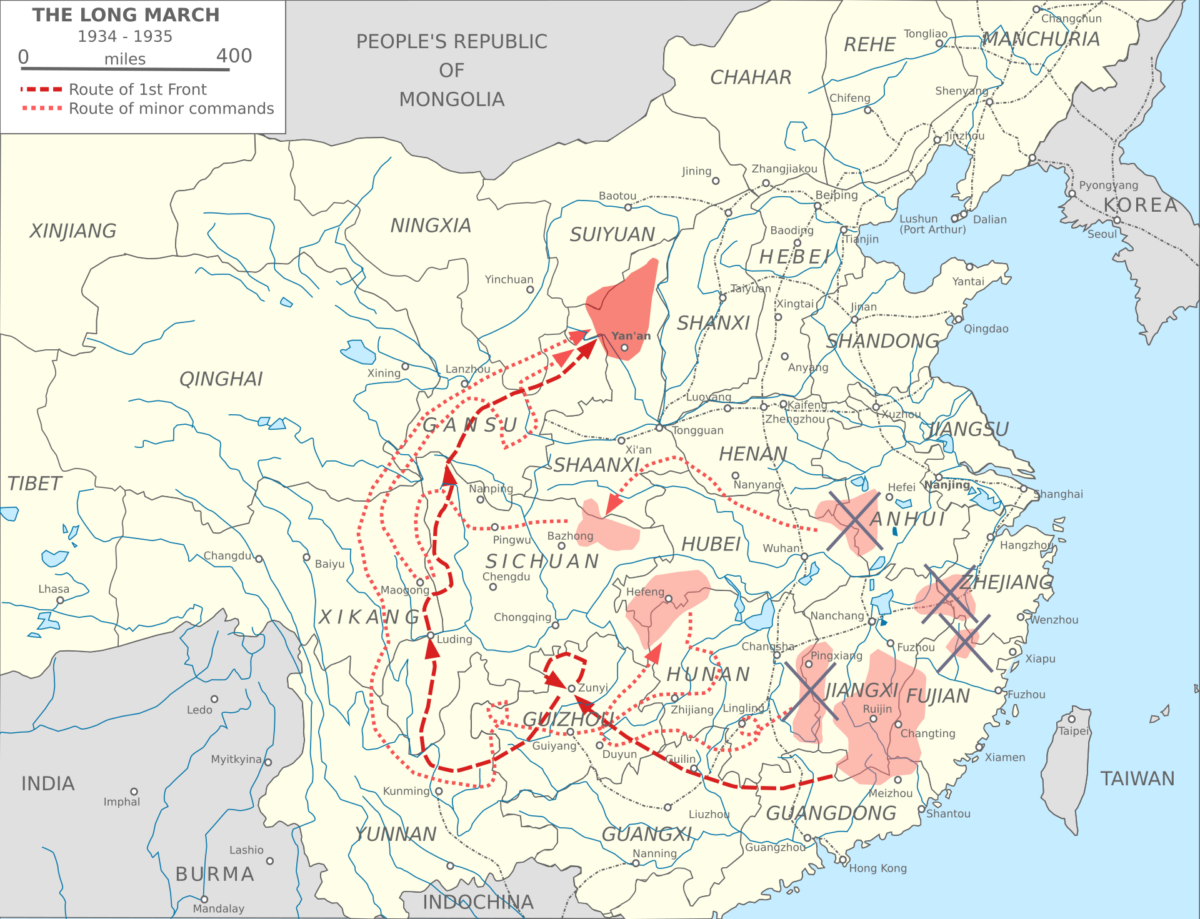
Encircled by the Nationalists, the CCP’s main base in Jiangxi province was evacuated in October 1934, marking the beginning of the Long March — a 4,000-6,000 mile trek to find a new home, with no settled destination. Heavily burdened troops — some lugging unwieldy equipment including office furniture and a printing press — moved slowly through the south. Desertion was rampant and brutally policed: thousands fled, hundreds were executed. The first catastrophe came in northwest Guangxi province, where the Red Army, trying to cross the Xiang River near the walled city of Quanzhou, was ambushed by the Nationalists, suffering an estimated 10,000 deaths.
Dikötter presents the rest of the Long March less as a heroic advance than as a grinding sequence of plunder, exhaustion and tactical scrambling. Chiang Kai-shek, he argues, shifted to an attritional strategy, using the Communists’ flight as an excuse to crush regional resistance to Nationalist rule. The famous Luding Bridge episode — a dangerous river crossing portrayed in countless Chinese movies as Red Army soldiers clinging to the chains of the bridge under heavy Nationalist fire over the raging waters of the Dadu River — is depicted rather differently in the accounts Dikötter cites. “Not a shot was fired at them,” Dikötter cites a contemporary Catholic missionary, Father Valentin, according to whose account no one even fell off the bridge. Instead, the Red Army “ransacked everything on their way and burned down a good part of the market at Luding.”
Not until October 1936 did the Red Army finally unite in Shaanxi province. Party membership had fallen to 40,000. “The Communists,” Dikötter writes, “had roughly the same popular appeal as an obscure religious sect or minor secret society.” He argues that their appeal was limited because the notion of a “proletarian uprising” had failed to resonate in the cities, while those in the countryside were fearful of the arrival of the Red Army and its need for grain. By this point, the fight against imperialism was also less resonant: foreign concessions were either in the process of being relinquished or had already been returned.
The Soviets “yet again came to the rescue,” continues Dikötter. Alarmed by the rise of Nazi Germany and the threat of a joint German-Japanese advance into Russia, Stalin abandoned calls for world revolution in favor of alliances between left-wing and right-wing parties to block the rise of fascism. This shift gave the CCP a ready-made and popular nationalist message — one Mao swiftly adopted in early 1936, when he “embraced the United Front, explaining to his colleagues that the Comintern now viewed the Chinese Communist Party as ‘the greatest Bolshevik Party outside the Soviet Union.’”
Chiang Kai-shek remained determined to eliminate the CCP. Yet in December 1936, while staying near Xi’an, he was arrested by the troops of Zhang Xueliang, a warlord loyal to the Nationalists. In what Dikötter frames as a remarkable stroke of luck for the Communists, Zhang demanded that Chiang agree to a ceasefire against the Communists in order to ally in a second United Front against the Japanese. Chiang reluctantly agreed. It was, perhaps, the decisive moment of the era: had it not been for the coup, the Nationalist army would likely have seen off the fragile Communists for good.
Dikötter presents the rest of the Long March less as a heroic advance than as a grinding sequence of plunder, exhaustion and tactical scrambling.
The Nationalists bore the burden of the fight against Japan’s invasion, which shifted into a new phase when Japan moved south from Manchuria in 1937. The CCP, meanwhile, regrouped in Shaanxi and built its strength. In 1937, journalist and fellow-traveler Edgar Snow published Red Star Over China, a glowing account of China’s Communist movement. Dikötter’s title is a deliberate allusion; his approach is an inversion of Snow’s hagiographic account of Mao as “a man of destiny, called upon by deep historical forces to regenerate his country.” Snow’s account of the Communists would be decisive in tilting international public opinion away from the Nationalists, who were beginning to be characterized as incompetent and corrupt.
Dikötter contrasts the cozy image conjured by Snow with the reality of CCP rule, which he portrays as an early prototype of Communist governance. During the Party’s internal rectification campaign of 1942-1944, thousands of cadres and new recruits were subjected to torture, imprisonment and denunciations, forced into false confessions and contrition in order to impose ideological uniformity. “Some 90 per cent of those who had confessed, it had come to light, were not in fact real spies or traitors,” Dikötter writes, and were rehabilitated into the Party. In a quirk of psychology, “[t]hose who had managed to survive the horror turned to Mao as a saviour.”
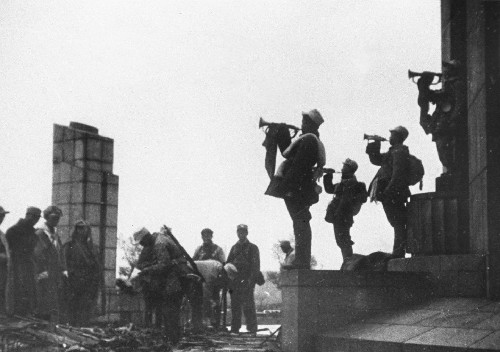
The Communist victory in the latter civil war of 1945-49, in Dikötter’s reading, was not the result of superior social vision or a peasant revolution, but of asymmetry, Soviet financial and military support, and the amoral pragmatism that marks his depiction of the CCP. The Red Army’s occupation of Manchuria in 1945 denied the Nationalists access to the industrial heartland, transferred Japanese weapons to the Communists, and allowed the Party to transition from guerrilla warfare to conventional siege warfare, often using brutal tactics. In the 1948 siege of Changchun, General Lin Biao gave the order to turn it into a “city of death”; more than 160,000 died of disease or famine. “The fall of Changchun was the single most important event of the entire civil war,” writes Dikötter. “It demonstrated steely resolve as well as the grim effectiveness of the Communists’ attrition warfare, conducted without regard for loss of civilian life.”
Dikötter’s insistence that amoral pragmatism was the explanation for the Communist victory is helpful in shaping the rhetorical narrative of an untidy period, but it risks leaving readers with only a partial understanding of the complex forces at play. By foregrounding their ruthlessness so consistently, the book underexplores the ideological appeal that the Party exercised among a committed minority — students, activists and rural organizers who were not coerced but rather persuaded that communism offered national salvation.
Red Dawn Over China’s tight focus on the CCP also means that the failures of its principal rival sometimes recede into the background. The Nationalists entered the final phase of the Chinese Civil War weakened by inflation, administrative corruption and declining legitimacy, factors many historians see as essential to explaining Communist victory. As historian Rana Mitter has noted in The Oxford History of Modern China (2022), “The Nationalist government [in 1946] seemed determined to alienate as many sectors of society as possible.”
Dikötter’s argument gains force through analytical compression, simplifying an extraordinarily complex political landscape in order to challenge triumphalist narratives. Yet that compression can make the outcome appear more one-dimensional than the historical record suggests. The rise of the CCP was not simply the imposition of power through violence, nor the inevitable unfolding of revolutionary destiny, but the product of an interaction between coercion, belief, the destabilizing effects of World War II and the profound failures of competing political visions. Dikötter’s purpose is not to offer a full comparative history of Republican China, but to isolate the communist trajectory within it. Yet the story of communism’s victory cannot be told in isolation.
Dikötter portrays the Communists as developing a pragmatic understanding of the ruthlessness and amorality needed to survive, hardened by the extraordinary political and military conflicts of the era.
Dikötter, who is Professor of Humanities at the University of Hong Kong and a Senior Fellow at Stanford’s Hoover Institution, is a best-selling historian of modern China with popular appeal. His “People’s Trilogy” — The Tragedy of Liberation (2013), Mao’s Great Famine (2010) and The Cultural Revolution (2016), three lengthy books that cover China’s history from 1949 to 1976 — have reached a large international readership, and won major literary prizes including the Samuel Johnson Prize (renamed the Baillie Gifford Prize in 2016).
Among scholars who research and teach modern Chinese history, however, Dikötter’s work has sometimes prompted a more critical response. Academic reviews of Mao’s Great Famine and The Tragedy of Liberation by Felix Wemheuer and Sreemati Chakrabarti have argued that his accounts are one-sided, foregrounding CCP atrocity at the expense of more nuanced social and economic analysis, and that his conclusions rest on selectively deployed evidence. Others have questioned the tone of his writing, with Cormac Ó Gráda suggesting that it is at times “more reminiscent of the tabloid press” than of academic history.

Red Dawn Over China is unlikely to allay such skepticism. It sets out a damning case against the Party that will be familiar to readers of the People’s Trilogy. Dikötter told me in an interview for The Wire China that he follows the primary sources where they take him, and is less interested in debates that take place in secondary literature. In the preface to the book, he points to his “unparalleled foundation” for reconstructing the Party’s early history: more than 300 volumes of internally-circulated CCP documents produced by the Central Party Archives in the 1980s, intended for Party eyes only but later surfacing in Hong Kong. These materials, alongside foreign consular reporting, Nationalist archives in Taipei and Comintern holdings in Moscow, underpin his attempt to strip away the patina of historiography (what he calls the “fairy tale”) to reveal a more faithful likeness.
Dikötter portrays the Communists as developing a pragmatic understanding of the ruthlessness and amorality needed to survive, hardened by the political and military conflicts of the era. In their mentality, a victory so hard won must also be protected at all costs. Alongside founding myths, such as the Party’s heroic account of the Long March, the reader can trace in this early history the origins of a political reflex that still motivates Xi Jinping: the conviction that the Communists’ supremacy is non-negotiable because it was won through existential struggle. As the CCP Historical Resolution of 2021 puts it:
Through tenacious struggle, the Party and the people showed the world that the Chinese people had stood up and the time in which the Chinese nation could be bullied and abused was gone and would never return.
In these terms, the revolutionary struggle becomes not a prelude to governance and order, but its permanent justification. ∎
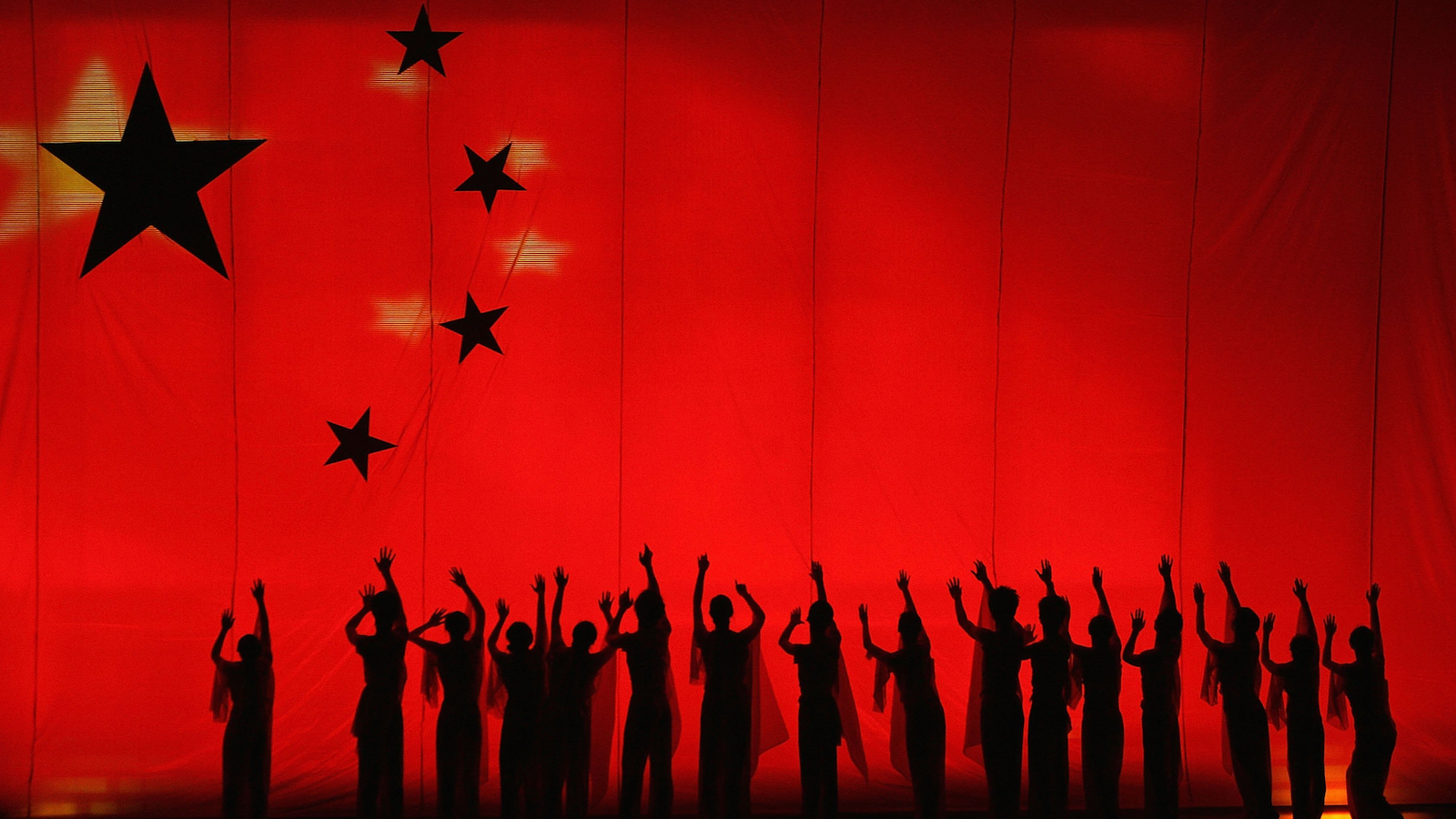
Header: Undergraduates dance on stage during a ceremony to mark the 70th anniversary of the completion of the Long March in Beijing, October 2006. (China Photos/Getty Images)

Jonathan Chatwin is a writer and teacher focused on China. He is the author of Long Peace Street (2019), tracing the history of a single street in Beijing, and The Southern Tour (2024), an account of Deng Xiaoping’s 1992 tour of southern China to boost the nation’s private economy.