Sign up for our newsletter to be notified of new posts!
In April 1992, the American evangelist Billy Graham met Kim Il Sung in Pyongyang. The extraordinary meeting between reverend and dictator was hardly surprising, argues Jonathan Cheng in Korean Messiah: Kim Il Sung and the Christian Roots of North Korea’s Personality Cult (Knopf, April 2026). Pyongyang used to be known as the Jerusalem of the East, and Kim Il Sung’s parents were fervent Christians. Before he became the “sun of the nation,” Kim was an organist and Sunday school teacher in Japanese-occupied Manchuria.
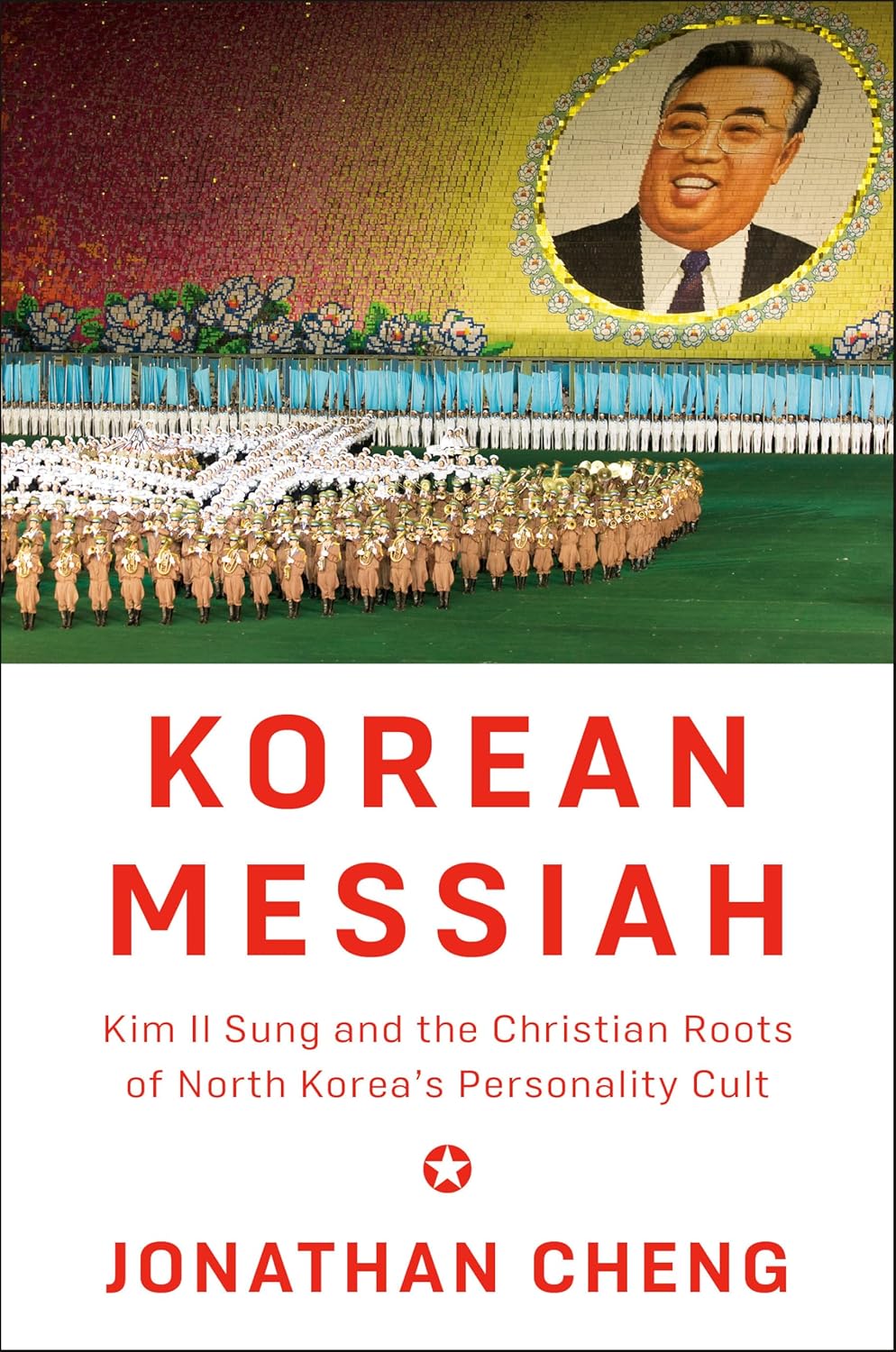
Korean Messiah uncovers the surprising ties between the Kim dynasty and American Christianity, and argues that the enduring power of the Kim dynasty’s hold over North Korea is attributable to the power of “Kimilsungism,” the state religion built on the borrowed foundations of 19th-century missionary work. Last week, we hosted Cheng at Asia Society in New York to talk us through this story, and what the personality cult around North Korea’s leaders tells us about global politics today. The Wall Street Journal China bureau chief also speculated on what Xi Jinping may have learnt from the same playbook; the state of foreign reporting on China today; and what to expect from Donald Trump’s upcoming China summit. Jonathan Cheng was in a conversation with Julian Gewirtz, a former Biden administration official and scholar at Columbia University’s School of International and Public Affairs, and the event was introduced by Orville Schell, Director of Asia Society’s Center on U.S. China Relations. Watch the video here, and read a transcript below:
If you treat Kimilsungism as a religion, as I would contend it is, that really does put it on the scale of world religions. Twenty million — that’s more than the number of practicing Jews around the world.
Jonathan Cheng
Speakers
Jonathan Cheng is the China bureau chief for The Wall Street Journal. Previously he was Korea bureau chief, running coverage of the Korean peninsula, including politics and society in both North and South Korea. Cheng is the author of Korean Messiah (2026). A native of Toronto, he lives in Beijing.

Dr. Julian Gewirtz is a Senior Research Scholar at Columbia University’s School of International and Public Affairs. He served in multiple roles over four years in the Biden administration, including Senior Director for China and Taiwan Affairs at the National Security Council and Deputy China Coordinator at the State Department. Gewirtz is the author of Unlikely Partners (2017), Never Turn Back (2022) and Your Face My Flag (2022), a poetry collection.
Transcript
The following transcript is an unedited AI transcription; there may be discrepancies with the video.
Orville Schell: Thank you for coming. My name is Orville Schell and I run the Center on U.S.–China Relations here at the Asia Society. This is a somewhat unusual event because this book, Korean Messiah, by Jonathan Cheng, combines two elements we’re not usually accustomed to having in tandem: Christianity and Leninism. In this regard, I think Kim Il Sung is a very interesting man, and he does suggest that belief systems — whatever they, however they are constructed, whether religious, political, Jim Jones, or whatever — share a lot in common, and are easily traded one for another.
There was a very interesting book written by a psychoanalyst, Robert Jay Lifton, about thought reform in China: how when missionaries underwent thought reform, they held out the longest against communism, but when they went, they went big time. So it makes me think that Kim Il Sung is kind of an avatar of both of those syndromes.
We are joined tonight by Julian Gewirtz, who is former senior director for China and Taiwan affairs at the NSC under the previous administration and deputy China coordinator at the State Department, and has had a long and distinguished career in Asian and Chinese affairs. And Jonathan — whose book, I have to say, I counted, has 48 pages of footnotes. I don’t think I’ve ever seen a book with more footnotes than your book. That alone, I’m sure, drove your publisher to distraction, having to pay for all those extra pages. Congratulations on that fun fact.
Jonathan has been bureau chief both in Korea for the Wall Street Journal and in China. How many years have you been there?
Jonathan Cheng: Seven years in Beijing.
Seven years. Quite a run. We might actually talk about what’s happening to the media in China a little bit at some point, if you’re of a mind to do it. Gentlemen, the floor is yours.
Julian Gewirtz: Thanks so much, Orville. And as Orville said, I’m Julian Gewirtz, and I’m also very proud to be affiliated with his center here. I’m delighted to celebrate the publication day, no less, of Korean Messiah, which I was lucky enough to get a pre-publication copy of. My first reaction was to go to the gym to bulk up a little more, but my second reaction was to devour it. I’m so glad to have read it, because it is an extraordinary work of history, of scholarship, and also of writing — and of the craft of turning these stories from the past into what feel fresh and contemporary and relevant. Kudos to you. It really is a history of Korea in addition to a profound and original argument about the Kim dynasty and the origins of the cult of personality.
Jonathan, to get us started, tell us a little bit about how you came to this project — how you ended up writing this work. And I should just say for the audience: we’re going to talk about Korea, about Kim Il Sung, for a while, and then we’re going to use the opportunity of having the China bureau chief of the Wall Street Journal here to also talk a bit about China. Jonathan, over to you.
Thanks, Julian, and thanks, Orville, and to the Asia Society. It’s a pleasure to be here. It is my book publication date. It’s also, as some have noted — perhaps a coincidence, perhaps not — Kim Il Sung’s birthday right now in North Korea. The Day of the Sun, the holiest day on the North Korean calendar. The day he was born, in 1912. Incidentally, does anybody know what else happened on the day he was born, April 15, 1912?
Audience Member: Something with Japan?
No. A major world event took place —
Audience Member: The sinking of the Titanic.
Yes. On the very day the Titanic sank. The West is falling and the East is rising, I guess you could say, to sort of sum up everything we’re going to talk about today.
I’ll quickly say how this book came to be. I was sent to Korea for the Wall Street Journal. I was based here, actually, for three years — thanks to Ken Brown, who was an editor at the Journal for a long time and brought me from Hong Kong, where I started my career with the paper, to New York. I was here for three years. I studied Korean at the Korea Society nearby. When they sent me off to Seoul in 2013, I read as much as I possibly could about Korea.
I just found it so puzzling that Pyongyang — before it was known for what it is today, as the capital of the Kim dynasty — was known as the Jerusalem of the East. It was the most Christianized city in all of Asia. It was home to some of the largest churches in the world. It was home to the world’s largest Presbyterian seminary. Billy Graham’s wife went to high school in Pyongyang in the 1930s, because it was where all the missionaries sent their children to school; she was the daughter of missionaries to Jiangsu province in China.
I thought this was an interesting starting point. I also went up to Pyongyang for the first time in 2013. I went again in 2017 at the invitation of the North Korean government. They invited us at the Wall Street Journal, the New York Times, and the New Yorker for three separate trips during Trump’s first term — to send the message, I think, to America: we’re not afraid of you, and your sanctions aren’t working.
When I went in 2013, I was really struck by what I would describe as the religiosity of the country. The first place they’ll take you — and Billy Graham, I have this in the book as well, visited North Korea in 1992. When he’s taken to Kim Il Sung’s birthplace, it’s a humble thatched-hut cottage, and he jokes, “All they’re missing are the three wise men in the manger. This looks very familiar to me.” They take you — they took me — to the foot of the 66-foot statue of Kim Il Sung in the center of Pyongyang, where we’re all to bow. Every person you’ll see on the street wears a badge pin with Kim Il Sung’s face on it. You’re literally singing his praises. You’re dusting his portrait in your home every morning. You’re opening the newspaper, and there he is on the front. You’re turning on the TV, and there he is on the news. To me, it struck me as very religious in a certain way.
So I thought: is there any connection between the Jerusalem of the East from about a century ago and the religiosity of North Korea today — this extraordinary cult of personality? It didn’t take me very long to recognize that the pivot point here is Kim Il Sung himself, the founder of the North Korean state. He comes to power at the age of just 33, quite young — compare him to Stalin and to Mao, who both came to power in their early 50s. He was 33 when he took power in Pyongyang. And he lived quite a long life. He ruled for 49 years. For half a century, Kim Il Sung was the ruler of North Korea. He was born in this Jerusalem of the East. He was raised in its churches. His grandparents and his parents were among the very first converts to Christianity. When he grew up in Pyongyang, he grew up going to church every Sunday — but not just going to church every Sunday. He taught Sunday school. He learned to play organ in the church. He performed in church plays. He spoke at the YMCA. He lived in the home of a pastor for two years as a teenager. He was steeped in Christianity. He was a quintessential product of this Jerusalem of the East.
So when he comes back home in 1945 at the age of 33, I don’t think it’s a coincidence that the state he then constructed had these religious resonances. That’s the working thesis I had. I then went on a bit of an academic excursion into the archives of the missionaries, but also everything the North Koreans produced. And that’s how you get to 768 pages.
Fabulous. One irony embedded in this project: he is on the one hand clearly adapting from the Christian experiences and exposure he had, and on the other hand he’s cracking down on the worship of Christianity, on churches, and very much wants to remove that allegiance to something else — because, as you argue so forcefully, the core belief system of Kimilsungism is absolute loyalty, fealty, to the leader. Talk a little bit about how he navigates, in your mind, adapting these influences in North Korea while eradicating the influence of the church.
I wish he was more forthcoming or more honest in his writings. He didn’t sit for an interview for the book.
No, he did not sit.
No, he didn’t. The interiority and the motivations of a self-mythologizing dictator who died in 1994, whom I never met and had no chance to interview — I’m not going to try to go there, and I tried to be very modest in some ways. You say forceful in my arguments; I hope I was modest as well. I know what I don’t know, and what is inaccessible to any of us until the North Korean archives are ever open — if they’re ever open, and if they’re honest — is that we simply don’t know what was driving a lot of these decisions. We can infer, and that’s what I’ve tried to do.
What I infer is that, growing up in the Jerusalem of the East, sitting on his mother’s lap in a packed church — the missionaries would talk about how the churches were so full they really worried that the walls would bulge out — he understood intuitively, because he was raised in this, the power of religion, the power of faith. I think he really intuitively understood that.
So when he comes to power at the age of 33, I think he treats Christianity — again, this is my inference — as both inspiration and as a potential rival faith to what he ends up constructing. That requires this delicate two-step. He’s both learning and adapting and adopting, but he’s also shutting out Christianity. His relationship with Christianity is so interesting. At the end of his life, he ends up building churches in North Korea. He ends up inviting all sorts of pastors, of course including Billy Graham, to North Korea. He ends up praying with some of them. He ends up singing church songs from his childhood in his old age. And yet that doesn’t change the fundamental fact that he was perhaps the greatest persecutor of Christianity in the 20th century. He’s certainly up there at the top of the list.
It’s a fascinating irony, and it gets into one of the reasons I found the book so eye-opening: we all know that dictators adapt, they’re totally sui generis in some sense — and then, actually, you realize, once you begin to scratch the surface, that they’re adapting constantly.
One other thing I wanted to ask you about: when we think about religion, we genuinely think of voluntary belief. Of course, religions are imposed politically, and there’s coercion involved. But say a little bit about how you see the balance of coercion and genuine belief in some of the episodes you chronicle, because this seems like another area where the North Korean case is quite distinctive, quite different from aspects of the Chinese case or the Soviet case, but also others outside of Asia.
Sure. There’s no question that repression is a big part of the mix in North Korea. That’s always been the case, and it continues to be the case under the third-generation ruler. But the genius of what Kim Il Sung and his successors presided over is that there was a lot of almost voluntary acceptance of this. You’ve got to put a very big asterisk on the word “voluntary,” because he created an environment — a Truman Show, as it were — where, think about it, it’s now been 80-plus years that this family has been in charge. There has not been any reform and opening. There’s never been any glasnost. This has been one narrative, and it’s only gotten more and more and more extreme. It’s always been the Hermit Kingdom. “Hermit Kingdom” overstates it a little bit, both for the historical Joseon Dynasty Korea and for North Korea today. But in the main, it’s generally pretty true. This is an isolated country, and it’s in many ways self-isolated. They were able to craft this.
If you create a world in which you get to create a reality, how voluntary is any of this belief? That’s a very philosophical question. But certainly it’s voluntary in the sense that many people in North Korea — when you see images of North Koreans weeping during the funeral of Kim Il Sung, it’s quite dramatic and quite over the top, I encourage you to go on YouTube and look at footage of it — it’s mass hysteria to a certain degree, and there are questions about how real that was. I actually think it was, to a large degree, real. It’s of course within the parameters of this alternate reality they’ve created, but I think those emotions are very real.
One little fun fact I always love to finish this thought off with: I’ve done the math on this. 25 million people in North Korea. Even if you give a 20 percent haircut and say 20 percent don’t actually believe, they’re just going through the motions, you still get to about 20 million people. If you treat Kim Ilsungism as a religion, as I would contend it is, that really does put it on the scale of world religions. 20 million — that’s more than the number of practicing Jews around the world right now. That’s the scale of this. Even if you apply a 20 percent discount. You’ll have to allow that all 20 million of these people are in one geographically confined place. But it’s a world religion, if you want to look at it that way. And one of quite some scale.
As I was reading the book, I found myself grappling with this question of coercion and violence and belief, and those are not necessarily things we can distinguish. But when you have cases of people who are executed for not applauding sufficiently intensely, which you also allude to, you wonder — even if perhaps individuals can’t totally tell the difference — the violence is pervasive. It’s just an interesting other dimension that comes out of the book.
One moment in the book that I thought was so interesting, and that reflects my bias as an American but really stood out to me, is the trip Jimmy Carter takes, which you narrate right toward the end of the book. It would be great if you could tell people about that. In particular, you mentioned a moment ago this late-in-life blooming of a certain degree of re-engagement with Christianity from Kim. Tell us a little bit about that.
I’m glad you’re asking about that. “Re-engagement” is the right word. I don’t want to say he re-embraces the church, because there’s two problems with that word. One is that it presupposes he had embraced the church as a young man. He certainly went to church and participated in church, but whether or not he was really a Christian — well, that’s a more complex question, and I’ll leave that to others to figure out. “Embracing,” too — I’m not sure that’s the right word either, because there is significant doubt about how real that was, how tactical it was. But I genuinely think it was more than tactical. I think it was nostalgia that drove him, to a degree. A lot of people, when they’re on their deathbed or close to their deathbed, are going to be wrestling with these questions of life after death and these transcendental questions. That’s pretty natural.
Towards the end of his life, Kim Il Sung, after persecuting the church for decades, has this re-engagement with the faith. He starts to invite pastors to come visit him in Pyongyang. He prays with some of them, or allows some of them to say grace. He impresses them with his knowledge of the Book of Leviticus: “Wow, who knew he knew the Bible this well?” He invites one of his childhood church-youth-group friends to come back, and they’re singing songs from their youth group together, tears flowing down their faces. He still keeps an organ in his home in Pyongyang, because he learned to play the organ in church.
One of my favorite anecdotes — this is, by the way, from North Korean sources, not from some defector or some dissident. This is from the official North Korean press. He has an encounter with an interlocutor who comes to visit him, and he tells this man, “My mother came to me in a dream. What should I do?” Unfortunately, he doesn’t tell us the content of that dream. But I can tell you — my surmising — his mother was a very devout Christian. She was a “Bible Woman,” in the language of the times, which meant the Presbyterian church had basically empowered her to go from village to village educating women, teaching them how to read by reading the Bible. That’s what she did. And she herself, as a daughter of a church elder, was very devout.
His mother appears to him, and I sort of imagine that the mother must have made him feel some sort of weight, some sort of guilt, some sort of shame — I don’t know. Here’s where I’m stretching a little bit. Kim Il Sung asks his interlocutor, “What should I do?” And the answer comes back, “You should build a church for your mother on her birthplace.” And so that’s what he does. He builds a church for his mother on the outskirts of Pyongyang. It’s actually the second church he builds. He builds one in 1988, and the second one in ’92.
I had the privilege of visiting both of them. When I went in 2017 for the Wall Street Journal, it was at the height of “fire and fury” and all the rest of it, as I mentioned earlier. At that opening banquet they threw for us, they asked the four of us who came from the Wall Street Journal, “What would you like to see while you’re here?” Our answer, of course, was, “We’d like an interview with Kim Jong-un” — which didn’t happen. “We’d like to go visit your nuclear facilities” — which didn’t happen. But it just happened that our trip straddled the weekend. This was 2017, and I was already deep in the research on this book. I said, “Well, can we go to church on Sunday?” They said, “Yeah, sure, we can take you to church on Sunday.”
So me and my three colleagues went to church on Sunday, and we were able to go to both churches. There’s only two officially recognized churches there, and they’re both Protestant churches. They’re both in Pyongyang. Unfortunately, both of their Sunday morning services are at precisely the same time, so we weren’t able to attend both. But we attended service in one, and they took us to the other one — the one he built for his mother. I can talk about that, if people are interested.
Let me stick with the story. Kim Il Sung does all these things towards the end of his life, and I think re-engagement is the right word. Jimmy Carter is part of this re-engagement — not explicitly; Billy Graham definitely is, but Jimmy Carter, as those who recall or have read the history know, was there to defuse a nuclear crisis, the first North Korean nuclear crisis. He was really there as a former president of the United States. But those of us who remember and know Jimmy Carter will know he wore his faith on his sleeve, perhaps more than any other recent U.S. president. Perhaps George W. Bush would be the only other one you could put in that same category — although we do have a president now who is tweeting himself as Jesus. But Jimmy Carter — whether or not you liked him politically, I don’t think many people would have doubted his commitment to his Christian faith. That was very much a part of his political identity.
He does go and meet with Kim Il Sung. I did have the chance to go down and attend his Sunday school in Plains, Georgia as part of this research, and I did pose the question to him, when we were all shaking hands with him and taking a photo, whether he did raise the faith with Kim Il Sung. At this point, Jimmy Carter must have been 97 or something like that. He didn’t really give me much of a straight answer. That was not the ideal time to ask him, but it was the only chance I had. I find it hard to believe he couldn’t have raised it, because he was very well briefed. Georgia had a very big community of engagers with North Korea from the church, including a former U.S. ambassador to South Korea, Jim Laney, who was a Methodist minister.
But be that as it may, he’s there. He meets with Kim Il Sung, and he writes in a letter — I believe to Bill Clinton — that’s in the archives down in Atlanta, where he says what I’m seeing in North Korea under Kim Il Sung — keep in mind this is 1994 — reminds him so much of what’s going down in Waco, Texas right now. It’s so similar. “These guys are just like the Branch Davidians.” In other words, it’s kind of a cult. He doesn’t use that word. I’m very careful using that C-word, because it’s a very loaded word. It’s basically a pejorative word. I don’t think you can use it in a neutral sense, except perhaps in the context of saying “a cult of personality.” There, perhaps, you can use a more neutral inflection.
But anyway, Jimmy Carter, of course — he’s at the very end of the book, because he meets with him two weeks before Kim Il Sung dies. Let me stop there.
It’s a remarkable moment, as you say, because you have these two former Sunday school teachers who took these extraordinarily different paths and who come back together at that moment. It’s the kind of unlikely encounter that the book is full of.
I want to ask you to read a little excerpt from the book before we shift to talking about U.S.–China. But before I do — because you raised it — how do you think about global lessons about the cult of personality and religion from this book? In particular, as you alluded to, in a week where the president of the United States is publishing, and then removing, images of himself — images that have unmistakable religious iconography, depicting himself as Jesus, and healing to the touch, and these sorts of things, that are commonalities with the personality cult in the DPRK — how do you think about that, and how did that factor into your thinking this week as you launched this book into the world?
I certainly didn’t plan for the president to tweet or post that image. I don’t necessarily know what to make of his denial — “I didn’t mean it this way or that way.” He certainly deleted it, so he recognized at some level this was not a good tactical move for him. I may dodge the question a little bit, just because I want to sidestep the inherent politics of it. But I had mentioned, of course, Jimmy Carter wore his faith on his sleeve; George W. Bush did as well. Donald Trump is obviously a very different person than those two, especially with respect to religion.
There’s one commonality, and I try to wrestle with it a little bit in the book: how much Kim Il Sung himself constructed his own cult of personality, and how much it was constructed for him — how much he permitted it to be constructed. There always is that interplay. In the case of Donald Trump, what we see is that we have people who support him who have begun to create a cult around him. I don’t think he himself is necessarily actively doing it. A lot of it are retweets of people portraying him in this way. I don’t know that that necessarily gives him a free pass or anything, but certainly I think it can happen that way.
Kim Il Sung’s cult starts in 1945, and it really begins with the Soviets backing him. Of course, he’s just 33 years old. He was largely anonymous when he comes to power. There is this famous name, “Kim Il Sung,” that he adopts — again, won’t get into it, it’s all in the book. It is constructed for him, but very quickly it begins to surpass the cult of Stalin. There’s very little question that by the end of the 1940s his cult has surpassed Stalin’s already, by many measures.
Kim Jong-il, the second-generation successor, was a film buff, and really did do a lot to orchestrate an increase in this cult of personality. But to say that Kim Jong-il had created this cult for Kim Il Sung doesn’t quite compute either, because he was just seven or eight years old by the time Kim Il Sung’s cult had already surpassed Stalin’s. I don’t see Kim Il Sung himself at the switch here crafting all this. I think it was constructed for him.
That’s my best stab at answering your question. In many ways, people allow the adulation to come at them, and it does go to your head. I don’t know how it couldn’t, to a certain degree. Even in a more secular realm, you’ll think of pop stars or movie stars — it does get to them. They do start to believe their own legend and their own myth. They do drink the Kool-Aid, as it were. I don’t know if that’s what’s going on here, but certainly cults of personality — and this propensity towards almost an element of adulation, bordering on worship, towards other humans — continues unabated. I don’t see it abating anytime soon. It’s just part of our DNA. We know these people are just like you and me. They also have trouble sleeping. They also have digestive issues. They also get sad sometimes. But you put people up on a pedestal — and with Kim Il Sung, it’s taken to the extreme.
I want to spend a few minutes now having you remove your historian-of-the-DPRK-and-the-Korean-Peninsula hat and place on your China bureau chief, Beijing-based reporter hat. We are one month out from President Trump’s rescheduled, postponed trip to Beijing, which I believe you’ll be covering. We’re eager to hear your take on that.
Before we get to that, I wanted to ask you a bit of a thought-experiment question: what do you think Xi Jinping would make of this connection? What do you think Xi Jinping, who himself has constructed a cult of personality that has some historical antecedents he’s drawing on — what would he make of this, if you could hypothesize? A knowingly impossible question.
If I could get into the head of Xi Jinping — wow. Well, I have a couple of scoops on my hands at that point.
I mentioned earlier that in North Korea, there was no reform and opening. There was no glasnost. If you’re looking at Xi Jinping, a lot has been made of the cult of personality that’s been built around him as a revival of Maoism to a degree. I always ask this question of people, especially when I’m in Beijing and talking to friends — I’ve talked about this book because everyone knows I’ve been working on it for a long time — any comparisons between Xi Jinping’s cult and the North Koreans’? I don’t know that you can mention them almost in the same sentence.
I ask my friends in Beijing, and if anyone’s been to Beijing recently, you can try to answer this question yourself: how many times a day, unless you go out of your way to look for it, do you see Xi Jinping’s face in an average day in Beijing? I can tell you my answer: probably zero, unless you go looking for it. If you go looking for it, of course you can find his face. Kim Il Sung — if you’re in Pyongyang, hundreds of times. You can’t avoid it. He’s everywhere. Been to Havana? You don’t see Castro’s face. You can go to Cuba for a week and not know what Fidel Castro looks like.
I’m not saying the image is the only thing that counts in a personality cult. But I don’t know that Xi Jinping is quite there. If I’m in Xi Jinping’s head, insofar as he does want to build that up — I don’t know that he does. But insofar as he does, I don’t know that it’s possible to put the genie back in the bottle. We had Deng Xiaoping come along and say, “We went a little bit too far with this Cultural Revolution — 70 percent right, 30 percent wrong.” Of course, we saw Deng Xiaoping take China on a remarkably different path. The cult of Mao at its most extreme was really ’66 to maybe ’69, I think.
Right.
Even though the Cultural Revolution arguably went on until ’76, it kind of burned itself out by ’69. Now, there are a lot more people in China than in North Korea, so a lot more people were affected by this cult. But I think jealousy, perhaps, is what Xi Jinping feels, insofar as he wants to build up this cult of personality. I don’t know that it’s possible, because you have to hermetically seal a society — not give it any chance to breathe for eight decades — to get to this stature. So I don’t know. Perhaps he looks at it and thinks it’s grotesque. I don’t know, because he experienced the cult of Mao personally.
It’s a very interesting question to hear your response to, in part because I was also vacillating between: would he see this as something he’s envious of, or would he see this as somehow retrograde and backward, and the cult he is building he believes is more suited to the 21st century — which I don’t think anyone reading your book could come away thinking, that this cult of personality is designed for the 21st century per se.
Just to get your perspective: where you think — you live in Beijing, you have a perspective that has become vanishingly rare, as the number of foreign reporters in China has dwindled — how do you see people thinking about, talking about, the United States, President Trump, and this upcoming visit?
Like a lot of the world, China has been surprised at the pace that President Trump has kept up in terms of upending established norms on the global stage. Just this year, we’ve seen Maduro in Venezuela, and the strike on the Ayatollah in Iran was breathtaking, both in its execution and its audacity.
To a certain degree — I can’t speak for all of the Chinese people, and I certainly can’t speak for Zhongnanhai, as the leadership compound is known. But I surmise that they must be glad his field of vision is elsewhere.
This idea that China plays the long game — perhaps too much is made of it, but it is true to a large degree. They’re happy continuing to build and build and build. We just had them finish their 14th Five-Year Plan. What did they say five years ago with their 14th Five-Year Plan? They said, “We are going to work on technological self-sufficiency.” Guess what they did over the last five years? They really built themselves quite a fortress when it comes to technological self-sufficiency. What did they say for the 15th Five-Year Plan? Steady as she goes. Why would you want to deviate from this? It’s working well.
They set these five-year plans — and five-year plans, as we know, is one year longer than the U.S. presidential cycle. They have the ability, and they’re not going to have policy swing from one extreme to another as we have seen over the last, let’s call it, three administrations. You have a lot of flip-flopping. I’m not saying their system is superior by any measure, but certainly it does allow them that luxury, and they have taken advantage of it. I think they’ve done relatively well with that.
So they’re happy to keep doing what they’re doing. They know the clock is running out on a second term by Trump — presuming there is no third Trump term. I think they can wait him out, as long as his ire doesn’t get aimed towards Beijing. They’re feeling pretty comfortable. And certainly they think that their relative standing in the world is going up, because they are seen, in relative terms, as perhaps more benign, perhaps as someone you can work with. They certainly see themselves as the better choice for all the swing-state countries around the world that are looking to the U.S., looking at China, and trying to figure out how to chart this course.
On the fortress point — if we recall, the reason the trip was postponed was the war on Iran. Initially, a lot of the coverage was quite congratulatory toward China: they’ve been preparing, they’ve been stockpiling, they’re resilient, they’ll weather these shocks, they’ve built up an unprecedented fuel reserve, and so on. But as this has dragged on for many weeks, it’s become clear that even fortress China is not invulnerable to geopolitical disruptions. We think of this as an energy crisis, but obviously petroleum-based products are used throughout industry, and they’re beginning to have some real shortages in parts of their value chain in China.
Does President Trump potentially head into this meeting in a stronger position than I, as a former Biden appointee, or others might like to think, in part because Beijing realizes that what he chooses to do vis-à-vis Iran does actually matter for core national interests in the economic domain in China? Or is that an overreading of incomplete data?
I have to be modest in my claims here too, because I simply don’t know. China is not the only country suffering unintended consequences from what’s happening in the Strait of Hormuz. They have company in this respect, including the U.S. The U.S. is also going to be impacted. Of course, it already is, in many ways. I think it does reinforce this instinct towards insulating yourself from external shock. It only tells them that we were on the right path, but there’s more work to be done. We need to insulate ourselves all the more so.
As ideological as Xi Jinping’s China is, the pragmatism — they’re so pragmatic in so many ways. People have asked me in recent years: do they like Putin’s invasion of Ukraine? Do they prefer Biden, or Harris, or Trump? How do they feel about Iran? How do they feel about Venezuela? I think at a certain level, I don’t know that they themselves are preoccupied with such questions, because in many ways they will take what’s coming, and they will do what, in some sense, is the obvious thing to do. You maximize the positive, and you try to minimize the negative. They’re ruthlessly focused on doing that.
It doesn’t mean there are no downsides to what’s happened, but there are surely good sides — good things. Certainly, if this becomes a full-blown quagmire for the U.S. and Iran, of course there are going to be benefits to be extracted from China’s point of view. There will also be downsides they’re going to need to mitigate. But I don’t know that they look at it necessarily in a normative or prescriptive way. I think they say, “Look, this is the hand we’re dealt. This is how we’re going to play our cards.” This is me surmising, but I get that sense as I watch how they respond.
I don’t actually even agree with the assertion I just made — more just straw-manning it to try to tease you out a bit there.
I want to come to the audience for questions. But as a last question: your book is a story of North Korea, an aspect of it that we know well, the cult of personality, told through a very unlikely set of discoveries you made on the China file. What is a story you think is underreported or underexplored that you, living in Beijing, think is really salient or important, but that maybe all of us living in New York haven’t yet heard about? It is an acceptable answer to say that the Wall Street Journal‘s coverage is comprehensive and flawless, and therefore there is no answer to the question.
The Wall Street Journal‘s coverage is comprehensive and flawless. There’s nothing —
The reason I wrote this book is not because I wanted to write a book, it really isn’t. When I saw this, I couldn’t believe nobody had written about it. I wanted to read this book. I really did not set out to write it. I hope I will find a topic in China that compels me to this degree, because China, of course, is a much larger country than Korea, just in terms of its population and size. I know there are stories to be uncovered there. If I knew it, I wouldn’t tell you, because I would then set about —
A room full of writers. Very dangerous.
Full of writers, competitors, rivals. But really, I do think it is tougher in China. The constraints we have — we have so few foreign journalists now in a country that large, with that many people. Yes, we are clustered in Beijing and Shanghai.
Surprise, surprise, the stories that are probably missing are the ones I want to tell more, which is to get out into the countryside. We know America is not just Washington, New York, San Francisco, Chicago, and LA. We learned that lesson with the 2016 election. All of us mainstream media outlets had to do a lot of soul-searching: how did we fail to document the rise of Donald Trump as a political force? I don’t know that the answer is “we need to open bureaus in Topeka and in this city or that city.” There was some of that reflex, and the impulse is certainly correct in some ways.
But in China, we don’t have that luxury. We cannot go everywhere. I do get followed basically everywhere I go when I leave Beijing, and sometimes it’s very unsettling. But I know there are stories to be told in the countryside and just outside the big cities that I do want to tell. I wish we had more — I wish we had more boots on the ground. With my two boots, I’ll do what I can, but it’s tough.
I’ll let you and Alec compare notes on reporting on the countryside after.
Okay, audience, now is your moment to ask the hardest and most interesting questions of our distinguished speaker.
Audience Member: Thanks, Jonathan, for the great talk and for telling us all these interesting things about the DPRK. My question is about China, also segueing off what you talked about with regard to media rights. It seems like a lot of that has tightened post-COVID. Obviously, there’s been a big exodus. Do you see more ease in getting press visas in the future? What’s your outlook, and the current situation?
We’ll take a few questions. Anyone else? We have a gentleman up here.
Audience Member: I think the next supreme leader in North Korea is likely to be a female, right? Unless there’s a son hiding somewhere. What do the regular people in North Korea think that their next leader could be a girl? Just for reference, South Korea has had female leaders, Thailand has one, India has one, Pakistan has one, Taiwan has one — in mainland China, the female leadership has seriously declined. I wonder if you can compare this perspective between North Korea and China too. Thank you.
Two very different questions, so I guess I should just take them in order. There’s no way to combine these.
The press situation in China — the foreign press situation — is definitely in a bad state. I tend to be more of a pessimist, simply because that’s an easier way to operate and plan. If we’re surprised and we get more visas, wonderful — I can cross that bridge when we get there. But I do worry that we are on a glide path to zero.
Just to explain a bit more of the lay of the land: I lived this all in real time. I got to China in mid-2019, about six months before COVID first started spreading in Wuhan. Our editorial page, our opinion page of the Wall Street Journal, which is entirely separate from the news page where I work, published an article with a headline the Chinese government was very unhappy with. It was “The Sick Man of Asia.” I won’t get into why they were so upset about it; there are many reasons. They then proceeded to expel three Wall Street Journal reporters, which resulted in Mike Pompeo, then the Secretary of State, capping the number of Chinese journalists that could be resident in the U.S., which then prompted the Chinese to expel all U.S. citizens working for the Wall Street Journal, the New York Times, and the Washington Post.
I’m a Canadian citizen, so I was spared. Other non-U.S. passport holders were also spared. There were a couple of exceptions. I’m happy to talk about them afterwards if anyone’s interested. Again, I lived and breathed this in real time. I was demarched multiple times by the Foreign Ministry. I spent a lot of time there listening to them tell me why we had offended the Chinese people.
Ever since then, we went from about 15 foreign correspondents in Beijing and Shanghai at the Wall Street Journal to currently two. The New York Times went from, I don’t know, roughly — call it eight or nine — to one for a time, two, one, two, somewhere around there. The Washington Post is actually a degree of magnitude smaller; even at full strength, they only had two. They’ve been down to zero for a few years now.
The three newspapers were not the entirety of the foreign press. You also have a lot of other outlets — newswires, broadcast journalism, and some new media outlets. America is not the only country that sends foreign journalists to China. You have the European outlets, the Five Eyes countries, and many others — the Japanese, the South Koreans, the Indians, and so on. It is a broad and diverse foreign press corps, but certainly the American outlets are the best-resourced, and therefore the best positioned to do reporting that is more than simply reactive and reflexive. We are the ones more likely to send reporters deep into the countryside and to invest that time to tell these sorts of stories and to do more investigative work.
I don’t know that the Chinese are terribly unhappy that we are basically a skeleton crew. I think they don’t mind that, in the sense that we will cover the biggest stories, but we don’t really have the boots on the ground to get into the nooks and crannies of China. That obviously is a loss for the world’s understanding of China, because — love us or hate us as the mainstream press — that is how most people will know about other countries. No matter how much of a jet setter, how worldly you are, you cannot be in all countries at the same time and know them well. China is a country that deserves to be known well, because it is the world’s second-largest economy, the world’s second-most populous nation, and it is a nation that is rapidly transforming the world with frontier technologies, certainly, but also just with its traditional economy. Whether China succeeds or fails economically is of great importance to the rest of the world. And yet, we don’t have the capacity to tell those stories on the ground. That is a real tragedy and a loss.
To finally answer your question: perhaps — and this is the optimist in me speaking — perhaps in a year where there are potentially up to four engagements between Xi Jinping and Donald Trump, there may be some scope for a deal to restore some journalist visas. It’s certainly high on my priority list. I’m not sure how high it is on the White House’s priority list, or on the priority list of Zhongnanhai in Beijing. But my only hope is that perhaps, after the first summit, the second summit, the third summit, when they’re looking for deliverables and scraping the bottom of the barrel, journalist visas might possibly be a part of that. That’s me daring to dream.
Second question — sorry, these are long-winded answers. What I find more remarkable about Kim Ju-ae — the daughter; we believe that’s the name of Kim Jong-un’s daughter, we still don’t entirely know — is certainly the fact that she’s a daughter as opposed to a son accompanying Kim Jong-un. I find the more remarkable thing her age — just the fact that she’s so young and that she is being given so much exposure at a time when her father is in his early 40s. Health questions aside — I don’t know what conditions he may have. Certainly he has a smoking habit. But barring that, his father and his grandfather did live relatively long. There is a universe in which he is still the leader of North Korea 10, 20, 30, 40, 50 years from now. I don’t know. He does have access to very good medicine.
To have her accompanying her father at this age would be quite a long runway, potentially — especially when Kim Jong-il didn’t have that public exposure before he came to power, and Kim Jong-un even less. Of course, at each turn, Kim Jong-il was grossly underestimated, I think we can now say in hindsight. Kim Jong-un was also grossly underestimated. It is remarkable on many levels. I don’t know how it will play out, but I guess we’ll find out. We may not find out soon. It may be decades before we find out. I’ll leave that answer there.
I think we have time for two more questions. I see someone in the far right corner — if you don’t mind passing the mic to her.
Audience Member: Congratulations on your book. I was recently traveling from Beijing. I spent a lot of time — one decade in the Middle East, seven years in Iran — constantly traveling among the world of the West, China, and also the Middle East. From what I see, because I’m in the field all the time, the people’s lived realities are quite different from the things we’re discussing here in policymaking circles and academic circles. Exactly echoing what you say, I think that also comes from the lack of communication between both worlds. My question is: do you think China and Iran, in a way, are each other’s imagination — imaginative enemies, in a way — and is that what you are trying to demystify and improve, that communication?
Thank you. And then — right here.
Audience Member: Hi, thanks for doing this. Did reporting a book on religion in North Korea — as you know, the connecting thread — change the way you view religion in China, or reporting on religion in China, and how China approaches religion?
Great questions. The first question was really about: do you see your job as bridging the lack of comprehension between these peoples?
Yeah, definitely. To take an example we can all relate to, because we’re sitting here right now — even before flying to the U.S. for the first time as a Canadian citizen, after Trump’s re-election, I did wonder: is the U.S. going to feel different? Certainly, even at border crossings, you saw a lot of reporting about what was happening at border crossings. A lot of my peers and friends back in Beijing and in Seoul always had these questions about what America was really like.
I think of one colleague in the Seoul bureau of the Wall Street Journal who spoke perfect, flawless American English because she went to an international school in South Korea, but had never actually been to America before. She went to a trade show in Las Vegas — CES. This was more than a decade ago now. She asked me really genuinely — there was no artifice whatsoever in the question — “Am I going to get shot in the country?” It’s not an invalid question. We do write about mass shootings that happen in America, and certainly in Chinese state media that’s amplified. But South Korea doesn’t try to egg it on or blow it up — this is an American ally. It’s a valid question. My answer, of course, was, “Probably not” — but the answer was “probably.” I couldn’t guarantee it. It’s not wrong of the press to write about mass shootings in America. If that’s not news, I don’t know what is news.
Those are very, very real. What the Chinese state media portrays to its people about America is not incorrect in its substance. There is a lot of inequality, there is homelessness, there is gun violence, there is racism. All of these things are very real. And yet, when you get these images, you can easily think that is all there is. When we write about China, we’re frequently accused of smearing China: “Why do you only write the negative things about China?” We do write positive things. We don’t think of stories as inherently negative or positive. We write about these stories. I think readers remember the negative stories, because that’s how we’re wired as human beings. We do our best. I don’t know that we’ll ever be perfect. It’s as much how the news is received and interpreted as it is how it’s reported and portrayed. Maybe that’s a cop-out, but that’s kind of how I see it.
The other question — now I need a reminder. Oh, yes. The more time I spend in China, it does give me a lot of humility, because I frequently have assumptions overturned. Maybe this is actually an answer to both questions. There are so many times I think the scientific method is sort of what we apply as journalists. You start with a hypothesis, and then you go out and test that hypothesis, and then you try to synthesize and analyze, and then come to a conclusion about what’s going on.
There have been so many times that I have had a hypothesis in my head — either because I had heard it or read it, or some sort of narrative had developed — and you go out there and test your hypothesis. I don’t know how many times I’ve had that hypothesis utterly debunked when I get there, or changed, or different.
Religion is actually very, very true. I understand that I wrote this book about North Korea and religion without really being able to go there. I mentioned that I was able to go to church in Pyongyang, which is already more than what many people are able to do, but I went there for an hour on a Sunday back in 2017. I wish I had that access. But when I do have that access in China, I’m surprised again and again. I can tell stories, but I’m not going to, because of time. Stepping into a Seventh-day Adventist church in Quanzhou, in Fujian, just a few months ago, and just being shocked at how openly they were able to worship and to proselytize — because that’s what happened to me while I was walking down the street. I went to a Catholic church that was definitely not part of the state-backed Catholic church, with Vatican flags and other things around that.
I thought I understood what I knew about religion in China, but I’m constantly thrown curveballs. It’s a reminder — and maybe this is the final thought to end on — that what I hope I bring to this book, what I hope I bring to reporting, and what I hope most reporters bring, is a sense of humility. Because we really don’t know. We certainly don’t know the future. I hate to predict, or to give any sort of prescriptions about what ought to be done. Describing is hard enough as it is, and it’s really, really hard. I find myself wrong-footed all the time. So, you do your best, and you try to be very modest in the claims you assert, because it’s a big, big, big world. China is a big, big, big country, and there are a lot of people out there. With one man, I get the same 24 hours as anyone else does. I can’t do everything, and I can’t talk to everyone. Certainly, not everyone wants to talk to me in China. So you do your best, basically.
Wonderful. It’s a great note to end on. But I’m going to add just one final beat, which is to really exhort you all to get this amazing book. It’s a fabulous read. As you can tell from hearing Jonathan discuss it, it’s the product of an extremely wide-ranging and creative person. Congratulations to you on the publication of the book, and please join me in thanking him.
Thank you, Julian. Thank you, Orville. ∎