Sign up for our newsletter to be notified of new posts!

This is an episode of the China Books Podcast, from China Books Review. Follow us wherever you listen to podcasts, including Apple Podcasts and Spotify, where a new episode lands on the first Tuesday of every month. Or listen to this episode right here, where we also post the transcript.
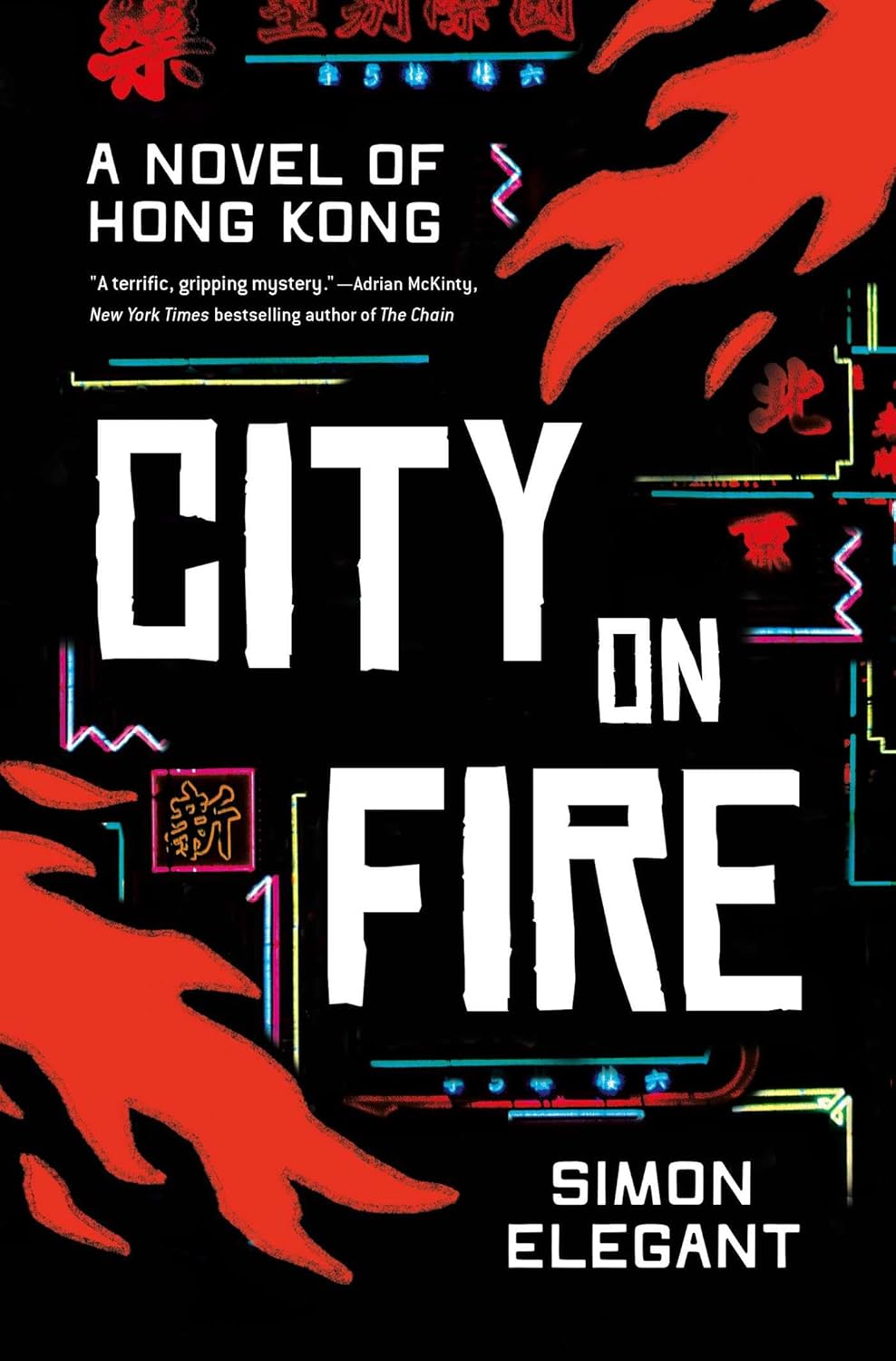
At the height of Hong Kong’s street protests in 2019, a mutilated body is discovered in a landfill site. This is, luckily, not fact but fiction — an opening scene from the novel City on Fire, a new thriller set in Hong Kong during its anti-extradition-treaty and democracy protests. We follow disgraced police Superintendent Killian Tong as he investigates this murder, all while navigating family conflict with his younger sister Jun, who is involved in the protests. The case quickly exposes systemic corruption that reaches into Hong Kong’s political and business elite, all against the backdrop of street unrest and Beijing’s tightening grip on the city.
We’re thrilled, if you’ll forgive the pun, to be joined by the book’s author Simon Elegant, a journalist who was born in Hong Kong and lived there for many decades, before moving to the mainland. Elegant was formerly China bureau chief of The Washington Post, and before that Beijing bureau chief for Time magazine. He’s also written two previous novels, A Chinese Wedding (1994), which was also set in Hong Kong, and A Floating Life (1999), about the Chinese poet Li Bai. Simon talked to us over the wire from Kuala Lumpur, to tell us about his new novel, Hong Kong during the protests, and how life can be as thrilling as fiction:
Guest

Simon Elegant spent more than two decades as a foreign correspondent in Asia. He was formerly China bureau chief of The Washington Post, and before that Beijing bureau chief and Southeast Asia correspondent for TIME magazine. He is the author, most recently, of City on Fire (2026). He is now at work on a fourth novel, set in Beijing.
Is Hong Kong destined just to become an appendage to Shenzhen and Guangzhou, to be a minor part of the Greater Bay Area? Or will that baffling, exciting, idealistic spirit among young people survive?
Transcript
Alec Ash: Let’s start with your own story in Hong Kong before we get to the fiction side of things. I know your dad, Robert Elegant, was a journalist based there for many years. He opened the Newsweek bureau in the 1950s, when Hong Kong was a listening post listening into China and the Mao era, and you were born in Hong Kong. Can you tell us more about your own engagement with the city and how that evolved over the decades since?
Simon Elegant: Absolutely. For both myself and my family, I would say Hong Kong has been a — I was going to say a port in a storm, but certainly our lives have revolved around it. Both of my children were born there as well. I keep coming back to it. My sister still lives there, so I’m there all the time. I went back to work for the Far Eastern Economic Review. It’s been a transient place which has had a great deal of permanence for me and my family, which is actually surprisingly not that unusual. About 7% of Hong Kong’s population is, quote-unquote, “not foreign,” as non-Han Chinese. So yes, I would say that I have a great affection, as one does, for the place of one’s birth. Maybe some people don’t, but it’s always been a bizarre combination — the exotic and wonderful and fascinating and different, and also extremely familiar. And obviously it’s changing. When I was born it was a colony, obviously, and remained that for many years.
And I’ve been fascinated by the transition from the colony, and in particular by some of the institutions. Because one of the things you do have to — without saying that colonial was any good — at least, this is one of the least bad places that the Brits operated, in particular. And they established, by what some of them call benign neglect — but at least benign administration, or somewhat neglectful administration, famously because of the economy — but essentially, and I guess not many people are aware of this, they established excellent healthcare, excellent public administration and a very good police force, really the pride of Asia after a disastrous collapse during the ’60s when it was the most corruption-ridden, and then it was reformed after that. I don’t think a lot of people realize that the people of Hong Kong at one point were the longest-lived in the entire world, longer than Japan or other places. Those things change, but they’re still in the top three. Just as a testament to the kind of social services that have been set up in a place that you wouldn’t think would be particularly conducive to a long life, being so crammed, one of the most populated places on Earth.
Anyway, I love the place. I’ve had mixed feelings about it many times. I certainly feel extremely attached to it, and I went back in 2019. In fact, if you go back now, despite the fact that underneath it the city has changed very substantially — which we can talk about later, because of the crackdown after the passing of the National Security Law in 2020 — I would say that on the surface it didn’t change much. Another thing I don’t think people often realize about Hong Kong is the extent of poverty, and that poverty grew worse. So now about 20% of the population are under the poverty line, which is astonishing for a place with, in theory, one of the highest per capita incomes. But you didn’t see that unless you looked for it. And one of the things I was interested in writing this book was maybe illustrating that a bit. And I was particularly interested in not writing a book that was about, obviously, expats. I’m not Chinese, but I certainly felt like I was half a Hong Konger, in the sense that I definitely was not someone who waltzed in and went on boats — my eyes were opened by going there and talking to people during the protests. But to go back to your question, I don’t think there were many visible changes. I think there are a lot, if you followed Hong Kong, changes in society, the biggest being the essence of a Hong Kong identity as separate from a Chinese identity. Those are necessarily things that manifest themselves.
The first protests were in 2004, and later the Occupy Central movement. That was a really astonishing moment. People may not know that much about it, but it was the equivalent, as a protest movement, of occupying Fifth Avenue in New York for months on end. I was there, walked around, talked to people. It was just mind-blowing, actually, in a lot of ways, especially for a place, as I say, that a lot of people thought of as culturally empty, completely money-obsessed, no idealism. It was astonishing for me even back then to talk to these people, mostly kids, but some of the older people too, who were camping on the highway in the middle of Central. So obviously from then on to 2019, the fantastic changes became apparent in Hong Kong.
And those changes really did culminate in 2019 with the anti-extradition treaty protests, which I think we were both covering as journalists. How did those protests feel on the ground, and how did they change the character of Hong Kong for you?
If I might, I’ll answer the second one first, which is the character. I think I alluded to it earlier, that for me — and I think it’s a danger for anybody, and it’s an advertisement for why it’s so important to have real reporting on the ground in anything, really — I had internalized somehow this idea that I alluded to before, which is that Hong Kong was this place, as many people know, where as high as 70-plus percent of the population is either descended from or directly refugees from China. And the idea that they don’t care about anything except themselves and their family, they want to make some money, they want to get on — it lodged itself into my head. But when I got there on the ground and began to talk to people, as I’m sure you did, I found the exact opposite. If anything, people who were kids particularly, but many people, were so idealistic, so taken with the idea of Hong Kong as a place that deserved the democracy that it had not been given by the British, deserved to preserve its own rights to free speech, did not deserve to be crushed on the wheel of history by the Communist Party.
I was just astonished by it, and I had to revise all my ideas. And I decided to go back to journalism, having taken a break from it for five or six years, because I thought it’s really important to do that kind of reporting on the ground. And that’s how I ended up going back to be a reporter for The Washington Post, because I was so inspired, at the relatively advanced age of 60 or something.
So how did those protests feel on the ground when you were back there?
So one of the things I did learn, as well as having been a reporter for many years — even though I’d written a couple of novels, I’d never been as intensely involved on the ground. I’ve been in a bunch of protests over the years, most of them in — in fact, all of them in Asia, ranging from Indonesia to Malaysia. But the astonishing organization of the protesters, not just the extensive equipment, but — one of the examples I always give, and I’d love to have got in the book but didn’t, was that they were particularly aware of the police grab squads that they had, and I feature in the book.
So they’d station the little, like, mini factories which were making Molotov cocktails under the cover, like a Roman testudo, like a Roman turtle, under the cover of umbrellas. And there’d be a bunch of people assembling these things, but they knew they had to be far away or they’d get raided by these police flying squads that burst out and grab people. And the one I saw was on Nathan Road in Kowloon, a very long, very broad shopping avenue, two lanes wide. And they were stationed 800 meters back, and they just had a line of protesters, one after the other, passing the assembled Molotov cocktails down and then passing them into the crowd, which was confronting the riot police. And occasionally, if you stood all the way at the back, you could see they’d lit them, and they’d be twirling through the air, smoking madly, and then you’d see them burst next to the police. It was astonishing to me, the sheer organization. There are plenty of other examples, but I’m sure you ran into the same thing.
They were extraordinarily well organized. And also, the other thing that’s so striking was that there was no head of the organization, or didn’t appear to be, and the police were desperate to capture anybody who was running it. But they were all organized through Signal or Telegram. They assembled. They were almost like a flash mob or something. It was really astonishing. Yeah.
So all of this is the backdrop to your novel, City on Fire, which is not to be confused with Antony Dapiran’s nonfiction book, City on Fire (2020), also about the protests. So I suppose my first question to you is, why choose the genre of thriller to tell this story about Hong Kong? Why not do a nonfiction book?
Basically because I think there were plenty of people doing excellent work already, including Antony, but other people. There’s Among the Braves, which is a wonderful book. There’s a bunch of books that are really good. I was happy to leave that. I’d written a couple of novels before, and I think there are genuinely other truths available. Some of the things that interested me were the change in Hong Kong, the splits between families, which I saw by meeting people, and you can write about somebody usually anonymous. It’s going to be very difficult — say you want to write about a child and a father, or a daughter and a father, or whatever it was, to illustrate how divided Hong Kong was in many ways, even though many people supported the protests. It was what Nixon would’ve called a silent majority. I’m not sure if it was a majority. Those things are fascinating, the divides between families at dinner tables. I wanted to get at that, and to me the best way to do that was through fiction. I think you can definitely illustrate truths, and you want people to read it.
And honestly, I love murder mysteries. I love thrillers. I didn’t feel that I had a road to the things I wanted to say through a conventional novel. And also, to be honest, I think there are plenty of people in Hong Kong who can write good novels and good fiction about families and stuff. So I felt like I was entitled to have that area of a thriller. So yeah, I decided to go that route, thriller mystery.
It reminds me of another novel that was recently published in English, Everyday Movement by Gigi L. Leung (2026). This was actually our book club pick at China Books Review in March. We had a great discussion of it at Asia Society. That’s a more literary novel about people’s ordinary lives, Hong Kongers’ ordinary lives in the protests, which also got into the sort of family disagreement.
Yes. I missed that book. I will definitely look for it after we get off this podcast, as a matter of fact. It sounds fascinating.
So can you set the novel up for us? Who is Killian Tong, and what is the murder he’s investigating?
Absolutely. Okay. So Killian Tong’s father is one of the Irish people who joined the police force — even as late as the late ’80s, there were people joining the police force from Britain. It took them a long time to, quote-unquote, “Sinify” the police. So Killian Tong’s father is a Caucasian Englishman who joined the police force and then married a local, because his mother died in childbirth, Killian’s mother. So he feels fully Hong Kong, went to school, all of his elementary and high school, speaks Cantonese, speaks some Mandarin, speaks English, of course, as well. But his stepmother does not speak any English, so he’s fully Chinese in that sense, or feels himself fully Hong Kong. He joins the police force because that’s who he’s familiar with, that’s what he loves, and he honors the institution as Asia’s finest, and it seemed logical, and was a place that he loved and honored.
And one of the things that happens is the book is him watching it deteriorate in many ways, and the distress that causes him, obviously. But because of the demonstrations, which were — perhaps many people don’t recall the scale of these demonstrations. In a city of six million people, occasionally a million people could be on the streets. The numbers — people exaggerate, but it was fantastic. It was extraordinary to see. Again, I’ve been to some demonstrations in different places in the world. I’d never seen anything like it. Oddly, I burst into tears when the crowd was singing “Let My People Go” from Les Misérables. I’m at the same time embarrassed but still moved by the memory of it. It was just extraordinary, the commitment of people to it.
At any rate, because these demonstrations were so big, and Hong Kong has a police force about the same size as New York City — which is a bit bigger, but it’s a fairly heavily policed place, and it’s been one of the safest places in the world, about 38,000 to 40,000, although more now, for obvious reasons. But yeah, even though they had a very high number of police, quote-unquote, they didn’t have enough people to man what they call the riot squads, the squads that police the demonstrations. And increasingly, relations between the protesters and the police got worse and worse, to the point where they loathed each other. More and more police were required, and regular police who were not on riot squad duty were cycled through.
Killian is, on one of the times that he’s assigned riot police duty, there’s an incident in which he discharges his weapon and a protester is very badly injured, and he’s pretty much banished. You can’t go far in Hong Kong, because it’s such a small place, but he ends up near these marshes where migrating birds are, right on the border with Shenzhen, in an old police station — a tiny old police station that exists, and which used to stop people from China trying to swim across to Hong Kong back in the ’60s and ’70s. And that’s where he gets the call saying all the other motor squads, effectively, are not available. There’s been a discovery of a torso in a landfill near him, way up in the north of the New Territories, right on the border with China, and would he go investigate?
Was that incident with the discharge of the weapon based on the shooting of the teenager on October 1st, which was a real incident? And did you draw on real elements from the protests, or how much did you fictionalize the backdrop?
It was absolutely drawn from that. And although in the fictionalized case I think he’s shot in the head, and in that case he was shot in the chest. But — I saw that footage. I’m sure a lot of people did. I was so horrified. But to be honest, I don’t know what you thought at the time, but I was convinced that somebody was going to be killed and things would really deteriorate from there, because the police were increasingly violent.
And one of the things I think I illustrate in the book, that I was really struck by as well, was the loathing that the Hong Kong people, many of them — it’s hard to make generalizations, but they really hated them. And I was really struck by how dangerous it was, in particular for the kids on the front line. And the epigraph of the book is a quote that was painted all over the walls, I’m sure you saw, which is, “If we burn, you burn with us,” which is from Katniss, from Katniss in The Hunger Games movies. I’ve forgotten the name of the woman, actually. I’m embarrassed to say.
I can’t remember her surname either. So between the two of us, we failed our pop culture check.
There were many other amazing slogans, but that one really stuck with me. There were slogans about poverty. But basically, they were perfectly well aware, especially the people I talked to — they were extraordinarily well aware, and I go into this in the book, of why they kept protesting when they knew they were bound to fail. Everybody knew they were bound to fail. It was a fascinating thing to me as well. So that was a very real element, and there’s a — I hope not too artificially set up — debate between the policeman brother and the really passionate daughter, who’s obviously modeled on a lot of these kids that I [met], about why they do it.
I’ve been asked this a bunch of times, and the best answer I can give, that was given to me, was — one of these young kids had read something from Churchill, who said, in the dark days of 1941, that nations that go down fighting recover much better than ones that submit to the boot heel. And I think at the back of their mind was the same idea. But I’m not sure it was that rational, to be honest. I just think they thought, “We’ve got to resist this.” And yes — we probably don’t need to go into the details, the five demands and Carrie Lam and all that sort of… that’s probably a bit in the weeds. But it was a salvageable situation, but the two sides were implacably stubborn, I would say.
Exactly. And it bears remembering that the reason that the protests, which were peaceful, as you said — they had these peaceful five demands for relatively reasonable changes in Hong Kong policy. The reason that escalated into violence and into the scenes from the street that we all remember from closer to the second half of 2019 is because of the police response to the original peaceful protests, and a lot of violence from the police. A brutal attack in one of the subway stations.
Indeed. Although I did particularly not want to make this “protesters are great, police are horrible.” Even though they were particularly horrible in that — there were several really disgusting attacks on the subway, one by the thugs, I mean mafia people, essentially, yes. Which was, at that point — I was really interested in how an institution can collapse into tribalism, effectively. They just hated their opponents. But yeah, I was particularly concerned not to make it “the police are awful,” but they were pretty bad.
Is that why you chose a policeman as your protagonist?
Yes, absolutely. And indeed, some other writers who’ve written about it were not particularly happy choosing a policeman as a protagonist, to be honest. But, I — fiction is about conflict, and having a policeman as a protagonist certainly raised the conflict level very high. So yes, I did do that deliberately.
And you draw out Killian’s internal conflict very much, and his ambiguous feelings around what’s going on in the city he’s from, which I’m sure was the case for many Hong Konger police officers. There’s also a conflict with his little sister, Jun, who, as you mentioned, is pro-protester, anti-police, largely due to that incident with the shooting. Can you tell us more about her perspective and what you were drawing on to create her character?
Sure. Partly she’s a composite of the people I met, but partly she was representing some of the ideals that the protesters were there for, which, as you say, were peaceful, amazingly peaceful, very well organized. Headless, in the sense that — I think the traditional people, like the Martin Lees, or some of the traditional civil servants or opposition figures, were eventually marginalized, in the sense that they chose to withdraw. But during that period where they were marginalized by, I would say, by the protesters themselves, I wanted to represent the ideals particularly of some of the younger people, who’d found themselves in a weird position in which they felt very Hong Kong, as I understood it. They felt like Hong Kongers.
You saw many surveys that were done at the time, in which people were asked — and this changed over the years. Twenty years before the protests, even in the early 2000s, people were surveyed in Hong Kong and said they felt Chinese mostly, if they were asked. By the time of the protests in 2019, the numbers were well into a plurality of people saying they felt like Hong Kongers, not Chinese. And I think that’s one of the things that really alarmed the Communist Party in Beijing, that the one thing they really loathe is anything that’s a separate center of power, or national idealism or patriotism separate from the idea of being Chinese.
It’s also fascinating to me that, I think in the end, they didn’t want to be bothered with this whole thing, and they were forced to intervene, actually, by the incompetence. I was very interested in just portraying her as a composite of why protesters did what they did, and particularly, as we’ve discussed, why they persisted in very dangerous personal acts, and dangerous to their families, despite the fact that they almost certainly knew they were going to lose.
And that family conflict inside Hong Kong families, between people who were supporting or participating in the protests, and often the parents who might disagree with the protests, or at least not want their kids joining in — the sort of clash between blue and yellow — that was such a lived reality for so many families in Hong Kong. And the dynamic between Killian and Jun is very much of an ilk. So I wondered what you were trying to draw out in the conflict within society there.
Again, fiction is about conflict, and this is really basic conflict. As Killian says to his sister at one point, “You’re not just endangering yourself by persisting in these protests. You’re endangering the family, myself, your own mother.” Because the Chinese authorities do not mess around. They play hardball, as we say in America. They really play hardball, and occasionally families can get swept up in this kind of thing too. You may end up in some labor camp in Qinghai, but so could your own mother.
Bizarrely, and in a contradiction — I don’t know about you, but I saw plenty of grannies, some of them in wheelchairs, in some of these protests. So it wasn’t as though everybody — it was a genuine feeling across society. I think later, when — again, I don’t know what you saw, but some of the, quote-unquote, “frontliners,” clearly at that stage, people had become totally absorbed. They loved the gear. They had knee pads. They had elbow pads. They had masks. They had helmets. I describe some of this in the action. Later on, especially towards the end of the protests that I saw, there were frontline troops who’d come — you’d be in a crowd, and they’d come stomping through, and you knew stuff was getting serious. And they were just a different class of people. They were ready to rumble. They were ready to fight. It was a whole different thing, and I had the feeling that, again, at that stage, it wasn’t just the police that had become tribal, it was the protesters too.
Yeah, I was following a frontliner around, and I got the impression that it was a little bit of a game to them, or that they were really angry about other issues in their life, dissatisfaction, and this was a venue through which they could show it in a violent fashion. So let’s loop back to the murder that Killian Tong is investigating. Can you tell us what he finds in the landfill, how this becomes his path to redemption, and what he uncovers in the journey to investigate this murder?
Actually, this whole thing started back in the day, the last time I was living in Hong Kong. And I actually got a briefing by the police on a couple of murders, and one of them was somebody who chopped up a victim in one of Hong Kong’s tiny flats. And in his particular case, he thought if you put them in the harbor he’d be fine, but he didn’t consult the tidal charts, and they all came back and ended up on the shore, and he was caught. But in this case, Killian finds a body that has had its limbs and its head taken off, and concludes, not surprisingly, that somebody wants to disguise the identity of the victim. And he pursues that line of identity in a very frustrating way, eventually discovering some other parts of the body, which help him a little bit to try and pursue a path to discover why this person was murdered.
He does discover a lot of opposition from his senior officers, increasing opposition, who wanted him to shut the investigation down — which, in the tradition of a lot of stubborn people who do these things, just makes him more eager to discover what’s really going on, and he pushes even harder, and finds that in many ways the investigation reaches very high into Hong Kong’s police force and, in general, into the government structure.
And what’s the connection between this murder case and the protests in the background?
I suppose, in a way, what you’re asking is, how is it connected to the reality of post-1997 Hong Kong? And it depends, for people listening, on how familiar they are. But pre-’97 Hong Kong, and in many ways post — it was a peculiar place once the British had started to disengage, the colonial government. But it had always relied on the government’s funding, and in many ways the structure, the ability of Hong Kong to fund the economy, or at least fund the government, with a very low tax rate. So it had depended on a very cozy relationship with developers who made billions and billions. The government sold land to them. It was a very cozy relationship, which continued.
Without saying that the British colonial government was fantastic, they were very conscious, even from the ’50s — they instituted a program of public housing, which was admirable in many ways, and was in fact copied by Singapore, believe it or not, from the ’50s. It faltered in many ways later on, but it was funded by the government, and ended up with a great many people. After ’97, that process started to fall apart. The cozy relationship between the government and the developers became even worse in many ways, and they neglected to do some of the things that, I think in particular, the Communist Party in China is very conscious of, which is to make sure that even if you have some corruption or whatever it is, you make sure you do the fundamental things.
And one of those in Hong Kong is making sure people have a place to live that’s not absurdly expensive. They neglected that. Previously, when you built something, it was mandated by the government — you would have to build 20%, I think, I can’t remember the exact numbers, of quote-unquote “low-cost housing.” That was neglected much more, and that came to a head. One of the reasons that people were so angry, as I’m sure you found, was that they didn’t have a place to live. You couldn’t get a place to live. People were living literally in cages, in tiny cages. And I think the corruption associated with that, the neglect, the kind of collapse of the public administration, was something I was really interested in. The connection between people’s livelihood and the public administration seemed to have frayed and pretty much collapsed by 2015. In those years, they put chief executives in jail for corruption.
So it was an ongoing problem which didn’t seem to be being solved, and I think eventually that was one of the reasons that Beijing stepped in — that they ordered, and are still ordering, to — I was there recently reporting — they’re still trying to force the government to pay more attention to really fundamental issues of housing. And as I said earlier, 20% of people under the poverty line in a rich city like Hong Kong is simply unacceptable.
How has Beijing’s increasing control over Hong Kong changed those dynamics, and does that come out in the novel as well?
Beijing, as I said earlier, I think they were exasperated with the, frankly, incompetence and corruption of the Hong Kong administration, particularly of the then chief executive, Carrie Lam. They call the top person in Hong Kong the chief executive — obviously they’re attempting to emphasize business links — to have so completely mishandled it, she was clearly well out of her depth. I think in the end Beijing did step in, and I did address that in the book. In a sense, I did try and get into the idea that they stepped in reluctantly, but once they do step in, they don’t mess around.
I think a lot of people’s fear was that they would have to send in the PLA, but a combination of, weirdly, COVID, as you probably remember, and then people in Hong Kong understood that — once the National Security Law had changed and Beijing had asserted its will, there would be no going back to the days of protests, or indeed — and it completely died down, because people were smart enough. I wrote stories about this as well, and talked to some of the protesters who were in hiding by then, and they were very well aware that they couldn’t get away with it. And thousands of Hong Kongers left for Britain.
I think, interestingly, I was in Hong Kong a few times during COVID, and I noticed that the few flights that were at the airport, which was mostly closed down, were the Cathay and BA flights to London. And I did notice, walking past those queues, that most of those people who were leaving were young people in their 30s with young children. A lot of people who were relatively well-off, but in particular, I noticed people who did not want their children to be educated under the Communist Party. So yes, I would say that it’s a direct commentary on what happened, which was the direct intervention, the forced intervention — I think that Beijing would say by the party — to try and stop the incompetence, stubbornness and corruption of the then administration in Hong Kong.
So after 2020, with the National Security Law and the exodus from Hong Kong that you mentioned, the city really has entered a new phase. This is after the events of your novel, but when you go back to Hong Kong now, how does it feel different in this post-2020 reality?
In a weird, contradictory way, on the surface of it, it doesn’t feel that different. You don’t — because all the protest slogans have been cleaned up. There are obviously no protests anymore. All that seems to have vanished without a trace. But obviously it’s not true at all, and if you talk to people, they’re still very conscious. The story I was doing for The Washington Post when I was there, which is only a few months ago, was about the economic revival of Hong Kong. Hong Kong holds a weird position. It’s been eclipsed, since about 2015, by Shenzhen across the border, and even by Guangzhou in terms of pure GDP output, because that area, the great — it’s now part of the, quote-unquote, Greater Bay Area.
It’s still a thriving place, but it no longer has what it held as a unique position for many years as the, quote-unquote, gateway to China. But it still has a separate currency, and it still has the ability for Chinese firms to list companies there, which is particularly valuable now that Beijing has decided that Chinese firms should not be listed in New York, and generally elsewhere, so they can raise foreign capital. It’s a very big advantage. And in surprising ways, I think there are still an awful lot of foreigners moving to Hong Kong — and not just “failed in London, try Hong Kong” — people from around the world. And I think, economically, I was a bit surprised to find that was still an issue, and that Hong Kong was still somewhat vibrant in some areas, obviously not in others.
I would say the flip side of the coin was the despair among some of the people who used to protest and have found themselves just crushed. One of the other stories I was doing is about a film director who’s spoken out quite volubly. He’s pretty much the only person left in Hong Kong speaking out, and even he does it relatively cautiously. And I’ve always been interested in why people put themselves in positions like these, in various societies, as dissidents, and I did ask him why he was doing it. He was saying that he was ready to go to jail. He’s got a couple of young kids. He told the kids he might be put in jail. But really, that was a rare thing in Hong Kong. Most people have buckled down and are just — I’m not quite sure how to put this — I guess they’re just acknowledging reality, which for China, by the way, is a normal thing.
When things get bad, particularly intellectuals, obviously, but as far back as even the Han dynasty, a couple thousand years ago, Chinese intellectuals are very used to — or the Mandarins, whatever you want to call them, the ruling class — very used to the idea, and I think they’re doing it in China right now. It’s almost a reflex for them to understand that things are going badly politically, and they should pull over their shell. I’m sorry, I haven’t got a good turtle metaphor going on here, but they’re very conscious of it. It goes all the way back to even the poets. It goes back to the dragon boat races, the way the intellectuals both were protesters against injustice by the emperor, but ended up paying the ultimate price for it.
And in terms of media freedom — obviously it’s very different for local Hong Kong journalists — but does doing journalism in Hong Kong feel very different now than it did before? Is it more difficult to report, and to get people to talk?
It is, and I would say it’s much more like mainland China now. Which — I think mainland China is much worse than when I went there to report full-time in the early 2000s, which was probably the freest period, before the Olympics and immediately afterwards for a few years. Basically before Xi Jinping came to power. It’s a bit of an outrageous statement, but I would say it was certainly among the top few freest periods in Chinese history. Obviously you can’t compare it to the Tang dynasty or anything, but there was a lot going on. Maybe a bit in the late ’80s before Tiananmen, obviously, but those are different circumstances.
I would say definitely now what I call the authoritarian head twist, which is when you’re talking to somebody and they say something even mildly [critical], and they look over their shoulder because they suddenly realize what they’ve said, and they’re very conscious that there might be somebody behind them. That has now become a thing in Hong Kong, and people just don’t want to talk. They’re very conscious of it, and — I don’t know what to say. There’s just virtually nothing. It’s really been crushed.
I would say now that the Hong Kong authorities — I did report this during the white paper, or baizhi, protests in China, at which point it was easier to protest in mainland China than it was in Hong Kong itself, because the Hong Kong authorities are very conscious of how badly they’ve done, and how much Beijing’s eye is on them. A cold, withering eye, I would say, because they’ve done pretty badly, and they’re now trying to prove themselves more loyal than mainland Chinese. Examples abound of where they — there’s one example of one of the protesters who fled overseas, and they put her father into jail because he transferred some money to her. I can’t remember the term, but they put him in jail for four or five years. It’s very depressing, how crushed the soul of that society is.
And in many ways the question I do try to address in the book is, can that vibrant, exciting Hong Kong, which is going through a growth stage, I would say, of discovering its own identity — has that now been completely crushed? Is it destined just to become an appendage to Shenzhen and Guangzhou, to be a minor part of the Greater Bay Area? Or will that baffling, exciting, idealistic spirit among young people survive? I’ll certainly be watching with great fascination.
Me too, and hoping that the Lion Rock spirit lives on.
Indeed. Lion Rock spirit.
You can certainly see a little bit of it in this novel, which I hope that everyone picks up and reads. Simon, thank you so much for coming on the podcast.
Very enjoyable. Thank you very much for having me on. ∎

Alec Ash is a writer focused on China, and editor of China Books Review. He is the author of Wish Lanterns (2016), following the lives of young Chinese in Beijing, and The Mountains Are High (2024) about city escapees in Dali, Yunnan. His articles have appeared in The New York Review of Books, The Atlantic and elsewhere. Born and educated in Oxford, England, he lived in China from 2008-2022, and is now based in New York.