Sign up for our newsletter to be notified of new posts!

This is an episode of the China Books Podcast, from China Books Review. Follow us wherever you listen to podcasts, including Apple Podcasts and Spotify, where a new episode lands on the first Tuesday of every month. Or listen to this episode right here, where we also post the transcript.
Confucius took a beating during the 20th century. A whole range of thinkers — liberals, Marxists, feminists and reformers — criticized his philosophy as regressive and unenlighted. During the Cultural Revolution, Red Guards vandalized his tomb. But revisionist winds are blowing, especially when it comes to his views on women. Some scholars hold that the text of the Analects, a posthumous collection of Confucius’ teachings assembled by his disciples and later followers, engages with the gender questions of his age in a far more nuanced manner than previously understood, and that the rank misogyny of some later Confucian practices is a product of the interpolations and misinterpretations of a different age.
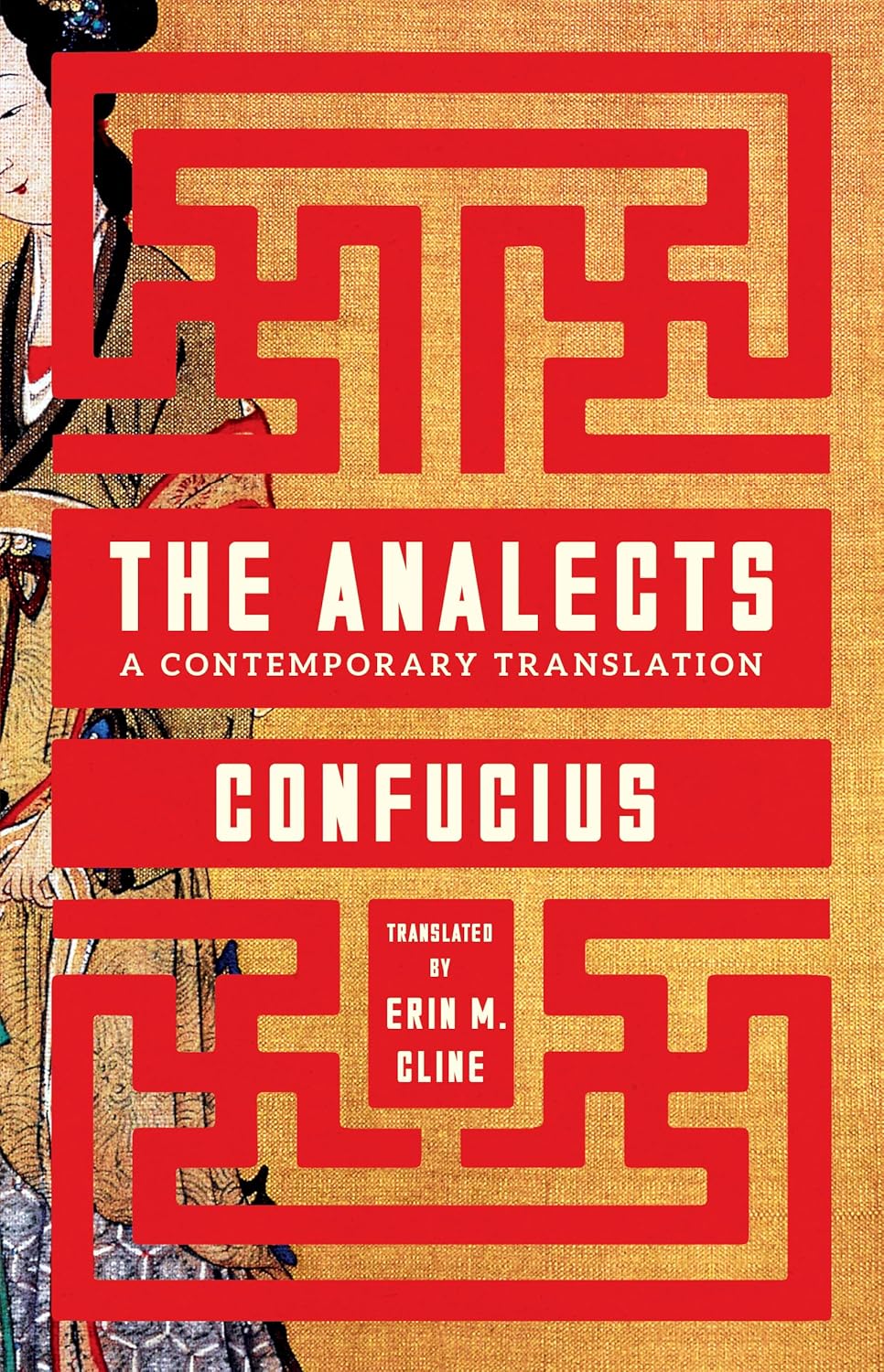
Joining us this episode is Erin Cline, a Georgetown classicist who makes just that argument in her revisionist approach to the Confucian classic, The Analects: A Contemporary Translation (W.W. Norton, February 2026). Cline’s translation makes a few notable choices: the text is organized thematically rather than in the traditional 20-chapter format; she eschews gendered pronouns; and leaves a number of words untranslated, most interestingly junzi. We were delighted to have her on the podcast to discuss all the above and more.
Guest

Erin Cline is a professor of Interfaith Studies & Dialogue at Georgetown University, and Senior Research Fellow in the Berkley Center for Religion, Peace & World Affairs. She is the author of numerous books on Chinese and comparative philosophy, including Little Sprouts and the Dao of Parenting (2020) and The Problem of God (2026); and the translator of The Analects: A Contemporary Translation (2026).
I tend to say that he’s the most influential thinker in human history. If we imagine the combined influence of Jesus and Socrates on Western cultures, we start to get a sense of his influence.
Erin Cline
Transcript
Alexander Boyd: Just to set the stage for us, what is the Analects and how did it come to be?
Erine Cline: The Analects is really one of the most influential texts in human history. If you measure influence by the number of people who have lived their lives according to a particular view of what it means to be a good person, what it means to live a good life, then the Analects is going to rise to the top. Maybe the very top. It is the most influential record of the teachings of Kongzi (孔子), known to most Westerners as Confucius, and it records his views concerning what it means to live a good life, what it means to be a good person, and has just had this incredible influence throughout East Asia and Southeast Asia.
When I go to talk about the influence of the Analects, or Kongzi in particular, what I usually tend to talk about first is the length of time that those teachings have been influencing people. Since Kongzi is looking back at an earlier time in his culture and trying to preserve earlier rituals, we can go back to the tenth or eleventh century BCE, even though his dates are 551 to 479 BCE. He dies about ten years before Socrates is born, just to give you a sense of how that compares with Western philosophy and religion.
So you have that broad length of time during which the text and his teachings are influencing people. You also have incredible depth, because Confucian teachings and his teachings in particular really sink their influence down into the earth of not just what we call China, but East Asia. You think about places like Japan and Korea and Taiwan. You think about Southeast Asia — places like Singapore and Vietnam. Just enormous swaths of Asia have been deeply influenced culturally by Kongzi’s teachings and by Confucianism. Sometimes I tell my students it’s a little bit like cultural saturation, because wherever Confucianism went in East Asia, it mixed together with indigenous traditions in really interesting ways. So you have cultural differences, but nevertheless, the fundamental values that define Confucianism really had an enduring influence and are visible today.
Who exactly was Kongzi, and did he write the Analects, or how did it come together?
He was a teacher in early China, and his surname is Kong, the honorific “zi” so “Kong Zi” or Master Kong, which was appended to the name of well-known teachers, philosophers, religious thinkers. He traveled, had a group of students or disciples, we might say, and there is a religious dimension to the Analects and to the Confucian tradition. I’m never afraid to say it’s both a philosophical and a religious tradition. I think it fits every reasonable definition of both of those kinds of things.
We know really very little reliably about his biography. We know a few things. We know that his father, we think, died when he was very young. He was raised by a single mother, and someone who likely had very impressive character, because it would have been incredibly difficult to raise a son who really rose in people’s hearts and minds in the way that he did, and received a good education. But he was really focused not just on helping people to become well-educated or smart — he wanted people to become good, wanted people to become humane and compassionate, and wanted to preserve traditional rituals that would shape people’s character and help them see how to get along with each other, how to have meaningful relationships with each other, and then how to build a good society based on all of that.
He dedicated his whole life to spreading these teachings. And he always said, “I’m not an innovator. I’m a transmitter. I’m just handing down these earlier teachings.” Like most of us, his self-understanding wasn’t completely accurate. The truth is that he was really both an innovator and a transmitter. He was handing down these earlier ways of thinking about what it means to live a good life, and ritual practices and things that were a part of this earlier culture and tradition, but he was also putting it all together in a new and interesting way — in a way that really made sense to people, captured people’s imaginations, and that people found made a difference in their day-to-day lives and helped them to live better lives.
I tend to say that he’s the most influential thinker in human history. If we imagine the combined influence of Jesus and Socrates on Western cultures, we start to get a sense of his influence in East Asia and Southeast Asia. His influence is really, really remarkable.
Your interesting point about being an innovator and a transmitter reminds me of the work of translation, right? That’s what your translation does. It’s both an innovative translation and also a transmission of these ancient texts that are hugely influential. So why did you take on this project? Why do we need a new translation of Confucius? There are a number of translations that have been done since the late nineteenth century, I think. So why do we need one now?
In true Confucian fashion, a lot of my work begins with conversations with my closest friends. My friend Bryan Van Norden, whose work I recommend to anyone who’s interested in Confucianism or Chinese philosophy, actually suggested to me that maybe I should consider this. I had never really thought about it before. Initially I thought, I don’t know if I can really contribute that much here. There are good translations of the Analects in English available and I use them in my classes. But the more that I thought about it, the more that I realized there are a number of things with existing translations that I amend or correct in my classes — things that I have to unpack with my students and explain, like, okay, I wouldn’t translate this this way, here’s what I would say about it. And of course I respect and understand the reasons why different translators make their decisions, and I love having discussions with them, and a lot of them are good friends of mine, and I’ve learned so much from their work. But as we move forward, and the longer that I live and work with this text, the truth is that I realized I do have some things to contribute here.
One of the really distinctive things that I do when I teach the Analects is that I teach it thematically. Usually my syllabi have these lists of passages that students have to read. I don’t have them read the Analects in order, because it’s a cobbled-together text. It wasn’t written by Kongzi. It’s not even edited together by one person. These are the records of his students, memories of what he said in his teachings. It’s sort of jumbled together. We know this; textual historians know this. It’s not this perfectly organized text. So I assign passages from the Analects thematically — all the passages relating to ritual, for example; all the passages relating to harmony; filial piety; the concept of junzi (君子), or ren (仁) — all of these big ideas. My syllabus gets really thick really quickly because I have these long lists and students have to go through the numbers.
So I’ve always thought it would be really great to have an edition of the Analects that is organized thematically, so it’ll be a little bit easier for my students to access. That’s one dimension of what I’m doing in my translation. But there are a number of things that I’m working to correct and render — not just in a more accessible way to modern readers, so that they can understand and appreciate the text, which is really the most important thing to me, because I think this is a text that should change your life when you read it and should influence your day-to-day living — but also just for accuracy.
This is a text that’s been in the hands of men for the entirety of its history. There are a number of things that I see, notice and appreciate, I think, as a female translator of the text that have been missed in most previous translations. I’m working to correct a lot of those. Most notably, there’s one named woman in the Analects, a woman named Nanzi (南子), and I’m working to really rehabilitate and redeem her story, because she was wrongly maligned throughout Chinese history. But there are a number of dimensions of the text that deal with gender and mention women that I think people have badly misunderstood.
So let’s talk about Nanzi then. What is the story that is traditionally told about her, and what is the story that you tell about her, and why do you think it matters to the modern reader?
I think that we should care because we should care about the truth — and about people’s actual lives and stories being remembered accurately. I often compare, when I introduce Nanzi’s story to those familiar with Western Christianity, most people are familiar with the figure Mary Magdalene. She was a female disciple of Jesus and she was the first person to whom Jesus appeared after his resurrection. Unfortunately, Mary Magdalene was maligned throughout most of Christian history because she was conflated with an unnamed woman who also appears in the Gospels — an unnamed sinful woman. And then the myth that she was a prostitute before she converted and became a follower of Jesus was perpetuated throughout history.
That understanding of Mary Magdalene came in, I want to say, around 400–500 CE? Like years after the original assembly of the New Testament.
That’s correct. Pope Gregory conflated her, in an Easter sermon, with this other figure, this other woman from the Gospels. There were some other things that I think led people to believe it — there were very popular stories about repentant prostitutes that were gaining ground at the time. So there were other reasons that people would have found that to be a compelling story. But there’s absolutely no historical basis for it. There has been quite a bit of work done to try to really tell the truth about her story and recognize who she was. Pope Francis very famously elevated her in the tradition and called her the Apostle to the Apostles — really did a lot of work to try to rectify that part of her story.
So when I go to talk about Nanzi, I often try to anchor it to that type of story, to Mary Magdalene, because I think the stories are very similar. In the passage — the only named woman in the Analects — that mentions Nanzi, we’re told that Kongzi met with her. She was the wife of a ruler in the region that he traveled to. He had a meeting with her, and one of his disciples — specifically a disciple who’s known for being especially hot-headed and rash — this disciple said, “Oh, this is terrible,” and was outraged over the fact that he had taken a meeting with her. Kongzi is reported to have said, “Well, if I’ve done anything wrong, then let Tian (天, Heaven) come and get me for it.” He seems to say that in a spirit of impatience with his student. The idea is that he wouldn’t have done anything inappropriate, but his student is worried about this.
The commentators fixate on all of that — not so much puzzle over it. They all really agree that she was a woman of ill repute, that it was scandalous that he took this meeting with her. So they talk about, well, why did he take the meeting with her? Most of them ultimately decide it’s a matter of ritual propriety — he had to meet with her because that was the appropriate thing to do with the ruler’s wife when you visit a place. So it’s a matter of him following rituals, which we know he’s dedicated to.
As it turns out, when you do a little bit more digging on Nanzi — and I spent a lot of time sorting through all of the different Chinese texts that record parts of her story, her biography, her husband’s biography — people really have not looked closely at her husband’s biography in relation to her story. I sorted through all of those sources as I tried to understand this passage and what was going on in the commentaries. And you actually find a really complicated, but also very interesting, story.
Nanzi’s son — maybe her biological son, maybe her stepson, it’s not clear — came to believe that she had had an affair with someone and was extremely angry about this. There was no reliable basis for him to think that. It was a matter of other people teasing him, and he came to interpret the things that they were saying — which are honestly really cryptic in the classical Chinese — as suggesting that his mother had had an affair. He was absolutely scandalized, outraged, angry about this, and made an attempt on her life, tried to kill her. She realized what was happening when it was happening, immediately went to her husband and said, “Look, this is what’s going on.” Their son was then banished. But eventually he returned after his father had died, ascended the throne, and did kill her. Succeeded in murdering her. That’s how that story ends.
The difficult wrinkles to unpack, of course, are: why exactly did he come to think that? Where is the husband in all of this? What was really happening? When you go to unpack the different sources that record different elements of her story in early Chinese texts, if you dig far enough and you look at her husband’s biography, one of the things that you find is that her husband was one of the first known men in history to be in a same-sex relationship. It’s very possible he’s one of the first known gay men. You even have a well-known phrase — the “bitten peach” (分桃) in Chinese — which traces back to his story and his relationship with another man, and is now a popular byword for male homosexuality.
So by all accounts, he very well may have been a gay man who, of course, was not surprisingly married. He was not known for being a good ruler — he was not that engaged; the Analects records that. But there also would have been complications with what it would be like to be a gay man in ancient China, what it would be like to have a family, to be on the throne, and what it would be like to have, by all accounts, a very capable wife who assisted in governing. She falls under suspicion because she does assist with governing, as her husband is absent in governing. And that would have led people to want to slander her and to be suspicious of her. But it also explains a couple of passages that record her husband inviting one man in particular — this is the man that her son believes she had an affair with — the account is that her husband invited this man to court, to be a companion. And of course that’s puzzling, unless you know that he very well might have been a gay man and was trying to help his family navigate the realities of their life.
I actually think there’s something really poignant and difficult and heartbreaking about the whole story, because I think it really represents the complexities of human life and family life and what it would have looked like in a really different time than our own. And of course, we don’t have to go that far back in our own history before you see stories that are a little bit like this.
So Nanzi ends up falling under suspicion and is really — as my kids would say — thrown under the bus. Her whole reputation ends up being ruined. She ends up being considered a woman of ill repute. But it was interesting: a couple of my friends who work on early Chinese texts, when they read my manuscript, actually said that story is worth the price of admission right there in terms of your translation, because this story really hadn’t been put together before. It’s a complicated story with a lot of layers.
From my memory, I read Sources of Chinese Tradition in my intro Chinese history class. And often the Confucian stories can be quite — and no offense — but quite dull. Her story is just really unbelievable. It’s rich, it’s layered, it’s stunning. So it’s a good addition. But you don’t just rescue her from history. You also go through a number of lines, and there are two things that you do. One is that you purge gendered language, or even misogynistic language, where it wasn’t there earlier. And two, you reinterpret some lines. So let’s start with where you see traditional translations having this gendered language and you take it out. Specifically, I’m thinking of passage 3.8 in the traditional organization. This is a translation from James Legge, which goes: “Zixia asked, saying, ‘What is the meaning of the passage: The pretty dimples of her artful smile / The well-defined black and white of her eye / The plain ground for the colors?'” But in the Chinese text, there’s actually no reference to gender specifically. How did you translate that, and if Kongzi’s original teachings were not inherently like this, how did this gendered language get inserted into the text? Because it’s not just translations; it’s also Chinese explications as well.
You have great translators like Legge — and of course no one who works seriously in classical Chinese doesn’t respect James Legge and his translations; he’s phenomenal, absolutely phenomenal — but that is not to say that there aren’t inaccuracies at times. One of the things that Legge does very well is he attends closely to traditional commentaries, and traditional commentaries are something I rely on in my translation. They’re a very important part of the tradition. In the Confucian tradition, people traditionally read interlinear commentaries, which meant that as you were reading the text in classical Chinese, literally in the margins you would be reading traditional commentaries and sub-commentaries alongside the text, and that would help you to understand what the references were to and what was going on. The commentaries are often helpful, but they also bring their own baggage.
This is especially true when it comes to something like women and gender. As Chinese history moves forward, the views of women — this is the story when it comes to the Confucian tradition — in the earlier periods, you actually find much better views of women, and then over time things devolve. That means that commentators who are writing later, who are writing in imperial China, especially once you get into later imperial China, really tend to view women with suspicion. They tend to view women as objects of beauty, as sex objects. And so you find a lot of derogatory views.
In passages like that, you find in translations interpolations that will interpret lines as references to women and female beauty, when in fact there’s nothing in the original that actually references a woman or female beauty. So I try to go back to the original text. I also look at earlier commentaries, which I think are really helpful, as opposed to getting to the later ones. But I look closely at the original and try to be faithful to it.
If you take a line like that, what you find is that you’re talking about adornment on a background — actually on a silk background, probably raw silk. This is a passage about moral cultivation, I argue. That’s what the text says. It doesn’t refer to a woman in any way, or a woman’s face being painted. What it likely refers to is a picture, and the idea of adorning a silk background as you would in a painting — in traditional painting — with the idea that as we learn rituals and as we cultivate ourselves and cultivate virtues, we are working with the original foundation that we have and working to improve it, bring out the natural beauty that’s in us, the natural goodness that’s in us, but also shaping us in positive ways. I also think that interpretation is more faithful to what Kongzi is focused on throughout the text, which is moral cultivation.
That makes a world of sense to me. And that brings us to probably what will be the most controversial line of your translation. In the Analects, the line that most point to as an example of misogyny is a quote from Confucius in 17.25, “子曰:「唯女子與小人為難養也,近之則不孫,遠之則怨。」,” which Annping Chin, a Yale scholar, translated in 2014 as: “The Master said, ‘Women and servants are the most difficult to look after. They become insolent if you get too close to them. They complain if you keep your distance.'” Other translations are quite similar. How did you translate that notorious line?
I translated: “The Master said, ‘Female and male servants are the most difficult to look after. If you’re close to them, they’re insubordinate. If you’re distant from them, they’re resentful.'”
The original is, again, not clearly misogynistic. The passage, I argue — and with the support of some early commentators as well — is a reference to male and female servants. Looking closely at the context can help us with that. It’s a passage about relationships, like so much of the Analects, and how to navigate them — how, when you’re dealing with hierarchical relationships, you relate to people in ways that are humane but also take account of the very real power differential that exists between you and them. If you’re overly close to servants, they’re insubordinate. If you’re distant from them, they’re resentful. So there’s a need to balance the relationship.
My contention here is that the passage really isn’t about gender at all. It’s about different kinds of relationships that people would have had to navigate. We’re not going to want to call people servants, of course, but we do have hierarchical relationships in the workplace. Some of us have authority over other people. We are supervisors. We have people who work for us. There are different kinds of roles. And the question is, how do you relate to someone if you’re in a position of authority over them? How do you maintain a good relationship, one that is humane and thoughtful, that might even involve an element of friendship and closeness, but which also allows you to serve as the person’s supervisor and to help them in their role, help them to improve, make sure they’re doing what they ought to do? It’s really about those dynamics. It’s not, I argue, about gender.
So how did it become so much about gender later? In Confucian practice, things like the Three Obediences and the Four Virtues (三从四德) don’t show up in the original text, I believe, but do become affiliated with Confucianism. And a lot of people would say — just as you said about this hierarchical relationship — that men are above and women are below. So how did it come to mean that?
I have to say, I’ve been profoundly disappointed to see the number of places in the Analects where even translators that I really respect and admire were engaged in what we call interpolation — not translating terms from the classical Chinese faithfully, but actually adding something new to the text. This is the case in a lot of places. I think people have tended to assume, when reading the Analects in English translation, that when there are references to “sons and fathers” as opposed to “sons and daughters” or “children” or something gender-neutral — the tendency has been to assume, oh yeah, this is a patriarchal culture, true, and it’s an ancient text, so of course the references are all going to be to men. But it is really surprising the number of places where those are not faithful translations.
Classical Chinese is actually a good language to use if you’re looking to be gender-inclusive, because a lot of the terms, at least when you’re dealing with this form of Chinese at this point in history, are often quite inclusive. They’re not gendering as many terms as even we will tend to gender. But in many places the text is actually intentionally inclusive, and you will find references to fathers and mothers. The tendency of translators has been to gender a lot of passages.
Now, they would defend themselves by saying, “Well, we think he was talking about men here, and it really was sons, and it really was men who could become rulers, and these rituals really did just apply to men.” In some cases, I think that’s accurate. In other cases, it’s not. You have to take that passage by passage and look at different cases. But one of the problems with saying, “Well, this is just historically accurate, so it’s okay to put it in the translation,” is that it fails to account for the fact that Kongzi, in many cases, is pushing back against his own culture very intentionally, and using terms — and his followers are using terms — in some different ways than people had before.
There’s no better example of that than the term junzi, which is traditionally translated as “gentleman.” I leave it untranslated. I think its actual meaning, or sense, in the way that Kongzi and his followers use it is something like “cultivated person,” “exemplary person.” They’re describing the best sort of person, the person that we ought to emulate, the person that we ought to try to become. It is not used to refer to the child or son of an elite, which the term “gentleman” sort of smacks of.
Now, I think a lot of people go with “gentleman” because the sense is, okay, the junzi is someone who observes rituals, and so the idea is, “Oh, well, that was a gentlemanly thing to do.” I get that, and I appreciate that. The problem is that in English, the term “gentleman” also has associations. You think about British culture and what it means to be a gentleman. It has a sort of elite sense to it in English. So when we go to translate for modern readers, we have to pay attention to what the associations are with different terms. That makes translation so interesting, so challenging, so hard — and there’s never any perfect solution.
But I think one of the reasons we don’t want to use the word “gentleman” is because it carries that original sense of an elite. But Kongzi is transforming that term and using it in a moral sense — to refer to a cultivated person, an exemplary person, and not just the son of an elite, not just the heir apparent who’s supposed to become the ruler. That’s because Kongzi and his students are proposing that the ruler should be the best person, the most virtuous person, and not just be the heir apparent, not just be the son of the person who held the throne. They are trying to upend that traditional view.
I think we have to be really careful, when we go to translate a text like the Analects, about saying, “Oh, culturally this would have been the view,” because in a number of cases, Kongzi is trying to reject traditional views.
I think it’s a very compelling argument. One of my questions is — I’m not a scholar of Confucianism; I’m not a scholar at all, actually. And I’m not that familiar with Korea and Japan, only really with the modern PRC. But in my understanding, the way the state deploys Confucianism, it’s just another melding of Confucianism onto its own ideology. And a lot of women find it quite stifling — they see the way Confucius is taught in school, they see the way Confucius is deployed by the state as a sort of hierarchical relationship, and in the end, obedience to the person above you. I wonder what the social status is of Confucius in Chinese social thought and feminist thought. Is there a pushback against Confucius, or are people trying to reclaim it, like you are?
It’s mixed. The reception of Confucianism has been mixed. It’s definitely the case that a lot of people associate Confucianism with the form of Confucianism that thrived in late imperial China. If you think about a figure like Zhu Xi (朱熹) — Zhu Xi has incredible influence, a Song dynasty thinker. He wrote commentaries on every major text. When I spend time in China, when I talk with Chinese friends — even friends who are not scholars — and we talk about the Analects, they will sometimes quote passages to me, and I will have to say to them, “That’s not actually the original. That’s Zhu Xi. That’s his gloss on a passage.” That’s how incredible his influence is. And that’s not problematic all the time. In some cases it is problematic.
When it comes to views of women and gender, Zhu Xi is not going to be the Confucian that we want to hold up as our authority. He in many ways is a product of his culture and Song dynasty China. And in other ways, he’s also, like all of us, a producer of culture — someone whose views shape the culture. So it’s a both-and, not an either-or. But the views that he held of women are markedly different from the views of women that someone in Kongzi’s time would have held. We know that because we have texts that really lay that out for us.
Zhu Xi has had incredible influence over the way that people think about Confucianism, what they associate with Confucianism. Part of what I’m trying to do is to say: we really need to go back to the earlier period and look closely at what those texts actually say, and not just rely on those later commentators — as brilliant as Zhu Xi is, as incredible a scholar as he is. We all have blindnesses, and patriarchy has a profound impact on human cultures throughout history. You really see that by the time you get to figures like Zhu Xi, who ends up providing the orthodox interpretation of Confucianism for his culture moving forward — an enduring influence that we still see today.
I think we have to work to get back to earlier periods and really look at what they are saying and openly ask those questions. Sometimes when we ask those questions, the answer is really disappointing. I am by no means saying that women were equal in early China. I always tell my students: would I want to be a woman living in ancient China? No, I would not. But it absolutely is not the case that we should be equating the views of women in early China with later Chinese views, and with what Confucianism comes to support and be associated with when it comes to women.
You think about later — I mean, it’s the Qing dynasty when we have foot-binding in its most extreme practice. You have these horrific practices that oppress women in ways that they had never before been oppressed. Part of what I am trying to do is to redeem Confucianism, especially in the earlier periods. If you look around the world at this point in history — look at Aristotle, who’s writing later than Kongzi’s time. Aristotle says women can’t even be moral agents. Nothing that he says about virtues applies to women. He doesn’t think women can cultivate any of those virtues.
Interestingly, that was not true for the early Confucians. They believed that women could cultivate roughly the same set of virtues as men. And we have some good sources to confirm that. Kongzi praises women for understanding rituals. There are rituals prescribed for boys and girls, women and men, at different ages. So it’s a really different picture of what’s possible.
This is another reason that I don’t think junzi should be translated as “gentleman.” I don’t think it’s clear at all that women can’t be junzi. Kongzi certainly doesn’t say it. None of his students say it in the Analects. And there are a number of texts recording some of the early views of women that Kongzi held and that others held that suggest that they absolutely can cultivate that same set of virtues that leads one to become a junzi.
The basic argument is that the original text is far more gnarly, challenging and open to interpretation than these later solidified readings are.
I always think it’s good for people to pay very close attention to what the texts actually say — and what they don’t say. The Analects, for example, is explicit that harmonizing is not the same as following or agreeing. It’s not the same as uniformity. You’ll have Chinese leaders very readily — I mean, they’re going to grab for anything that will move people, and certainly Confucianism is one of the tools they reach for.
One of the interesting things about that, of course, is that it shows that they know Confucianism continues to have an enduring influence. If you appeal to Confucianism, it will move people. It’s effective, and that’s why they do it. That, to some extent, confirms the depth of Confucianism’s influence in the culture. What we have to be careful of is how people use it. Of course, you think about leaders in modern liberal democracies who will appeal to teachings and lines from texts that maybe don’t quite mean what they suggest they mean, because they’re looking to get people to agree with what they’re saying.
Absolutely. To wrap this up: at the top of the show, you said that you did this translation in hopes that people can read the Analects, live by the Analects, learn from the Analects, and embrace them as a part of their daily life. Which has me wondering: which line of the Analects do you reflect on the most, day to day?
Day to day, I reflect the most on Analects 1.2, which tells us that filial piety (孝) is the root of ren — and ren is complete goodness. I reflect on that on a day-to-day basis because I am the mother of three children, and so I regularly think about how my relationship with them, their feelings toward me, their love for me, their respect for me, my love for them — all of the different dimensions of that relationship — in some way is building a foundation on which they will stand for the rest of their lives.
The Analects contends that it really is our relationship with our families, but especially with our parents, that sets us up in life and gives us this strong foundation to stand on. I think that’s one of the things that the early Confucians get right. We have a lot of good psychology to support that now. We really know that those parent-child relationships do have this unique importance for us.
One of the things I wish that the Analects said more about was the ways in which parents are enriched and challenged and led to grow as people as a result of the love that their children have for them, and as a result of being parents and standing in those really challenging roles, on good days and bad days. But that’s the line that I reflect on most, because my relationships with my children are right at the core of who I am.
And do you have any idea which lines your children reflect on most?
I can tell you that my son likes the line that tells us that Kongzi, when he would fish, would fish with a line — with a fishing pole — and not with a net or fishing device (7.27). It’s actually a nice comment on Kongzi’s desire to conserve natural resources and not take more than we need, but also his appreciation for the way that we interact with nature. It’s a dimension of Confucianism that is sometimes neglected. My son loves to fish. He loves aquatic life. He loves being outside. So that’s the passage he likes the best.
That’s sweet. Final question: is there a question that you wish I’d asked you, that you were hoping to get an answer off your chest, and I didn’t ask?
I think one element of the Analects that is just terribly neglected is the deeply religious elements of Kongzi’s life. If you’d asked this question, it would have been something like: What kind of spirituality does Kongzi have as a part of his life?
I think the descriptions in the Analects of him observing traditional ancestral rituals, and especially the passage which describes him setting aside a part of every meal and taking a moment to remember his ancestors — one of my favorite passages in the text — really highlights the fact that when he talks about rituals, they usually are very much about how our character is shaped and how we cultivate virtues. But there is also a deeply spiritual and religious dimension to his observance of rituals. I think he’s someone who had religious experiences. There’s this deeply religious and spiritual dimension to his observance of traditional rituals.
I love those passages because I think we’re living in a time when we need to find rituals that help us to stop and think about what more there is where we are. That can look like a lot of different things for people. For Kongzi, it involved becoming aware of the presence of his ancestors — maybe his grandparents, maybe his father — becoming aware of that presence and stopping to reflect on how that might influence who he is, and who he can become, and who we can be when we reflect on it. Those are elements of the Analects that I think are really enriching and that challenge us in some wonderful ways.
Thank you so much, Erin. That’s a really profound note to end on. I think we’ll wrap it up there.
Thank you. ∎

Alexander Boyd is Associate Editor of China Books Review. He served as a Peace Corps volunteer in Guizhou, China, from 2018-20, and was a contributor to The China Project, Politico and the ChinaTalk podcast. He was previously Senior Editor at China Digital Times.