Sign up for our newsletter to be notified of new posts!
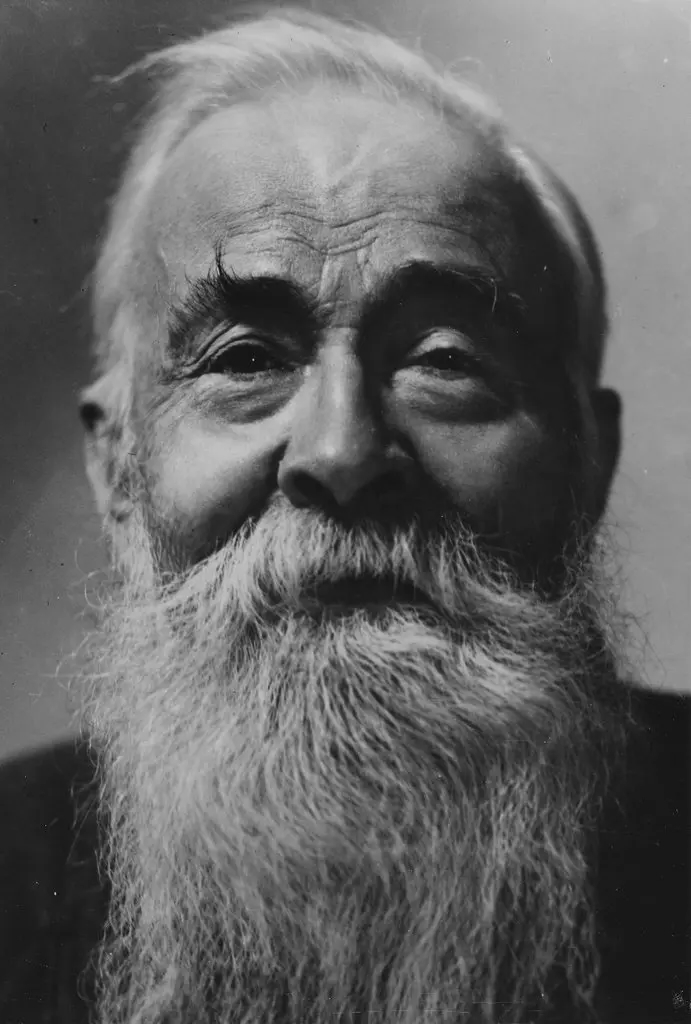
Few foreign residents of China have evoked such strong reactions as Sir Edmund Trelawny Backhouse. Born in England in 1873, and later the inheritor of a baronetcy, his family was landed gentry: his father was a Baronet and a director at Barclays Bank; his brother was an admiral in the British Navy. Edmund went in a different direction: after dropping out of Oxford University due to a supposed mental breakdown, he fled England for China in 1898 — to escape debts or scandal, depending on whom you ask.
Beijing in the early 20th century had become something of a magnet for gay men. Unlike many Western countries, or their colonial offshoots such as Shanghai, in Beijing a gay man could live with less fear of criminal prosecution or moral judgement. From 1898 until his death in 1944, working as a translator and fixer, Backhouse lurked in the hutongs, bathhouses and brothels of Beijing — and, if he is to be believed, in the bedchambers of powerful court officials, including the Empress Dowager herself, during the dying days of the Qing Dynasty.
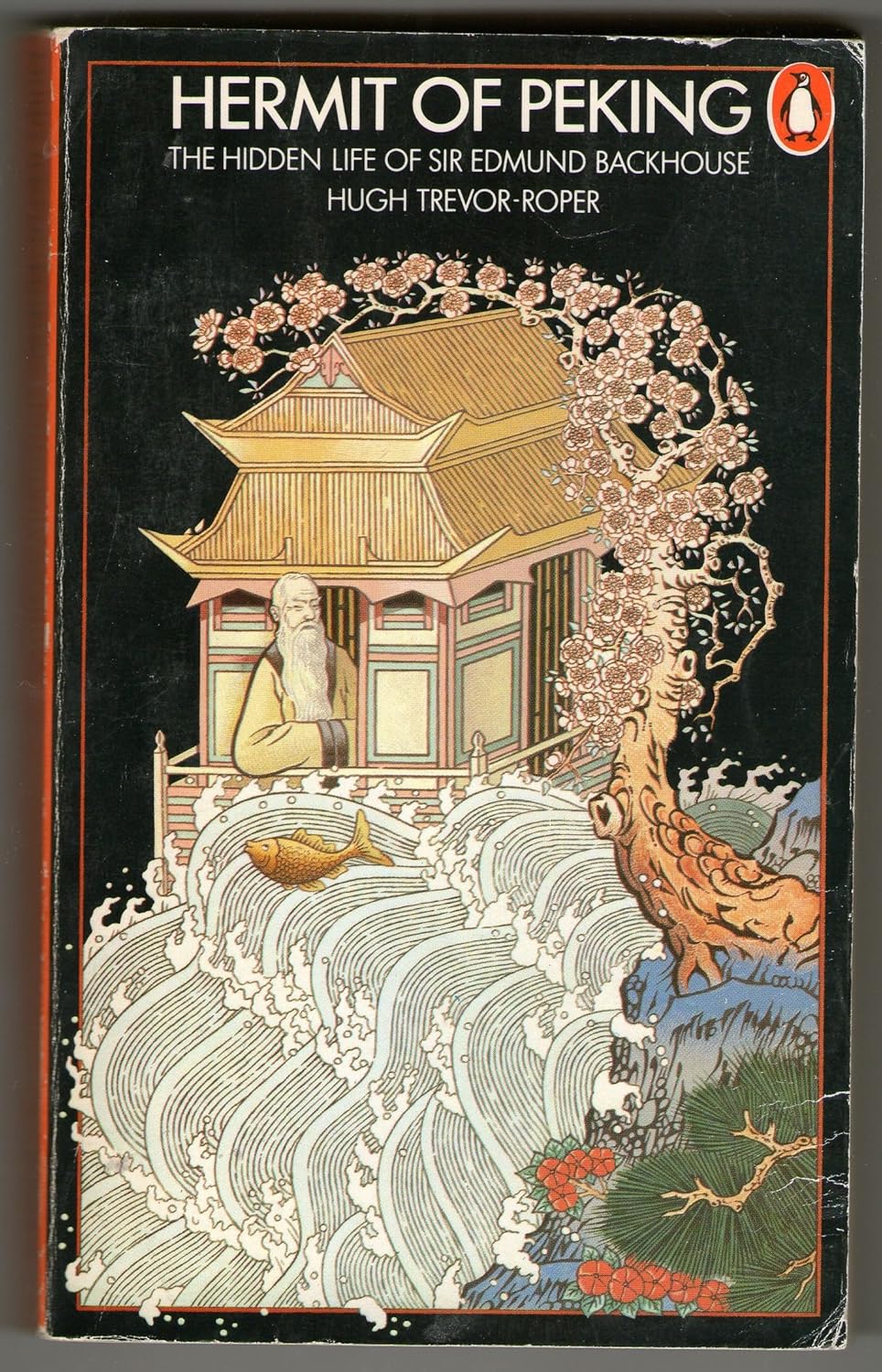
His detractors have labeled Backhouse a swindler, an inveterate fabulist and a not-so-secret fascist sympathizer. The kindest epithet awarded him is generally “eccentric.” Previous biographies, including the once definitive Hermit of Peking (1976) by Hugh Trevor-Roper, have been unkind to Backhouse’s legacy, condemning Sir Edmund as the archetype of a huckster peddling dubious connections to fellow foreigners who he otherwise disdains. These accusations are not necessarily wrong. But the truth, when it comes to Edmund Backhouse, is a fickle and feckless thing, prone to being bent, stretched and sometimes altogether abandoned as exigencies required.
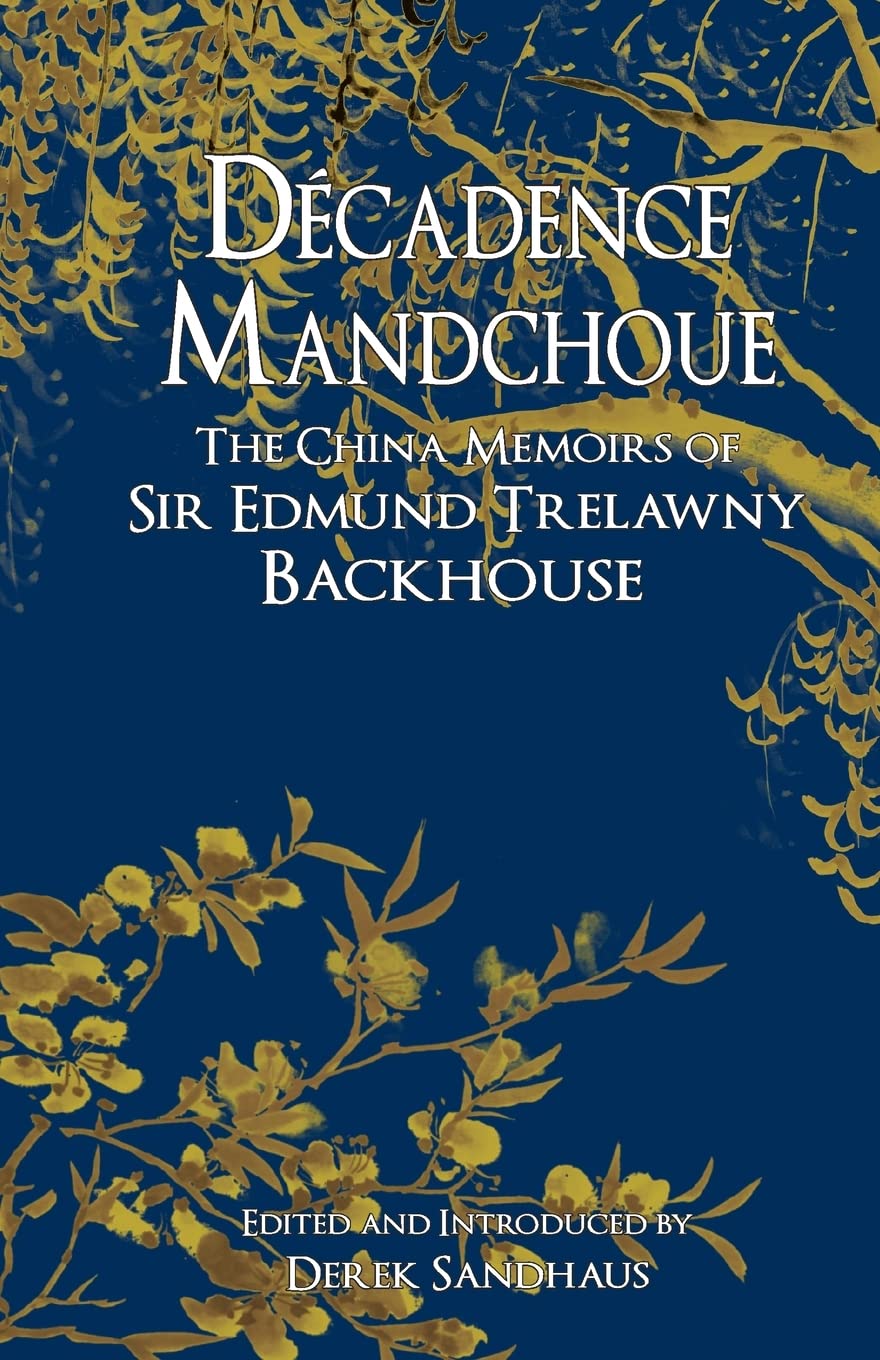
Backhouse is an unreliable witness of his own story. Did the openly gay (and, he wants us to know, enthusiastic bottom) Backhouse really enjoy over 100 nights of inventive sexual gymnastics with the elderly Empress Dowager Cixi? Probably not. But that relationship, and the spectacularly graphic details that Backhouse includes to convince the reader otherwise, are at the core of his memoir Décadence Mandchoue (Earnshaw Books, 2011), which doubles as an attempt to revise the consensus on the end of the Qing.
For those readers who think they’ve seen and done it all in Beijing — or the armchair traveler who assumes one China travelogue is like any other — Backhouse is here to prove you wrong. It is difficult, even allowing for Backhouse’s penchant for hyperbole or invention, to imagine another foreign resident who squeezed the juice out of his time in Beijing more fully, or who wrote about his exploits with such a delightfully lascivious eye for detail.
The story of the manuscript is almost as fascinating as that of its author. In 1943 Edmund Backhouse, then 70 years old, was a penniless ward of the British Legation in Japanese-occupied Beijing, his age and infirmities having spared him internment in a wartime prison camp. He met the Swiss physician Richard Hoeppli, who was amazed by his patient’s stories. With Hoeppli’s assistance, Backhouse produced two volumes of memoirs. The first dealt with Backhouse’s colorful days in England before he escaped to Beijing. The second became Décadence Mandchoue, which Hoeppli kept, unpublished, until he died in 1973. The manuscript came into the possession of British historian Hugh Trevor-Roper, who used it as source material for Hermit of Peking, not believing a word of what Backhouse had written.
But what if Trevor-Roper was wrong? Shouldn’t Backhouse have the last word? This was what motivated the American writer Derek Sandhaus to seek out the original manuscript of Décadence Mandchoue, held at the Bodleian Library in Oxford. For two years Sandhaus, a former resident of Beijing who also wrote two books about China’s drinking culture, examined, transcribed and edited 1,393 pages of manuscript — a third of which were handwritten by Backhouse in the last year of his life, the remainder transcribed by typewriter and lightly edited by Hoeppli. Somehow, Sandhaus wrestled Backhouse’s sprawling memoirs into a coherent narrative. Then he began the Herculean labor of annotation.
Did the openly gay Backhouse really enjoy over 100 nights of inventive sexual gymnastics with the elderly Empress Dowager Cixi? Probably not.
Backhouse was a linguistic prodigy. Born and schooled in the late Victorian era, he was fluent in French, Russian, Latin and Greek, and at various times demonstrated or claimed at least passing knowledge of German, Finnish, Hungarian and Norwegian. In Beijing, he became well-known for his written and spoken Chinese, Manchu and Mongolian, and often worked as a translator and interpreter. The problem is that he never wanted you to forget how smart he was. Almost every page of Décadence Mandchoue comes stuffed with references to French poetry, Russian literature and allusions drawn from the corpus of Latin and Chinese classical culture.
Backhouse often weaponized this erudition to settle scores with former colleagues who had slighted him. In one passage, he describes Sir John Jordan, the British Minister to China, with a barrage of classical Latin:
H.B.M.’s envoy to the Manchu Court, Sir John Jordan, that dauntless libertine who sold consular offices for the price of his staff’s and their wives’ favours, who was, like (in this one respect) the great Julius César, vir omnibus mulieribus et mulier omnibus viris [all things to all men and all women when they met his lusts half-way], princeps et pontifex maximus generis insignissimi pedicantium [sovereign lord and pope of the noble race of sodomites], wrote in 1908 to Sir E. Grey … that I was brilliant in intellect, unbalanced in judgment and amoral in character.
By all other accounts, John Jordan could not have been further from the unhinged libertine described here, while Backhouse’s raving slander does little to debunk Jordan’s assessment of his fellow Briton’s mental state.
All of these linguistic gymnastics are in addition to Backhouse’s rich vocabulary drawn from le boudoir. (See, it’s contagious.) Décadence Mandchoue is a must-read for anyone who is a fan of polyglot porn. The human anatomy, bodily fluids and a dizzying array of sexual positions are described in whatever language Backhouse feels is most suitable for the moment (rarely English). Editor Sandhaus does heroic work translating almost all of it, and his many footnotes are essential to understanding Backhouse’s story. While a few key terms can be inferred from context, the reader is discouraged from skipping the annotations, particularly if they wish to expand their linguistic horizons or their knowledge of what is ballistically possible between two or more naked people in full rut.
Sandhaus’s glosses also include a wealth of historical context about key figures with whom Backhouse and his contemporaries would have been familiar, such as Yuan Shikai, the Guangxu Emperor and Kang Youwei. These historical footnotes are essential, as Backhouse’s goal was less to produce a memoir than to rewrite the history of the final years of the Qing Dynasty from an insider’s perspective. He claims to be on intimate terms with high-ranking members of the imperial clan, and is fond of citing his recollections of private conversations, letters and documents unseen by other foreigners, as well as extended discussions with his friends and lovers.
The result is a counter-narrative that undermines many long-held beliefs, especially by foreigners, about the inner workings of the dynasty. Long before TikTok influencers started live-streaming from Beijing about how they truly understand China, there was Backhouse, the anti-foreigner who despised the Western presence in China almost as much as the Qing court did. In his telling, the Empress Dowager Cixi was not a demonic anti-foreign dragon lady but a Buddhist paragon of kindness who occasionally lost her temper, only xenophobic toward those foreigners who criticized China.
The notorious chief eunuch Li Lianying, arch-villain of countless historical telenovelas, was also a nice guy once you got to know him:
I found him kind-hearted, a loyal friend, generous to a fault, good-natured toward his staff, though he occasionally caused the discipline to be with severity applied to recalcitrant younger eunuchs’ posteriors.
Backhouse’s version of the events that led to the fall of the Qing Dynasty in 1911 had already been published years earlier in two collaborations with British journalist J.O.P. Bland, China Under the Empress Dowager (1910) and Annals & Memoirs of the Court of Peking (1914). While both books were considered authoritative works for years, their credibility has been seriously undermined by recent scholarship demonstrating that many of Backhouse’s sources were either fictional or fraudulent. Much of the information for China Under the Empress Dowager came from a diary purportedly written by a court official named Ching-Shan, conveniently found and translated by Backhouse. The diary was proven to be forged, arguably by Backhouse himself — a debacle that destroyed his reputation as a serious scholar, though the erudition required to forge a convincing Chinese diary is impressive.
And so it is with some trepidation that the student of history reads Décadence Mandchoue. Did members of the imperial court frequent brothels? Undoubtedly. And while it’s far from certain that Backhouse was part of their coupling, his linguistic skills and penchant for frequenting the same establishments used by members of the Qing court and their entourages would suggest that he was privy to a fair amount of court gossip. But at the heart of Backhouse’s memoir is an impossible-to-believe sexual relationship with the ruler of China. The Empress Dowager Cixi was one of the most important, reviled and misunderstood figures of her time. For the Chinese, she is the archetype of a woman in power — capricious, abusive, sexually incontinent. For foreigners, she was the ultimate symbol of a doomed empire: feminized, ignorant, vain, unstable. Backhouse’s graphic recollections draw from similar tropes of sexually salacious female rulers including Catherine the Great, Empress Wu Zetian and Messalina, third wife of the Roman Emperor Claudius.
While the Empress Dowager is portrayed in Décadence Mandchoue as the object of his outlandish sexual fantasies, he also characterizes her as a living, breathing, loving woman, as well as an intelligent and able ruler forced to deal with a court of bumbling princes and a Legation Quarter full of arrogant foreign diplomats and their equally annoying spouses. Cixi is the primary love interest and catalyst for most of the events in the book, their relationship progressing against a backdrop of court intrigue and power politics. The 32-year-old Backhouse begins as an unwilling and insecure paramour, secreted into the 69-year-old Empress Dowager’s bed by a conspiracy of eunuchs:
Guessing what the ‘important business’ might be, I asked myself: was I sexually adequate for Her Majesty’s overflowing carnality? Alas! I doubted it and wondered if I should develop the necessary timely orgasm to meet her unsated lust which would assuredly not have failed me, had another type of love been in question.
Backhouse explains to everyone involved that he is attracted to men, but this only makes him more of a novelty for a bored monarch looking for a replacement after the death of her (rumored) lover, the Manchu official Ronglu. Despite his sexual preferences, Backhouse is kept at the ready through a steady diet of aphrodisiacs and other pharmaceuticals provided by Li Lianying and Cixi’s attendants. The results are fascinating reading if nobody on the airplane is looking over your shoulder:
I gained, all unworthy, Her Majesty’s affections in erotic superabundance. The sexual apparatus of a European … seemed to appeal to her unchaste mind; my bizarre affinities amused her; my homosexuality, amoral, totally uncurbed by ordinary standards, and its concomitant manoeuvres.
Though Décadence Mandchoue is mostly the product of Backhouse’s imagination, it is still worth reading. A story doesn’t have to be literally true to have meaning, or even to be historically accurate. For example, Backhouse claims to have first-hand knowledge of the murder of the Guangxu Emperor in 1908, claiming that the emperor was strangled to death for plotting against Cixi. When Backhouse was writing his memoirs in the 1940s, the untimely death of the Guangxu Emperor at age 37 was still seen as suspicious, but nobody could prove murder. It turns out that Backhouse was mostly right. As Derek Sandhaus notes in his annotations, in 2008 researchers studied the remains of the emperor and found exceptionally high levels of arsenic. The emperor might not have been garroted with a silken cord, but he was definitely done in. (Less likely to be true is Backhouse’s assertion that Cixi was shot to death by Yuan Shikai a day later, a murder he claims to have been an eyewitness to.)
If nothing else, Décadence Mandchoue can be seen as elaborate historical fiction, written by one of the few foreigners to immerse themselves in both Beijing’s official court life and its equally colorful demimonde. As he writes:
Memory and imagination; the first counts as nothing without the second which is verily the ode of the agnostic to immortality and gilds old age with the after-glow of youth. These dear phantoms of the past, if they cannot restore happiness to one who moveth in what is certainly not an ampler ether, a diviner air, at least make life easier to be borne. ∎

Jeremiah Jenne is a writer and historian who taught late imperial and modern Chinese history in Beijing for over two decades. He earned his Ph.D. from the University of California, Davis, and is the co-host of the podcast Barbarians at the Gate.