Sign up for our newsletter to be notified of new posts!
Spring reads trend light and hopeful. This selection for China Books Review’s “New China Books” quarterly column does not. The five books I’ve selected below (from our comprehensive listings of recent China books) are an eclectic bunch, but each is a bold sally into the wild plains of Chinese history. Collectively, they show the peril of trying to change the nation, or one’s life inside it. An entertaining narrative of the Warring States period makes antiquity accessible. Internet novels are found to harbor a yearning for popular participation in authoritarianism, and something more subversive. The campaign for Chinese democracy gains a sharp new advocate. A translated memoir tells of factory life. And a collected volume examines China’s enduring enchantment with the world beyond the veil. Thanks for reading, and if you’ve got a spring reading list of your own, drop us a note.
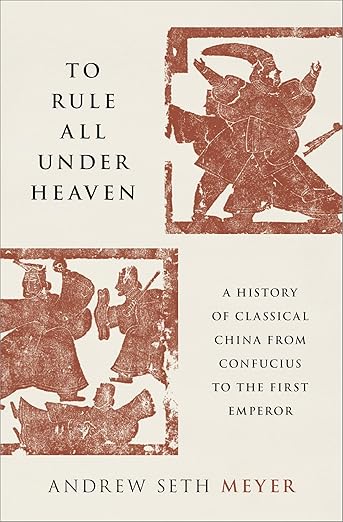
To Rule All Under Heaven
A History of Classical China, from Confucius to the First Emperor
Andrew Seth Meyer has written a deft history of China’s classical age, the Warring States period (481-221 BCE). For two and a half centuries, proto-kingdoms clashed across China’s central plains, while sages — Confucius, Mencius, Zhuangzi — formulated then-radical ideas that would come to define an age. Meyer narrates this history, explaining how competition for the mandate of heaven spurred innovations in statecraft across ritual, bureaucracy, diplomacy, warfare, land management and philosophy. The Warring States period, he holds, was a revolution as consequential as 1776. Thrillseekers will delight in tales wet with blood and guts: a grotesquely-endowed queen’s consort, minced bodies of usurpers, and plenty of grain liquors and splashed brains. At times Meyer stops trusting his readers and reaches for modern analogies to explain the ancient world, as when he digresses on the sovereignty of Kiribati and Kurdistan. Yet To Rule All Under Heaven is a lush read that ends on a harrowing note: Qin Shi Huang’s unification of China as its first emperor. The great river of Chinese history still flows in the channel he carved.
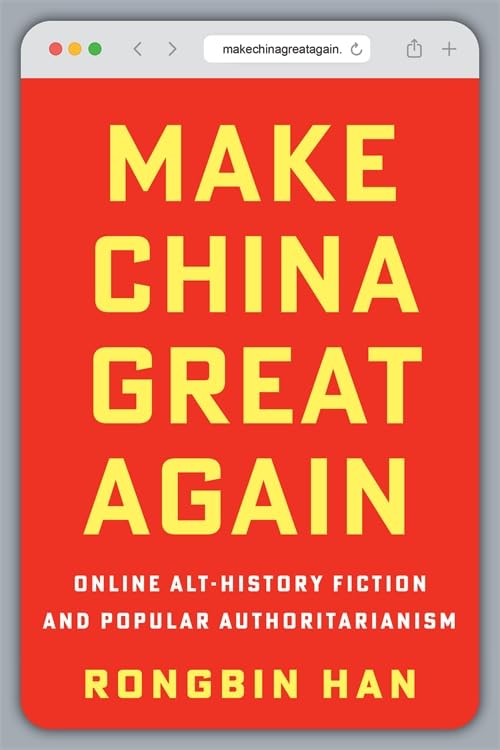
Make China Great Again
Online Alt-History Fiction and Popular Authoritarianism
How would you change the past? Fans of Chinese “alt-history” might use the scientific method and Mao’s guerilla tactics to stave off the Mongols, turning medieval China into an industrial superpower. Make China Great Again is a study of nationalist internet novels by Rongbin Han, a leading scholar of China’s web culture. Since the 1990s, patriotic stories of Chinese revival led by time-travelers have earned tens of millions of readers online, despite being baggy hundred-chapter monsters. The novels are, essentially, elaborate domination fantasies rife with ethnic chauvinism. (Han tells of a riled-up reader slapping a historian of the Manchus at a book signing.) Intriguingly, Han observes that these online alt-histories belie the claim that the Party alone can save China. In writers’ imaginations, a lone hero with a gun and a time-machine can spare China the humiliations of history. Bushwhack through Han’s tangled academic prose and find sharp insight into the debate over whether China could have taken a different path, or if it yet might.
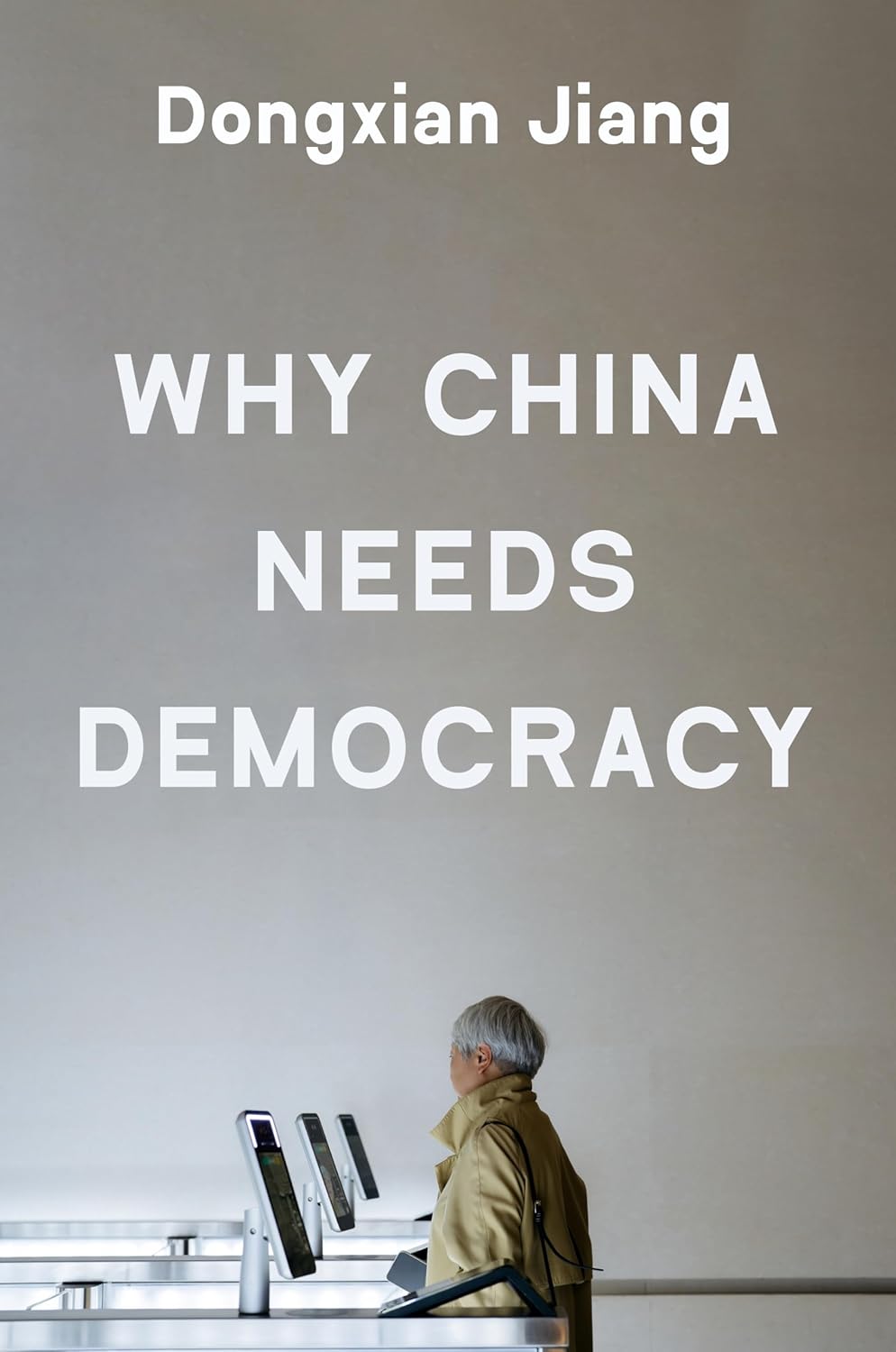
Why China Needs Democracy
Dongxian Jiang believes he knows the path China should take: democracy. Prominent voices such as Adam Tooze have called today’s China a “master key” to modernity. This book is a lifeline for skeptics of that conclusion. Jiang, a Princeton-trained political theorist, acknowledges China’s remarkable economic development under the Party while arguing that this very success has created a society too complex for anything but constitutional democracy. His monograph, a study of the China Model’s viability, notes that experts foreign and domestic encourage limited democratization. But half-measures can hasten collapse. The Party knows this: éminence grise Wang Qishan quotes Tocqueville’s L’Ancien Régime on the danger reform poses to bad governments, according to Jiang. Democracy, he argues, is a bitter pill the Party would be wise to swallow whole. Though Jiang writes as a realist, he occasionally slips into fantasy, as when he muses that the Party might require “psychotherapeutic intervention” to entertain his proposals. Fat chance. Why China Needs Democracy survives such stumbles because it is not predictive. Instead, it makes a case for one person, one vote.
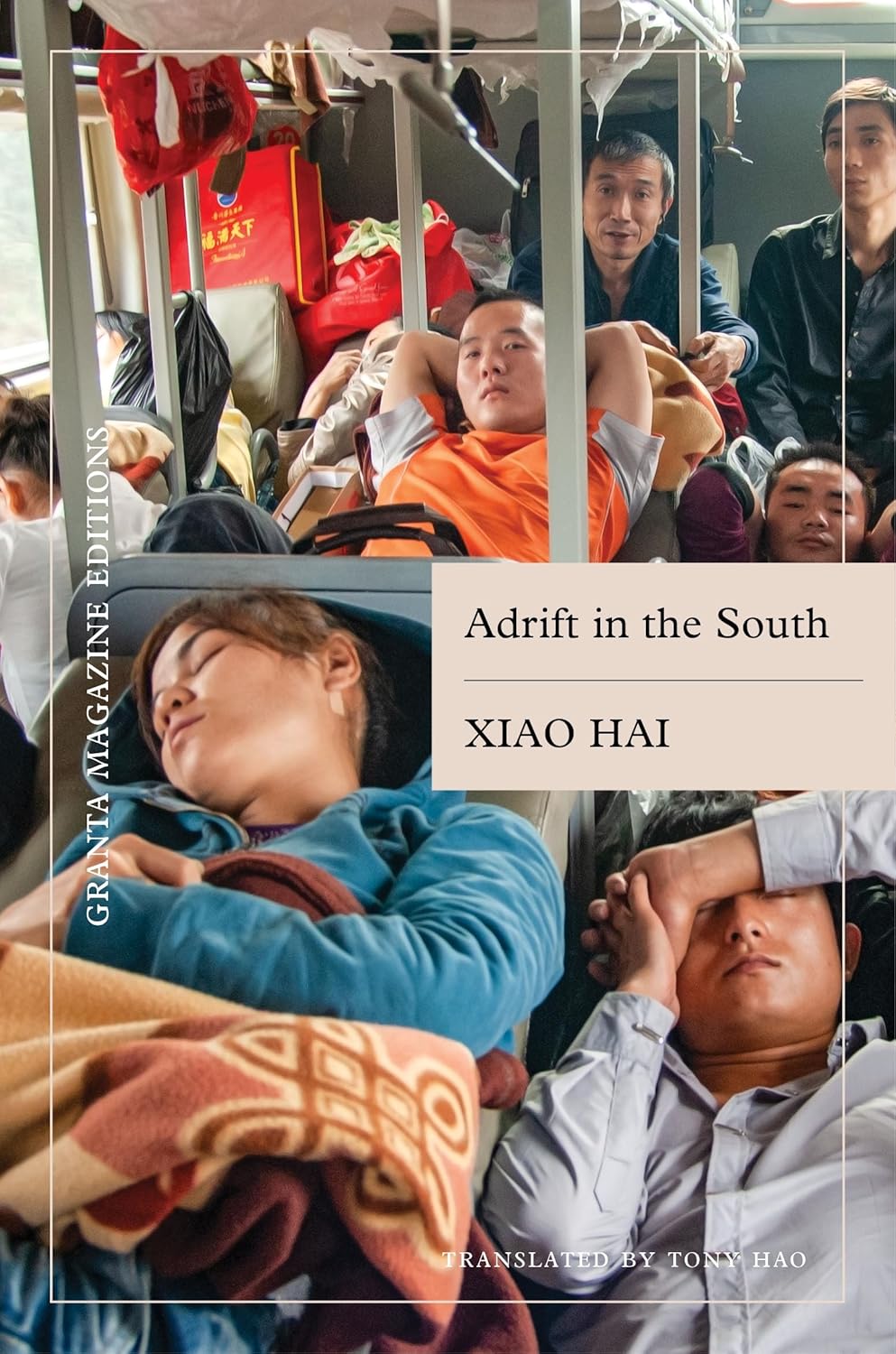
Adrift in the South
Then, there is the path China did take: the helter skelter modernization of Reform and Opening. Artists and writers — such as the author of this volume, Xiao Hai, born in 1987 — toiled for years on factory floors, creating for China the wealth they fantasized about sharing in. Adrift in the South, a memoir of Xiao Hai’s life on and off the assembly line, is a snapshot of that era. We follow him through industrial parks and worker dormitories (where he squirrels losing lottery tickets under his mattress) all the way to Picun, the migrant-worker-artist colony on the outskirts of Beijing where his talent is recognized and polished. Where last year’s workers’ memoir I Deliver Parcels in Beijing was optimistic to the point of dopiness, Adrift in the South is grim. Buildings shrivel, garlic harvests disappoint, lovers split. In Xiao Hai’s world, even the dictionaries are pirated. Though acclaim for the genre is overwrought, this work of workers’ literature has a poetic flow thanks to Tony Hao’s liquid translation.
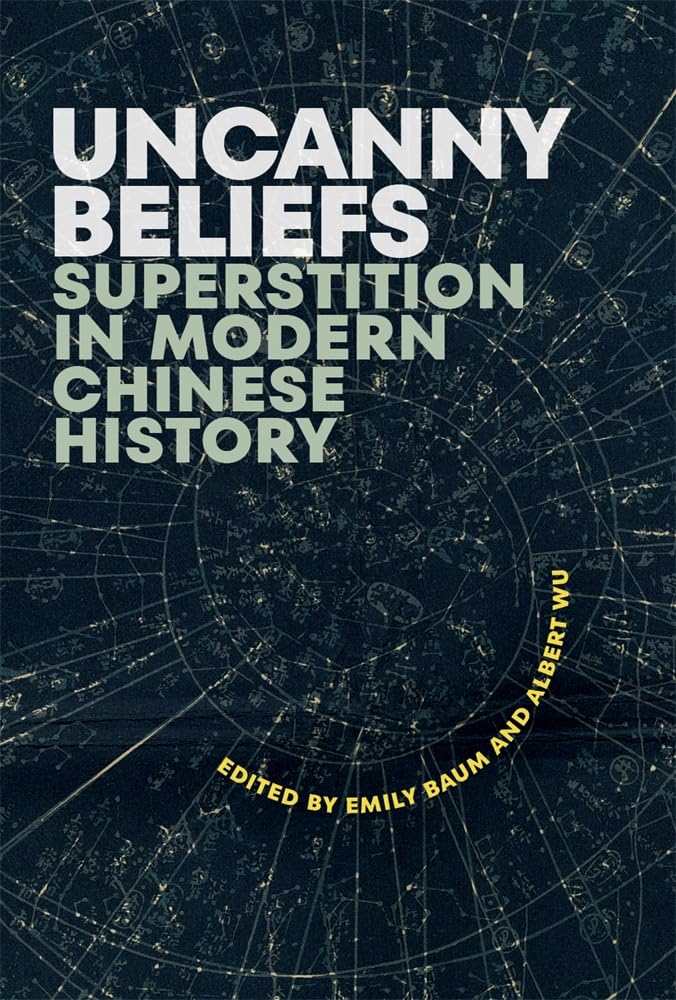
Uncanny Beliefs
Superstition in Modern Chinese History
A spectre haunts China — the spectre of superstition. An unholy alliance of modernizers spanning Liang Qichao to Xi Jinping have tried to stamp it out, but the nation remains enchanted with the spirit world. This volume of collected essays covers the occult in China from 1850 to today, as well as efforts during the Qing, Republican and Communist eras to tame it. We learn about vampirism in the Shanghai “jazz age,” spirit writing, mediums, tomb-raiding and semi-Daoist temple gods. Uncanny Beliefs shines when it explores the crannies of history, like the 1950s “miracle water” craze that saw peasants and cadres abandon their fields and posts to seek riparian healing; or the story of a cadre with imposter syndrome expelled from the Party after turning to Daoist rituals to bolster her confidence. Collected volumes share the same foibles (patchy voice, a snoozy essay or two) but the best ones leave a reader wanting more. That bar is amply cleared here, and the collection is as relevant to today as to the past. China’s disillusioned youth have recently taken to burning incense in hopes of a better tomorrow. Will anyone, or anything, listen to their prayers? ∎

Alexander Boyd is Associate Editor of China Books Review. He served as a Peace Corps volunteer in Guizhou, China, from 2018-20, and was a contributor to The China Project, Politico and the ChinaTalk podcast. He was previously Senior Editor at China Digital Times.