Sign up for our newsletter to be notified of new posts!
You’re the leader of a large country, pushing 80. You can look back on a handful of failed marriages, questionable friendships and a few spectacular public failures. Your rise to power was fueled by a potent cocktail of ambition, ruthlessness and the need to escape a voice in your head telling you that no matter how many people worship and idolize you, none of them will be your father.
They worship you because if you are wrong, then they are wrong. And if they are wrong, then the last decade or more of their lives will have lost all meaning. This is good for you, less so for the country, and disastrous for anyone who works for you. You have purged everyone in your government who refused to bow and scrape. Now your circle is reduced to flunkies whose political future — indeed, their ability to avoid some very public trials of retribution — is tied to your physical well-being and your staying in power. And in the corner the whole time has been your personal physician, quietly observing the drama as it unfolds, and taking notes.
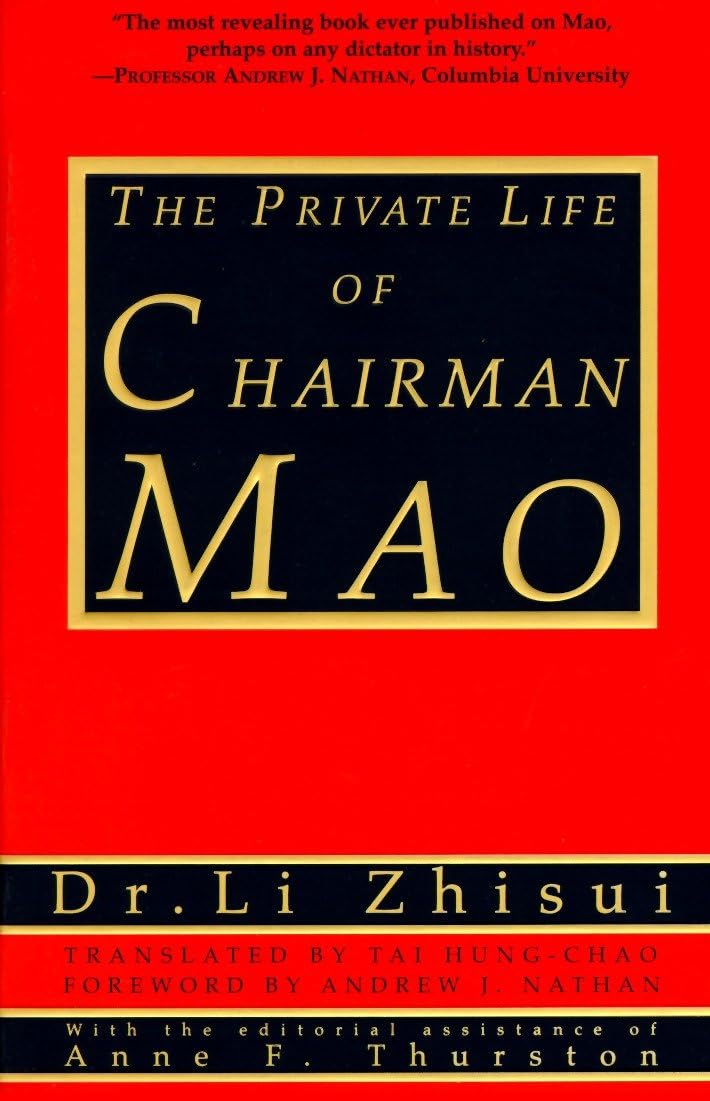
Li Zhisui served as Mao Zedong’s doctor for 22 years. Dr. Li kept careful diaries of his interactions with Mao, but later claimed to have burned them in a panic. In the dark and tumultuous denouement of the Chairman’s Cultural Revolution, possession of such incriminating documents would have been a one-way ticket to giving proctological examinations to pigs in Gansu province. Fortunately for students of Chinese history, he was able to reconstruct his notes from memory. The result is The Private Life of Chairman Mao (1994), a tell-all story of the Chinese leader’s personal life as told by his trusted confidant.
Books about Mao Zedong are never just about Mao Zedong. Reviews of books about Mao are usually even less about Mao. From Edgar Snow to Stuart Schram, Jung Chang to Philip Short, every Mao biography has its champions and its detractors. Knives are drawn before the first page is turned; which side you’re on often depends on the Mao you brought to the bookstore. Diabolical monster or misunderstood patriot? Narcissist or nihilist? Innovative Marxist or “ideological turnip”? (Red on the outside, white on the inside — Stalin’s preferred nickname for Mao.)
Li Zhisui deftly sidesteps these debates by making the book mostly about himself. He has been rightly criticized for exaggerating the extent of his access, and it is great fun to watch him insert himself into almost every important moment in the early history of the PRC. Take the founding of the Republic in October 1949, which he somehow makes about himself:
I had no doubt that Mao was the great leader of the revolution, the maker of a new Chinese history. Though I was standing so near him, he still seemed very far away. I was only an ordinary doctor and he was the great revolutionary leader of the People’s Republic of China. Never in my wildest imagination, standing in Tiananmen that day, could I have suspected that soon I would become his personal physician, the director of his medical team, that I would be with him for twenty-two years and present at his death.
By the end of the book, you get the sense that Li Zhisui is a kind of Socialist Flashman, well aware of his own lack of moral backbone and charmingly surprised each time he finds himself at the center of a major moment in history. Eighth Party Congress and the start of the Anti-Rightist movement? Check. Lin Biao Affair? Check. Lurking just outside the door as Mao met Richard Nixon? Sure, why not.
If Dr. Li played fast and loose with his integrity, perhaps it was because his class background made his position precarious. He was born into a family of elite physicians in Beijing. Family legend has it that his great-granddad was called to the Forbidden City to determine the cause of death of the young Tongzhi Emperor. Granddaddy Li said “syphilis,” but the boy’s mother, Empress Dowager Cixi, insisted on “smallpox” and had him stripped of his rank. Before he died, he forbade any of his descendants from ever serving in the imperial court — an edict that held until Dr. Li went to work for Mao.
It didn’t help his political dossier that Li Zhisui was educated at an American missionary school in China, served a spell in the KMT youth brigade and was working in Australia when the call came that China needed patriotic physicians. Dr. Li’s wife was in an even more delicate situation, having been employed by the British Council, among other similarly sinister imperialist agencies, prior to marrying the good doctor.
Books about Mao Zedong are never just about Mao Zedong. Reviews of books about Mao are usually even less about Mao.
While Li’s background is fascinating, the reality is that most people read this book for its chronicles of Mao’s medical curiosities. His love of British 555 cigarettes. His undescended testicle. His penchant for nubile young women, kissing them with a mouth so foul that the slightest pressure on a tooth caused it to wobble and ooze pus. The meetings he held while sprawled naked in bed. His odd working hours. His barbiturate addiction, fatty pork addiction, nicotine addiction and all of the other sordid details of an elderly man with staggeringly bad impulse control and nobody to tell him he needs to wash his undercarriage.
All of that and more is in Dr. Li’s book, including a memorable opening scene where he attempts to embalm Mao’s corpse shortly after his boss’s death in 1976. (I won’t spoil it, but imagine what happens when you overfill a pliable body with too many liters of a volatile preservative.) How much of all this is true is a matter of some debate, but I’m more disposed to believe Dr. Li when he’s talking about Mao’s problematic foreskin than to trust his opinion on Mao’s relationship with Stalin.
The story of how and why Dr. Li published his memoir is almost as murky as Mao’s urine samples. Flash forward to the 1980s. Dr. Li is living in Illinois, close to his two sons, who both immigrated to the Chicago area. He’s relatively safe from political reprisals, and has the time to recreate, from memory, his lost journals and diaries. The result is a manuscript that requires extensive work — first translated by Tai Hung-chao, then edited by Anne Thurston and others before being released by Random House in October 1994.
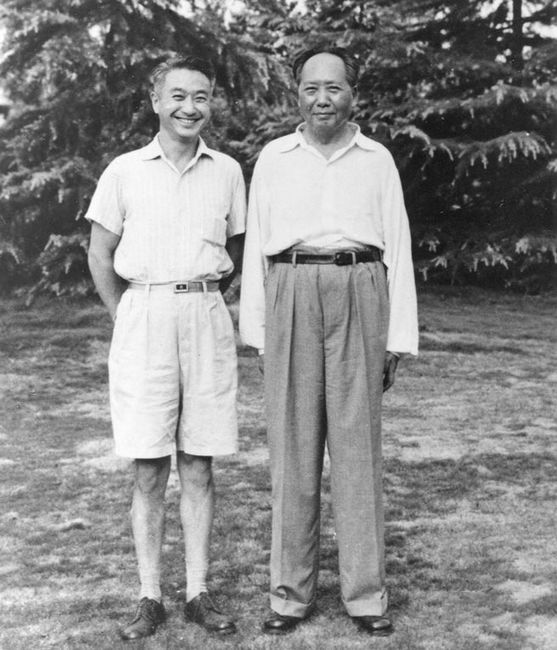
Almost immediately scholars, partisans and patriots began lining up to pick holes in the memoir, especially as Dr. Li passed away four months after its publication and was no longer around to defend himself. The questions were not really about the big political stuff. Li’s rather banal “insider” takes on major historical events offered little insight, even in 1994. His account tracks the documentary record so well that Frederick Teiwes, the Sydney-based specialist on CCP elite politics who gave the book its most thorough academic colonoscopy, said he could only find one piece of genuinely new political information in all of its 682 pages: Mao’s reported handing of the succession to Zhou Enlai in January 1972.
Instead, it is the sex stuff in the book that has been catnip for critics. I have a personal story about this: For many years, I taught a Modern Chinese History class at a program for international students in China that included the occasional Chinese student. One of the films I showed in class was a documentary about the Chinese revolution featuring oral histories of political hardship, deprivation, famines, killings and purges. None of the students batted so much as an eyelash. But when Dr. Li appeared on screen and talked about Mao “resting with young girls” during dance parties in the leadership compound of Zhongnanhai, one of my Chinese students all but dissociated. Great Leap Forward. No problem. Cultural Revolution. Whatever. Tank Man. Meh. But Marx forbid a class film suggest that Mao was some sort of lecherous old man who used his power to seduce women.
Honestly, the sex parties are the most believable thing about Dr. Li’s book. As recent events and a few thousand semi-redacted government files attest, old men will always trade power for sex with much younger people. Mao just did so with a cultural fluency and flair not found even in the visitors to Jeffrey Epstein’s island. As Li writes:
Mao often gave them the Daoist sex manual, Classic of the Plain Girl’s Secret Way, and asked them to read it in preparation for their trysts. The text, written in classical Chinese, was difficult to read and there were many ideographs the young women did not understand. They would question me about the meaning, and over the years, I learned the Daoist text well.
Anne Thurston, a brilliant scholar who spent two years hammering this book into shape, was daringly honest about the original manuscript that landed on her desk. It was, according to Thurston, a fragmentary mess without the usual things that sell memoirs: chronology, context and a story that has some relationship to the truth. Her process was less editing a book and more rearranging a box of notecards into a plausible story. She had to make choices, and not everyone was happy with how she made them. Meanwhile, the original translator of the memoir, Tai Hung-chao, suggested that Random House forced the production team to emphasize (some Mao partisans might say “invent”) juicier material to push sales. Li himself admitted that the Chinese edition of his book wasn’t his writing but a translation back into Chinese of the English-language version assembled by Thurston.
Naturally, Li’s book is aggressively banned in China, although pirated copies were discreetly available back when books for sale on street carts was still a thing. There was a semi-choreographed rebuttal in the Chinese state media of Dr. Li’s more shocking claims. Mao’s secretary Lin Ke, another member of the medical staff Xu Tao, and Mao’s nurse Wu Xujun all signed a document saying that Dr. Li either lied or misremembered. They claimed, among other things, that he didn’t get the job until 1957 (Li says he was named to the post in 1954). The discrepancy matters because some of the major events Li describes with a confidence that would make ChatGPT blush occurred in the gap.
Given these questions over its veracity, why should you read Dr. Li’s memoir? Because while it’s not a perfect book, it’s the only one like it. How many people who lived and worked at the heart of the Chinese government wrote a memoir of what it took to survive in that environment? Li’s account of lurking in the courtyards of Zhongnanhai, dodging the moods of Mao’s wife Jiang Qing and the calculations of other Party officials, all while keeping Patient #1 alive, is a story few others could have written. ∎
Jeremiah Jenne is a writer and historian who taught late imperial and modern Chinese history in Beijing for over two decades. He earned his Ph.D. from the University of California, Davis, and is the co-host of the podcast Barbarians at the Gate.