Sign up for our newsletter to be notified of new posts!
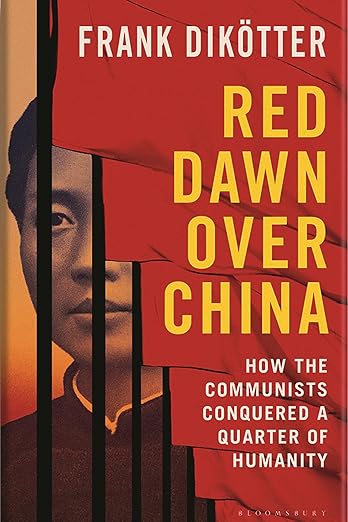
Frank Dikötter’s Red Dawn Over China: How Communism Conquered a Quarter of Humanity (Bloomsbury Publishing, February 2026) is a formidably researched narrative history of the Chinese Communist Party’s (CCP) origins and rise to power (don’t miss our review). The book asks: How did the Party, a group with “roughly the same popular appeal as an obscure religious sect or minor secret society” come to rule China a mere 28 years after it was founded? Dikötter draws on Chinese archives, as well as Russian material from the Comintern, to answer this question. In the process, he flips the Party’s patriotic narratives about the liberation of China upside down, arguing that the CCP’s conquest of China was a product of fanatical determination, unscrupulous tactics and a hefty dose of help from Stalin.
We were delighted to welcome Dikötter to join us for a book talk at Asia Society, moderated by Orville Schell. They discussed the CCP’s struggles against the Kuomintang, their support from the Soviets, and their tactics against the Japanese in World War II. Watch the video, and read a transcript of the event below:
Every dictatorship portrays itself as a democracy. The dictatorship is there to protect the majority from an insidious small number of people — referred to, for instance, as capitalists, or bourgeois, or outsiders.
Frank Dikötter
Speakers

Frank Dikötter is a historian of modern China. He is a Senior Fellow at the Hoover Institution, Stanford University, and Chair Professor of Humanities at the University of Hong Kong. His books include Mao’s Great Famine (2010), The Tragedy of Liberation (2013), The Cultural Revolution (2016) and China After Mao (2022). His latest book is Red Dawn Over China (2026).
Orville Schell is the Arthur Ross Director of the Center on U.S.-China Relations at Asia Society, and co-publisher of the China Books Review. He is a former Professor and Dean at the University of California, Berkeley, and author of over ten books about China. He is a regular contributor to The New York Review of Books, The New Yorker, Foreign Affairs and other publications, and has traveled widely in China since the 1970s.
Transcript
The following is an unedited AI transcription; there may be discrepancies with the video.
Orville Schell: We’re really in for a great treat. Frank has done something quite unusual. He has not just written one or two books about China — he’s actually done a survey of modern Chinese history, the 20th century and the 21st century, and given it a very different gloss than the ones that most of us grew up with. So this makes it a kind of very interesting odyssey through all of his works, and we’ll get into why it’s different. So let’s maybe start by having you, Frank — and welcome — tell us, what are you up to?
Frank Dikötter: Should I just go through the book roughly in about 10 minutes?
I would say just tell us what you think you’re doing with all of these books. What do you have to tell us that’s new and worth our paying attention to? And we’ll only take, let’s say, 7 to 10 minutes. So go.
Okay, great. Well, it should really start with what I was up to in December 2019, when of course I had already published a trilogy of books. I went to live in Hong Kong in 2006. One reason was that the archives were opening up — communist archives. I was in there like a ferret. There’s so much stuff you could find, so exciting. Produced one book after the other — three, as a matter of fact. That wasn’t enough. Went on with a book called China After Mao, sort of a sequel.
And here I am, December 2019. I depend on the archives. It’s my bloodline. And on the way back to Hong Kong, I hear a lot of people cough on that plane. It didn’t sound too healthy, honestly. Of course, a few months later, the border is closed. Hong Kong is locked off. I depend on my sources. I’m an evidence-driven historian — as opposed to someone who’s driven by, say, ideology or ideas, never mind theory. I like facts. I like facts. I like discovering them and putting them on the table. You might think all historians do that. It’s not necessarily the case.
Now I’m cut off from the facts. What am I going to do? Here I am in Hong Kong. So I thought, could I do a prequel to my trilogy? The trilogy really took the entire period under Mao, plus a sequel brings it up to that last man in a suit with dyed black hair — I think his name is Mr. C. My wife calls him Mr. X. Anyway, I thought, can I do a prequel from 1921, when there are 12 chaps in a room and somehow they manage to conquer a quarter of humanity by 1949? The Republican era — wonderful period, but on what basis?
Ferreting around the libraries in Hong Kong, I discovered about 300 volumes that had been published in the 1980s, all the way up till 1989. I forgot what happened in ’89 — must have been tanks or so, some 200 of them, crushing the population in Beijing. Anyway, some 300 volumes published by the central archives in collaboration with provincial archives. Pretty much any scrap of paper left behind by a local branch of the Communist Party from 1921 onwards can be found in them. Fascinating. Can’t say I read all those volumes myself — my students were helping. They too were locked up in Hong Kong. They too were keen to do something.
And something extraordinary comes out of all that material, namely — very briefly — that there are a huge number of documents that talk about how some party branches in the 1920s and ’30s don’t really exist. How the young men and young women — very few of them — in Shandong province, the size of France, 20 female Communist Party members in the 1930s — how they are actually more interested in dating each other than in reading the classics of Marxism-Leninism. How in entire provinces they’re barely more than a few thousand of them. What is crystal clear is that this is not a very successful party.
Let me just give you a few numbers — the numbers we do know. It is very clear. 1921, foundation of the Communist Party of China. 12 chaps in a room, organized by a Dutchman. I’m Dutch; I’m not proud of it. But they were squabbling so much, it took the Communist International — established in 1919 in Moscow, an organization there to promote world revolution and overthrow so-called bourgeois governments — it takes envoys, emissaries from the Comintern, to organize them into a party. They represent about 50 people by 1923. Stalin, who will start funding the Nationalist Party, comes up with a sort of Trojan horse ploy where communists are allowed inside the ranks of the Nationalist Party.
By 1936 — I have to go very fast — some 15 years later, at the end of the so-called Long March, which is a long, headlong sort of escape, there are about 40,000 followers of communism in this country of half a billion people. That’s like — what — 12,000 or so in Salazar’s Portugal. Under Salazar, 1934, about one person out of 280 in the population is a communist, as opposed to one in about 12,000 in China. By 1940, according to that very same Comintern, if we are to believe the figures, one in 1,000 people in China is a follower of communism, which is roughly the same number as you have in the United States of America — followers of communism. There’s something like an American communist party, the Communist Party of the United States —
I think it still exists.
It still exists. But all one can say is that it’s not exactly a leader of the international revolutionary movement. So China was on a par there. So what happened? Very quickly: from ’21 all the way through, communism manages to survive time and again, despite all sorts of difficult moments, thanks to Moscow — funding, money, munitions, military advisers from Moscow. Time and again Stalin intervenes — he appears in no fewer than 69 pages in the book — and saves them. So what happens in 1945? If the communists were so incredibly weak that they represent no more than, say, a religious sect in some province, how did they manage to prevail? Not even by ’45 are they anywhere truly significant.
Well, it’s a good question. That’s a very good question.
Except, of course, that you’re not going to ask that question when it comes to Poland. You’re not going to ask me, why did Poland become communist in 1945? Why was Germany divided into a Western Germany and an Eastern Germany, and Eastern Germany was communist? Is there something in Eastern German culture there, some predisposition, some social conditions? No. In fact, they tried revolution in Germany — 1923, didn’t go too well.
The point is, the Red Army invades Europe, and a million soldiers, pretty much equipped and paid for by Lend-Lease material from the United States, take over Manchuria — a region the size of the United Kingdom and France combined. Huge, and strategically very important. They stay there. They hand over the countryside to the communists. They build them up. They established 16 armies, artillery, aircraft. They sent officers to Moscow for advanced training. Trainload after trainload of military equipment arrives, even as the Americans impose an arms embargo in 1946. So that really is the true tipping moment — 1946-47 — the Soviet Union arms the communists, and the Republic of China, the central government, has to rebuild a country the size of Europe, which is in rubble, without very much support at all. So at that moment you can see the communists prevail.
One reason for that is not just the gun. Mao said it very nicely: power grows out of the barrel of a gun. It’s also how that gun is actually used — what one is willing to do with the gun. And what they are willing to do I refer to as unrestricted warfare. You can read telegrams — they’re still there in the archives in Taipei — where in Changchun the soldiers are demoralized for having to shoot at unarmed villagers who were sent in one wave after the other onto the troops of the central government. There’s also the use of barrier troops, something that goes back to Trotsky. Barrier troops are troops behind the soldiers — if you’re a soldier and you move forward, you might manage to escape; if you turn around, you go back, you get shot, definitely. So it’s an incentive to move forward.
But most of all, the willingness of the communists to encircle and starve cities to death. We’ve all learned, we’ve all heard of Leningrad. We all know a great deal about Stalingrad. But Changchun somehow is still a sort of vague memory — even though Lin Biao very clearly gave the command and turned Changchun into a city of death in 1948. He surrounds that city for five months. 160,000 people die of disease and famine. Once Changchun falls, other cities follow. The man in charge of Beijing is not willing to see that ancient capital undergo the same fate as Changchun. Bit by bit, these cities fall. By 1949, the red flag goes up over the Forbidden City. I hope it was not more than seven minutes — I did my best.
So, in your telling of Chinese history — I think many people, particularly of an older age, grew up with a much more idealized version of the Communist Party as at least cleaner, less corrupt than the Republican, the Guomindang, the Nationalists. And your version is that there was a certain amount of deception that went on — that what actually allowed the Communist Party to prevail in China was that they were willing to be realistic, violent, surreptitious, underhanded, and above all to ally with their ally, the Soviet Union. Let me read you something you wrote and let you comment on it: “They excelled in a very traditional pursuit of power” — this is the Chinese Communist Party — “prevailing over their opponents through the immoral application of military strategy. Feign, lie, deceive, retreat, hit, run, sabotage; view everything as a means to achieving an end.” Now, where’s the idealism in that?
Well, the idealism is like the lodestar beckoning ahead. The idealism is that great society where all are equal. And that is pretty much the end that precisely justifies all the means there — all the means I listed: cheat, deceive, undermine, you name it. And beyond that, I think there’s just an extraordinary determination to prevail at all cost. But most of all, what matters so much in the 1920s and ’30s is, time and again, the backing of the Soviet Union. This is not a secret. We know about this. The histories that were written in the ’50s and ’60s and ’70s know perfectly well who all those Comintern envoys were.
So describe the Comintern a little, and what their role was. How did Russia reach out with these tentacles around the world to foment revolution, particularly in China — because this is an important element of your writing.
It is. Communist International, abbreviated as Comintern, established in 1919 in Moscow. The idea is, of course, to spread revolution worldwide, fight the bourgeois capitalist class. So the first target really is Germany — red Germany would be wonderful — but it collapses in 1923. From that moment onwards, 1923 is very interesting: it is the moment where the Russians agree to fund the Nationalist Party, which is not a rival. I think the literature constantly describes Chiang Kai-shek and the Nationalists as rivals to the communists, as if the 1920s and ’30s are some sort of fight between these two opposite parties. But there’s no such thing — absolutely no such thing. The Nationalists are established in 1912, after the collapse of the Qing Empire. They wish to unify the country through a northern military march, which they manage to do in 1928. They are the universally recognized Republic of China. They represent a great many people. They have an army of several million, whereas the communists are really merely tens of thousands, wandering around the wilderness from 1927 onwards until at least 1940. So there’s no equivalence there.
But the point is that, despite that, the Soviet Union puts a huge emphasis on continuing to support the communists, even when that united front between the Nationalists and the communists — engineered by Moscow — collapses in 1927. So time and again there is money. This United Front collapses in 1927; here comes Heinz Neumann, a German sent by Stalin, and he travels literally from Shanghai to the south, to Guangzhou, to foment a rebellion, with a suitcase full of money. And it’s important for Stalin that this uprising happens rapidly — and it does. It does, in the uprising in Guangzhou, 1927. Just a very small little detail — but the book goes on and on with many other examples. This uprising, in a city of some 270,000 workers, hundreds of unions, attracts precisely 3,000 workers. So this great idea of a proletarian revolution fails to somehow attract a proletariat. These 3,000 people burn down the entire center of the city, kill several hundred policemen, and then, of course, local armies return to the city and exterminate a great many of them, including innocent people — the height of violence on both sides.
But time and again this communist revolution fails. It’s encapsulated, I think, quite nicely by a saying of Mao — the man’s got a great gift for pithy sentences — and this one comes from the 5th of January, 1930, and I’m sure many of you have heard of it: “A single spark can set the prairie alight.” To me, it’s the most fundamental insight: a single spark can set the prairie alight. It means that revolution is just about to happen. All the social conditions are there. It’s just a few reactionaries, representatives of the bourgeoisie, who stand in the way of that revolution. That spark is the violence that will remove them. And once they’re removed, the masses will lead all the way to an overthrow of the old regime.
And yet, Frank, I have to say — this notion that there is something about communism that is spark-like, that does animate people, that does start a revolution — and yet in your description of this revolution (and it’s a necessary corrective, but some people might think it’s too excessive), you put the preponderance of the responsibility for keeping this revolution going on an exogenous force, on Moscow. So I’m curious — if you look at both of these sides — where did all the tenacity in China come from? What made people believe that this spark could light a prairie fire? Because, as America well knows, when the CIA starts to foment a revolution, it doesn’t always work out very well.
Indeed. But you’ve got to remember, this is a small number of people who believe in the communist cause. By 1936 they have a very little audience. They’ve lost the workers, for starters. After 1927 the central government passes legislation to help workers — in fact, the proportion of workers is greater in the Nationalist Party than in the Communist Party, about more than 30%. And they’ve lost what the communists refer to as the peasants — in other words, the villages.
And describe how they lost them, in the ’20s and ’30s — the kind of level of violence in villages against ordinary people and landlords.
Yes, I’d be happy to talk about that, because so much has been written, book after book, about land reform. So the idea is very appealing, and of course promoted by people like Edgar Snow, who wrote a book called Red Star Over China —
Well, I want to come to that, because that’s a big inflection point — but let’s stick with land reform.
Let’s stick with land reform. It’s a sort of magic term, invoked time and again. We have been told endlessly that a great many villages — referred to disparagingly, I think, as peasants — were impoverished in China, and that by taking land from the rich and giving it to the poor, somehow the communists liberated them and caused a massive following. Now, it sounds absolutely great. The question really is not to say that people weren’t impoverished in the countryside in China — but they were equally impoverished in pretty much all of Africa and all of South Asia. In fact, under Mussolini, by 1934, roughly 30% of Italians live in absolute poverty. So to invoke poverty is not going to help you.
So what is it they do? They take the land from the rich and give it to the poor. It sounds like Robin Hood. It sounds like a tale of David and Goliath, with the sympathy going to the boy with the sling. But what land is that to be taken? The idea comes from Russia. 1861 saw Alexander II free the serfs. What have we got by the time of the Bolshevik Revolution in 1917? We have a landed gentry, a rich aristocracy, the kulaks; and we have a lot of very poor people, very poor serfs who’ve been emancipated but are still poor. But there’s no such equivalent in the case of China. No squires, no barons, no landed aristocracy. Not only that, but when the communists manage, from 1930 onwards, to hold on to a bit of territory, it’s always very small, and invariably up in the hills, along several provincial borders, inhospitable, where people work very hard to eke out a living.
And here come the communists. Now, the communists have to take something from someone — but there’s no one who has anything to be taken. They are already poor. So there are no landlords. What do they do? They take something from people they refer to, in Marxist vocabulary, as rich peasants. Once that has been done, they take it from the so-called middle peasants. Now, you don’t need to be a great genius in economics to know what will happen. By the time the party turns its attention towards people described as middle peasants, not one single villager is willing to produce more than the strict minimum to feed themselves, because they know that any surplus will be extracted mercilessly by the party. This is a machine that needs grain, and it needs cannon fodder.
As Zhang Guotao puts it rather nicely — a man who was in charge of one of those regions controlled by the communists, briefly, for a few years — he says, “We squeezed it like a lemon.” We squeezed it like a lemon. There’s a point where the entire population is so impoverished that communist leaders take them to go and fight other poor villages across the border of the so-called soviet. As one leader puts it, “We behaved like colonizers.” Quote unquote: we behaved like colonizers.
So by the time you reach 1936, the reputation of the communists has preceded them. Villages are not keen. So they’ve lost the workers, they’ve lost the villages, they’ve lost just about everyone else, because they’re so keen on fighting the central government — in other words, the Nationalists. Who comes in? Who helps them? Stalin. What does Stalin say? Stalin says common sense. He says: Japan has invaded your country in 1931, took over all of Manchuria, and in the summer of 1937 invades all of China. You should fight with the Nationalists against the Japanese. Mao is very reluctant — very reluctant — but finally, by the summer of 1936, he realizes, yes, Japan is perceived as the enemy by most people in the Republic of China, and he agrees to come up with the United Front. So it’s not exactly… communism is not exactly an ideal that somehow gets a great deal of support by the middle of the 1930s.
So I want to query you now on this. What happened was, the Communist Party and the Nationalist Party of Chiang Kai-shek were sort of compelled to form a United Front to fight Japan, and many people think Japan gifted China to the Communist Party as a result. Here’s where Chiang Kai-shek — who actually was having a fairly good run during the ’30s in terms of improving development in China and building infrastructure — got captured, surreptitiously, by the Communist Party and forced to sign this United Front.
Yes. He had been fighting the communists and come very close to exterminating them in what he called bandit suppression.
All right. Here’s what you quote Chiang Kai-shek as having said upon being forced to form the second United Front — the first one had failed. He said, after the Xi’an Incident, that he lost the opportunity to eliminate the CCP: “the achievements obtained over the years have been ruined in a single day” — over 10 years.
Over 10 years — excuse me, over 10 years. It’s in his diary. It’s incredibly important. Why does it matter? First of all, there’s no equivalence between these two. But there’s another quotation, and it comes from a man called Stilwell. We all know — those of us familiar with modern Chinese history — that Joseph Stilwell was appointed commander-in-chief of the entire Burma-India-China theater, round about 1943-44. He did not get on well with Chiang Kai-shek — called him all sorts of things, including “peanut,” somehow slightly racist, I think. But nonetheless, the point is, he was a military envoy in the earlier years, and in 1936, over the summer, he writes himself: “This country” — China — “has never been so united without warfare.” So in other words, he praises the Republic of China, the central government, for having gradually united this country by 1936 without any major warfare. That is Stilwell, a great critic of Chiang Kai-shek.
What did Chiang do? He encounters the brute force of Japan in 1928 when, on the northern march, his troops are attacked in Shandong province. He writes in his diary: “The enemy here is Japan, and we must prepare. We must fight them.” Now, how do you fight the Japanese when you know that they’re an overwhelming force? Are you going to just declare, we should fight the Japanese, let’s go and buy weapons abroad, let’s equip our troops to fight them? Of course not. You can’t do that. So you use the communists. You pursue the communists. You allow the communists, during the Long March, to actually escape and enter all those provinces that had not quite been united yet, and then these provinces ask you for your help. You follow them, you impose some measure of national unification. That’s how he does it. He trains his troops by fighting the communists, because he cannot overtly train them to fight Japan. But when he says in his diary that he’s been preparing for 10 years, that’s exactly what he’s been doing. He knows full well that Japan is the enemy. He knows full well that he hasn’t got the clout, the military strength, the degree of national unity required to fight them full-on. He tries to postpone it time and again, and he almost manages, until he is kidnapped in December 1936. The Japanese are not dupes. They realize immediately: this man’s been kidnapped, Moscow came to his rescue, they will now lean towards the Soviet Union; the Soviet Union is of course the enemy of Japan. Japan does not hesitate — half a year later, bang.
But of course, Chiang Kai-shek does say that whereas the Japanese are a disease of the skin, the communists are a disease of the soul. Do you think he gets it right?
Yeah, of course he does. The Japanese came, the Japanese went. But the communists are there. Why? Because they have the backing of the Soviet Union. You’re not just fighting a religious sect with some crazy ideology. You’re not fighting a bunch of bandits. You’re not fighting a group of rebels. You’re fighting a highly armed, disciplined troop who are backed by a major power just across the border. That’s the danger.
It still raises the question of where all the tenacity comes from on the communist side. They must have been animated by some belief that what they were doing was, if not right, at least in their interest. How do you analyze the motivation that kept the communists going through thick and thin?
There is, of course, the vision — which is wonderful, and did inspire a lot of young people. It inspired people around the world, still inspires apparently a great many of them. So that vision is there. But there’s something, I think, much more straightforward — like neighbors who have a dispute, and three generations later they no longer know what the dispute is all about, but they do hate each other. Once you’re in that civil war, once you’ve scorched the earth, once you — as the communists do, from roughly ’27 till ’37, for a good 10 years — you take small towns, you execute local officials, you burn down government buildings, you hold people at ransom, you behave pretty much like the Taiping would have behaved.
And I have to say, when you hear Frank Dikötter say this, he’s not just spinning it out of nothing. In his book, you will find the citations for every village burned, every landlord killed — so that it is not fantasy without fact.
Yes, which is why the book is, unfortunately, a little bit on the long side. There’s a lot going on.
Yeah.
But the point is that they have become outlaws, and it’s difficult to just surrender. At one point they must continue, they must continue. But most of all, that tenacity — if I had to venture just a hypothesis, which is not in the book — I would say it’s that, time and again, you see communist leaders who are actually quite willing to go and fight, for instance, against the Japanese once they have a United Front in 1937. Lin Biao does fight in September 1937. Others are quite keen too. But Mao’s the one who said: no, no, no, you’re not fighting. You pretend to fight, but you hold back. You let the Japanese fight the central government. You hold back. You wait. And when the central government is defeated, you enter that distressed terrain and you occupy it, and you make sure the population follows what you say. He’s a real tough cookie.
Yeah.
So he is tenacious, he is ruthless. But to some extent it really also has to do not just with an ideology, not with the whole historical background, but also with one particular individual.
Okay, let’s get to this individual — namely, Mao Zedong. A critical point is when a person you’ve all heard of, Edgar Snow, a young journalist from Missouri, shows up in Yan’an, where Mao Zedong has gone at the end of the Long March — very remote, very poor place in northwest China. Tell us what Edgar Snow does, and what the lingering effects of that rather extraordinary moment end up being.
It’s not quite Yan’an — I know it’s complicated, so many battles, so many generals, so many names. It’s first Wayaobu and then Bao’an, and later on it becomes Yan’an. But the point is, Edgar Snow travels all the way to that loess plateau in the northwest — very poor — meets the communists, and becomes a mouthpiece for Mao Zedong and the communists. This is Red Star Over China. He writes Red Star Over China and publishes a book which appears in 1937, pretty much rescuing them — as I said earlier, by 1936 there are a mere 40,000 followers of communism in a country of half a billion. But this book really puts them on the map, and portrays them in a sort of romantic vision of people more in tune with the values of the modern age, fighting the good fight, fighting for freedom in the hills. And that message really is quite fundamental.
And now Mao is a kind of romantic leader.
He’s a romantic leader.
Is he a communist or not? That’s a question that many people ponder — Americans in particular, all the way till, what, four years ago or so.
The Americans, of course, described them during the Second World War as agrarian reformers. “Chinese communism is not communism” seems to be a sort of article of faith, which dates, I think, from this particular book. Nixon and Kissinger go to China for the rapprochement; Kissinger describes China not as a communist entity but more as a Confucian entity — which, you know, I haven’t really read Confucius, but confusing, maybe. Tiananmen Square, same story — Bush sends an envoy to reassure Deng Xiaoping these people are not really communist. Bill Clinton promises in 1999-2000, let’s have these people join the WTO, they will become democrats, they will have political reform follow in the wake of economic reform. The communists are always portrayed as not really communist, but democrats waiting to emerge.
But, in fairness, during this period — yes, the communists had muted their rather extremist programs in the ’40s and had proclaimed a New Democracy, which was to damp things down for a while. Now, I wouldn’t call it democracy by any stretch, but it was a practice that did deceive a lot of people into thinking they weren’t quite as violent as perhaps they’d thought before.
Yes. On New Democracy, 1940 — the so-called one-third system, that there can be no more than one-third communists in any local election. Now, if you had the misfortune of growing up under a dictatorship — say, Syria under Assad — then you would have been told that you were the greatest democracy on planet Earth. This is a mistake we make all the time. We think that we are democrats and they are merely dictators. But every dictatorship portrays itself as a democracy. The dictatorship is there to protect the majority from an insidious small number of people, referred to, for instance, as capitalists, or bourgeois, or outsiders — I’ll let you guess what it was in Germany in the 1930s. So this is why, actually, if you read the Constitution of the People’s Republic today, it’s referred to as a “people’s democratic dictatorship.”
It reminds me of George Orwell.
But it’s perfectly logical. So, On New Democracy, published in 1940 by Mao, does attract a lot of believers. This is the moment where that idea of communism and a better China really takes hold. This is where you see tens of thousands of young people — teachers, intellectuals — make their way to Yan’an, where the new society is being built. Now, what is being built from ’42 to ’44? A massive purge, as we know — massive purge. We’re talking some 15,000 people accused of being spies, counterrevolutionaries, god knows what; several thousand executed. And in the meantime, of course, Yan’an, by ’44, is being prepared to showcase to journalists — not Edgar Snow, but others. That becomes a sort of showcase of what communism could be. So that really is Yan’an. That is the promise of democracy. It’s a facade of democracy, but in the background it’s just one purge after another. And communism is the history of purges.
And yet that history, as real as it is, was offset at the time by a gathering sense of skepticism about the democratic bona fides of the Republican government — that it was corrupt, that it couldn’t win a war. And I think my generation came of age and learned that, in a certain sense, maybe the Republican government of Chiang Kai-shek deserved to lose, because it was so reprobate and so corrupt. How do you look back at that now? Do you think that’s an excessive evaluation of their failure, or what do you think?
Well, these journalists had every freedom to travel around so-called free China and Chongqing and criticize the government, but they were not able to set foot in Yan’an until 1944. So, for instance, inflation — “oh, this Republican government is completely corrupt, there’s inflation at every level” — absolutely true, absolutely true. But the inflation in Yan’an is even higher than it is in free China. It is higher. In other words, villages who work under the communists must produce more and sell more for the same amount of money. Inflation is higher. That’s hardly ever noticed by historians. The Japanese produce massive amounts of fake currency in order to aggravate the monetary crisis. The Japanese-controlled areas are also suffering from inflation.
So — corruption? Of course they’re corrupt. Of course they’re corrupt. Who isn’t corrupt in the 1930s or ’40s? Are they more corrupt than the communists? I doubt that very much. It does go pear-shaped after ’45. And I think the reason is quite straightforward. Here you have a central government that’s been holding down several million Japanese soldiers for the Allied powers, and has now to reconstruct a country the size of a European continent without very much help at all. Not only that, but the moment they rebuild the railway, the moment the central government erects a telegraph pole, it gets destroyed by the communists. The communists — all they need to do is wreck, sabotage; the central government has to rebuild and try to rebuild. They have to place troops around major factories to protect them from communist aggression. This is ’45. And then, as you move into ’46, ’47, this whole civil war becomes just impossible to wage.
So yes, they are corrupt, and yes, they seem utterly inefficient. Here’s what — 1950, I think it was ’51 or ’52 — a major American general visits Chiang Kai-shek in Taipei. And he says, “We’re fighting with the United Nations, we’re fighting in Korea, and those troops sent by the People’s Republic, they’re pretty tough — they’ll just send one wave after another, you find it very difficult.” So Chiang Kai-shek looks at him and says, “If you and the entire United Nations find it very difficult now in Korea, what exactly do you think I should have done in 1948?” You just couldn’t — not without help.
How, in the scope of your own life, do you think your views have changed about Chiang Kai-shek and Mao Zedong? Where did you begin your odyssey?
That’s an interesting question. I don’t really have any views.
Well, I wouldn’t say that.
I did read Red Star Over China.
And were you taken by it?
No, I certainly wasn’t. I thought it was an interesting story, but I didn’t quite believe it. At the time, I was a student at the University of Geneva, and I didn’t quite realize that Edgar Snow’s family, including his daughter, were living literally three streets away from where I was. So I was going to university doing history, and Russian and Chinese as a minor, and she was doing Spanish — she is an interpreter. Very close. I read the book and I didn’t quite understand it. I thought it was all a bit too pretty, a bit too difficult to believe. You might believe it maybe in the ’30s and ’40s, but when I was a student, we’re in the 1980s, and communism doesn’t really have a great press. It doesn’t have a great record, right? I was doing Russian history, the Soviet Union — I found it very difficult to believe. My attitude has always been that you should read very widely, but some things are just a bit too… you know, I leave them to the side. It’s a bit like the Taiping, which I mentioned earlier. I never quite believed the story of the Taiping being inspired by Christianity — and their leader claiming he was the brother of Jesus.
Yes.
It turns out, once you start looking at them, they’re really a bunch of — like the Taliban — really, a bunch of savages. They’re a bunch of savages that destroy anything and everything: Confucianism, Daoism, Buddhism, Christianity. They put to the sword entire cities — man, woman, children, elderly — every pig, dog, chicken gets exterminated, except if you join them. Sort of a Genghis Khan method. They were savages.
So do you think, if the Japanese had not attacked, not tried to occupy China, Chiang Kai-shek would have successfully rid the mainland of the communists, and we’d have a very different China?
Well, how hard could it be? There were 40,000 of them in 1936.
Yeah.
But the Japanese did what the communists could never have done. It displaced the central government from all major cities, and then created conditions in which the communists could thrive, in particular in the north of the country. There’s no doubt — in fact, one could go further and hypothesize that, if it had not been for the Xi’an Incident, when Chiang was kidnapped and came out and was forced more or less to come up with the United Front and submit to it… if he had been able to just go on a bit further, it might have been very different.
Might have been very different. And how do you look at the 1930s — that swing period, as the Japanese were coming in, when things were stabilizing, the country had unified? Does that, as you look back on it, seem to have a promise that was destroyed by the double threat of the Japanese invasion and insurrection?
Absolutely. I’m with Joseph Stilwell on that one. By 1936, this country is unified as never before. There’s an endless number of students being sent abroad. They pursue every branch of knowledge, from avionics all the way to zoology. This is a country that embraces the highest standards in every particular field — including prisons, as you know, the highest. They subscribe to more clauses and treaties of the League of Nations than any other country outside of Europe, with the exception, I think, of colonial India. This is a country that is looking forward, and is changing — the Universal Declaration of Human Rights —
Indeed.
Yes. So you can find plenty of misery, of course. But there is a very interesting survey by a professor from [Nanking] University called, um — what’s his name? — I forgot his name — [John Lossing] Buck, I think. I forgot his name, but he surveys some 16,000 villages, and does note that there’s a great degree of immiseration, a great degree of poverty, but does not see villages blame either landlords or excessive taxation for it. But this is an enormously complicated country. It’s incredibly difficult to keep together. But it’s not the China of the 1920s. Or — what are we comparing it to? To Europe in the 1930s? I mentioned Salazar in Portugal. There are other names one could mention. I think I mentioned Mussolini — a third of all Italians, by ’33, ’34, living in absolute poverty. What are we comparing it to? This country has made enormous strides. It’s entered the modern age with relish and a real sense of urgency, and that, I think, matters a great deal.
So, just as a final question — do you look at the communist victory in 1949 as a combination of accidents of history, almost, rather than a compelling movement that convinces people it has merit and will be their salvation?
Yes. There’s a great series of accidents. And the opposite is, of course, that there were social conditions somehow conducive to communism, which liberated hundreds of millions. I think that’s the old story, which I simply don’t buy. It’s accidents — but accidents all along, all along, all along: the invasion of Manchuria, 1931; ’37; the kidnapping in Xi’an; the arrival of a million soldiers across the border from Siberia, 1945; the Americans, who freed the central government. It goes on and on. And the weariness of America and its allies after the war, in terms of supporting the Republican government, because we thought it was corrupt, bankrupt, and its shelf life was over. And the gift — the gift of the Communist Party, in particular Mao, to exploit fortune and misfortune. He’s very good at it. Very good.
All right.
His poetry is also quite nice.
Let’s open it to you. We have C-SPAN here tonight, so please don’t start talking until you get the microphone, and keep the questions short. So, right here.
Audience question: Is the sabotage and cheating and deception that you found in China limited, in your view, to China? Or might a person who focuses on facts the way you do, in a different economy — in a Western economy — find similar sabotage, cheating, and deception in a particular government?
Well, I wouldn’t know, because I like the facts, and I don’t have the facts for other cases. But it’s very clear, again, that in 1919, with the Comintern established to promote worldwide revolution, they do try, time and again, to undermine what they refer to as the capitalist camp. They do their very best — and to some extent you might say that’s still the case today. Although Putin, of course, is not a communist, he does try to exploit every foible in democracies — not to mention the People’s Republic of China. He’s maybe not a communist, but I think it would be fair to say he is a Leninist.
Yes, absolutely. Absolutely. Okay, another question right here, and then we’ll have one right there.
Audience question: Hi Frank, how are you?
Not too bad.
I guess I’m troubled by your mono-variable explanations. I’m a political scientist, and you blame it all — the victory all — on the Soviet Union’s getting involved. Yet you also will admit, as Orville was pushing you, that the Japanese invasion plays a major role in that —
Absolutely.
— pushes the Nationalists out, allows the communists to come in. Going back on historical facts: the Shanghai massacre of 1927 — Mao wanted to pull out of the first United Front, and maybe it’s some different interpretation of history, but as we who study China would argue, that’s the time when Mao wanted to pull out and Stalin wouldn’t let him pull out. Right? Stalin insists that you stay in the United Front because he’s having a debate with Trotsky, and he wants to prove that the stage of the revolution is a bourgeois revolution, therefore it’s not time for the communists to step forward. They stay in, they lose — 10,000 people are massacred. I can go on — there are other aspects where I just think you weaken your argument by saying that it’s all the Soviet Union, and that without them —
I understand the question. I understand the question.
I can give you more examples, but —
No, I think you’ve given me enough. So, the Shanghai massacre is very interesting. This is 1927, on April the 12th and April the 13th. It is alleged that thousands were killed in the streets of Shanghai — streets awash in blood. Now, this is Chiang Kai-shek, who eliminates the communists all along the northern expedition. The communists inside the ranks have been inciting mobs to attack landowners, wealthy shopkeepers, and every foreigner seen as an agent of imperialism. So Chiang is fed up with it — not least after the incident in Nanjing where some 12 foreigners are killed by communist envoys. And this is the moment where historians like to write about the Shanghai massacre. The expression comes from a Trotskyist called Harold Isaacs, as you very well know, in a book called The Tragedy of the Chinese Revolution. There’s a book which — as is not surprising on the part of a Trotskyist — accuses Stalin of having pushed it all through until the breaking point, which is the massacre of communists on the 12th and 13th of April ’27. Not entirely wrong, I might add.
But, unfortunately, there is no such massacre. For starters, not one local or foreign journalist can observe a massacre. What happens is that there are several thousand pickets, armed by Moscow, in charge of great parts of Shanghai, and Chiang gives them several days to surrender their weapons, which they do not do. So they send in the army, both sides fire at each other, and several hundred are killed, including during a demonstration on the curfew on the 13th of April. The communists themselves don’t even complain about a massacre. At this point in time, they protest in a newspaper, and they say, “We want our weapons back.” They don’t complain about the massacre. In fact, the generals in charge, 10 days later, write to Chiang and say, “What should we do with these communists?”
So there’s a very interesting fact that I read once in a book by Betty Wei called Shanghai: Crucible of Modern China, on page 231. She alleges — you should check it, just in case I make it up — she alleges that no more than 165 people were killed during this massacre, which always puzzled me. So, again, I felt, well, I don’t know — why would I know? — but it was a rupture of that United Front. So the point I’m trying to make is, you have to check the facts. You have to check the facts. So yes, Japan matters a great deal, but some of these narratives have an ideological background. And this one is clearly Trotsky’s background — blame Stalin for everything. Well, in fact, Stalin should have been applauded, because he got the communists pretty damn far, and he will continue to support them.
Okay, next question, right here.
Audience question: Thank you so much. It’s a very insightful conversation and I’m looking forward to reading the book. My question was related to the previous one, because I’m also curious — you put, obviously, a lot of emphasis on the Soviet support and the Soviet intervention in the first half-century of China, which we all know — that Russia always had an interest in the Far East, the power struggle with Japan, with the Russo-Japanese War and all that. But I do think that — both from the official CCP narrative and from the outsider narrative — there is this kind of narrative of the power struggle between the so-called localists and the Soviets — the Maoists, who have more of an ideal based on China’s situation, fighting against the Soviet intervention. And some even speculate it has something to do with, even after ’49, the arguments on how to develop China, between Mao and Zhou. I may cut to the chase with the question —
I’ve got your question. It’s the one I didn’t answer in the previous one — namely, that Mao fights against a bunch of people sent by Moscow, who were generally referred to as the 28 Bolsheviks. The leader is Wang Ming. Wang Ming is a Bolshevik — meaning, really, a Stalinist — and they are there to implement the Stalinist line, and time and again Mao tries to get rid of them, to circumvent them, to impose a more local line when it comes to communism. Now, what happens in 1939? In 1938, Japan invades all of China; Stalin purges Siberia, removes something like 120,000 Koreans, and during that purge he also gets rid of a number of people in Moscow — there are purges there as well, including one man called Pavel Mif, who was in charge of Sun Yat-sen University, which had produced these 28 Bolsheviks. So Stalin sends a letter — which I did not discover; this is in the book by Alexander Pantsov, who reads Russian, and his greatest find is the letter — where he writes to Mao and says: you should not trust those 28 Bolsheviks. Do not trust them. They’re dangerous people. Trust Liu Shaoqi, Lin Biao, the whole leadership that will emerge in the early 1940s.
So the idea that somehow Mao was constantly fighting to assert a more local line is quite wrong. Let me go a little bit further. We have had books written, not least by great professors from Harvard University — you mentioned one of them earlier — about how Mao sinified Marxism, that that’s the great contribution: his contribution to the sinification of Maoism. Did he do such a thing? Well, for starters, it’s a bit of a strange idea to sinify Marxism. Do we mean that he focused on the villages, who are about 80% of the population, as opposed to workers and cities, who are about 0.5% of the population? If so, it wasn’t a great insight. But the point is that that Communist International, which I mentioned earlier, established in 1919, is abolished by Joseph Stalin in 1943. What does Joseph Stalin say? He can see the end of the war. He wants those communist parties in Europe and elsewhere to look as if they are truly authentic — not merely puppets of the Soviet Union. What does he say? He says: you, in Poland, in Germany, in Hungary, in China — you communist parties must try to adapt to local conditions. There cannot be one standard for communism. You must make sure that you respond to cultural differences, political background, social forces which are specific to your own country. That’s exactly what Mao does. I rest my case.
All right, we have time for one more question. Let’s see — in the back there.
Audience question: Professor Dikötter, I last saw you speak 10 years ago in Shanghai, at an excellent bar called The Apartment — I don’t know if you remember that. You were talking about the Cultural Revolution. It was really remarkable that you were able to talk about that at that time. I took notes, and you said at the end that one of Mao’s biggest regrets was that he didn’t do in the cities what he did in the countryside. We were in Shanghai. I think you said he hoped to remove 6 million of the 12 million in Shanghai, but he didn’t succeed. Reading this book, the ultraviolence that you describe in the countryside sort of puts that in a different light. I was wondering whether, working on this book project, you’ve come to rethink that comment — and I’m curious about your reflections on the 10 years since being able to speak in Shanghai. And one final quick one: you mention Jung Chang a few times in this book. I feel like a little bit you’re having a conversation with her book, which had a lot of scholarly criticism — but the Luding Bridge, the opium growing, you seem to corroborate. In her book she says she thought that Chiang didn’t go all the way in attacking the communists because his son, Chiang Ching-kuo, was essentially in the Soviet Union and wasn’t allowed to return. So I wonder if you could speak to any of those. Thank you.
So, what was the very first question?
The first one was: how do you look at the last 10 years, given your historical — the last 10 years in the PRC.
Yeah. Well, you know, I’m a historian. I’m going to wait.
That’s an artful dodge.
I mean, I was there in 1989. I didn’t count the tanks, but I could see them. And I had this Dutch colleague from Leiden University who said, “Oh, Frank, I’ve got all these documents on the whole movement leading up to the democracy movement, leading up to June the 4th, ’89.” So I said, “Well, that’s great. I will have a look at them 30 years from now.” And I did. In my book China After Mao, I did wait 30 years. There is a chapter there on Tiananmen Square — a very graphic one, by the way. I’m not too keen on doing the present; I’m a historian. I do remember I was in Room 1949 when I gave that talk — which I thought was very odd. It was also the last talk I gave in the People’s Republic of China. I thought I was pushing it a bit too much.
But there are, of course, remarkable similarities between the China I describe — or the Communist Party I describe — in this book, and the China today. I mentioned earlier that communism is the history of purges. Of course, the biggest purge after ’49 starts in 1950 — which is somewhat remarkable, that one year after liberation Mao decides that the corruption within the ranks is such that there should be a campaign. Of course, these campaigns never stop. And one is supposed to purge the ranks — since there are no opposition parties, your enemies are hiding within the ranks. You must get rid of them when you come to power, as Mr. X did in 2012. But the most remarkable thing is that this has been going on for quite some time — it never really stopped. So you have a military commission that is supposed to have, what, six, seven people on it, and now there’s, I think, two. Is that right? Including Mr. X himself.
So, yeah. Then there is, of course, the constant portrayal of that entity as being somehow democratic and open to the world — one that is exactly the opposite, that’s closed to the world. How many people live in the People’s Republic of China? How many foreigners are there? Less than 0.05% is what I used to say. There’s probably less than 0.04%. I mean, there are more foreign residents in North Korea, as a proportion of the overall population, than there are in the People’s Republic of China. The number of foreign journalists, you can count very easily, right? I think the New York Times just lost yet another one — I think they only have one, and sometimes two, full-time people, whereas they used to have a whole bureau.
So, yes, we can go back and talk about Chiang Kai-shek in the 1930s and how corrupt it all was. But it’s a different entity altogether. I think there is a great continuity, a sort of DNA that continues from ’21 all the way to this day. That DNA is quite simple: it is the Leninist notion of a monopoly over power — power should not be shared — and it is a Marxist commitment to control over the means of production. And that has not changed either. So when we sometimes talk about China the last 10 or 20 years as being somehow capitalist — it is not. The means of production belong to the state. The land belongs to the state. Most capital belongs to the state. The means of production generally belong to the state. And that’s the great genius of Deng Xiaoping and his followers — to have rectified that whole economy in such a way that they can stay in charge while still controlling the whole thing. Deng put it very nicely. He called it “capitalist tools in socialist hands.” He said: we have nothing to fear from any of those foreigners and their ventures and their capital, because our socialist hands control it. We will see. We shall see.
Well, listen — join me in thanking Frank Dikötter. ∎
A video of this talk was also published at Asia Society.