Sign up for our newsletter to be notified of new posts!

Professor John Minford is a world-renowned sinologist and literary translator. Born in England in 1946, he read Chinese studies at Oxford University and the Australian National University. He is best known for his translation of Chinese classics, such as the last 40 chapters of The Story of the Stone, as well as The Art of War, the I Ching and the Tao Te Ching. He has also translated Louis Cha’s martial arts novel The Deer and the Cauldron and a selection of Pu Songling’s Strange Tales from a Chinese Studio, as well as editing the new anthology Chi’ing, A Chinese Book of Love. In this latest installment of our occasional bookshelf column, we caught up with Minford over email to ask about his library of China-related books, and for a selection of five interesting titles from his shelf.
When did you start collecting books on China, and how did your shelf expand?
I began studying Chinese at Oxford University in 1966. At that time, the Cultural Revolution was just getting into full swing and Chinese books were hard to come by. As a student I had scant resources. I did, however, manage to save up £20 to buy the big revised edition of Herbert A. Giles’ Chinese-English dictionary [around $650 today].
It was really only in 1980, when I embarked on a two-year stint teaching in the northern city of Tianjin, that I was able to start buying Chinese books (mostly of poor quality). From 1982 to 1986, when I was living in Hong Kong and Taiwan, I started building up a more comprehensive library of traditional Chinese literature, philosophy, art and history. I have tended to collect books that are relevant to whatever I was translating at the time. So from the very start I was looking out for books about The Story of the Stone (红楼梦), then I broadened the scope to take in the Hong Kong authors I was working on, PK Leung (也斯) and Louis Cha (金庸), before putting together a generous library of works related to The Art of War (孫子兵法), the I Ching (易经), Tao Te Ching (道德经) and the Strange Tales of Pu Songling (聊斋志异).
As I went along, I added other books of a general nature, often old ones by missionaries, connoisseurs and consular officials about aspects of traditional Chinese society, religion, culture, art, music, theater, furniture, games, calligraphy, epigraphy and so on. Everything from Ways that are Dark (1890) by W. Gilbert Walshe to Jan Jakob Maria de Groot’s volumes on Chinese religion and Robert van Gulik’s books on connoisseurship and sexual life. I have always had a particular interest in books about fellow sinologists, from the early Jesuits onwards. I also felt the need to have the basic Chinese texts to hand, of classical fiction and poetry, as well as background studies on Chinese culture, folklore, social customs and erotica. I collected a wide selection of translations, mostly English and quite a few French, including a pretty complete collection of the translations of Ezra Pound, Arthur Waley and David Hawkes. And, of course, a comprehensive collection of dictionaries and other reference works, such as histories and biographies.
Where is the collection now, and how do you organize it?
My books are all kept in our 19th century house in Plymouth, England. I moved them to Britain just over two years ago, from my previous house in New Zealand. They came in a container containing 420 boxes. I am still in the process of organizing them. I also shipped nearly 20 beautiful hand-made bookcases made from recycled Rimu (native New Zealand pine) by my friend Malcom, a local Wairarapa joiner, now supplemented by an array of less attractive Ikea shelving. My shelves need to reach the ceiling, to maximize space, so I spend a lot of time up a ladder. When I lived in New Zealand, I gave my library the Chinese name “Three Dog Hall” (三犬堂) after my three dogs who loved to keep me company among my books. The dogs have died but I have kept the name.
In another room further downstairs, beyond the kitchen, I keep three ceiling-high bookshelves, devoted to the I Ching, The Story of the Stone and the Tao Te Ching (all three past projects in which I still have a lively interest). Upstairs in our main bedroom, one of the beautiful Rimu bookcases contains my poetry library, perfectly placed for bedtime reading. Two built-in bookcases in the same room contain my selection of traditional fiction. Pride of place goes to the Proust shelf, with the complete French text and (most unusually) the multi-volume Chinese translation, published in Nanjing shortly after the Tiananmen killings. My favourite authors of English fiction are well represented, and betray my rather old-fashioned taste: John Galsworthy, Somerset Maugham, H. Rider Haggard, Rudyard Kipling.
Of course, there is also the inevitable overflow of unsorted (but nonetheless interesting) books. For the time being, these are either “up in the loft” (such as the complete translations of Fu Lei 傅雷), or else “down in the garage,” biding their time.
What else lives on your bookshelf?
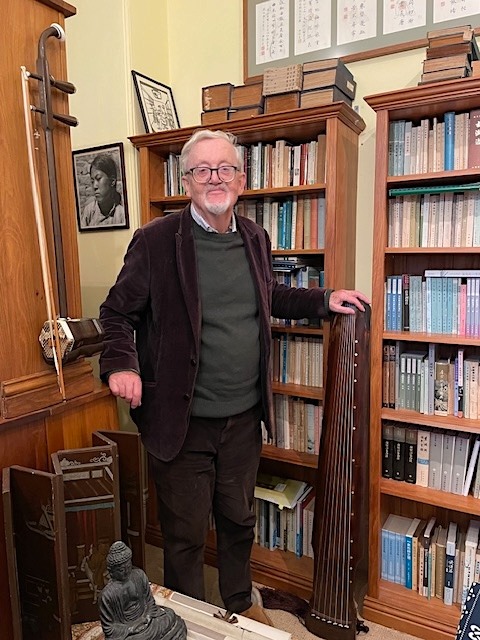
In my study, in order to create something of the studio ambiance, I keep a beautiful guqin — made for me by an elderly master qin-maker from Yangzhou — leaning against the wall. Above it is a framed couplet given to me in 1982 by my calligraphy teacher in Tianjin: “情未静时诸妄作,人当悟后一言无.” (While passions are unsettled, delusions run wild; once one is englightened, there is nothing to say.) I also keep in my study, for purely sentimental reasons, an enormous rare book in a beautiful brocade silk cover, containing a series of Chinese poems in both the original Chinese and Czech paraphrases by the poet Bohumil Mathesius (1888-1952), given to me by a dear Czech friend.
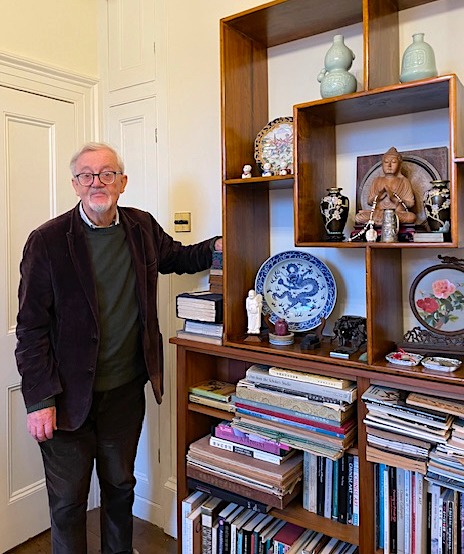
My favourite “shelf” is a large Chinese-style display structure, bought in Hong Kong in about 1998. This contains my Chinese treasures: an old ivory Buddha; a blue-and-white Qianlong dragon ceramic bowl, a small “sang-de-boeuf” Kangxi vase; a Shang shamanic bi jade signifying Heaven; a couple of rare ink-sticks; a calligraphy by Jao Tsung-I; all interspersed with a number of old thread-bound classical texts. A bookcase below contains Chinese calligraphies and rubbings, photos and reproductions of Chinese landscape paintings. On the floor to one side sit two antique leather boxes I bought in Tianjin in 1981, containing my old draft translations of Pu Songling.
How do you consume your books? Do you annotate or mark them up? Any thoughts on physical vs. digital editions, or the act of reading?
I try not to write on my books, but tend to interleave them with written notes. I often keep notes when reading, sometimes in separate notebooks. Digital editions are useful, but they are sometimes unreliable. Real printed books have a life of their own, and my library is full of my old friends. It is wonderful to come back to the same book 30 years later and discover new things on the same, much-read page.
I gave my library the Chinese name “Three Dog Hall” (三犬堂) after my three dogs who loved to keep me company among my books. The dogs have died but I have kept the name.
John Minford’s book picks
The Story of the Stone
红楼梦
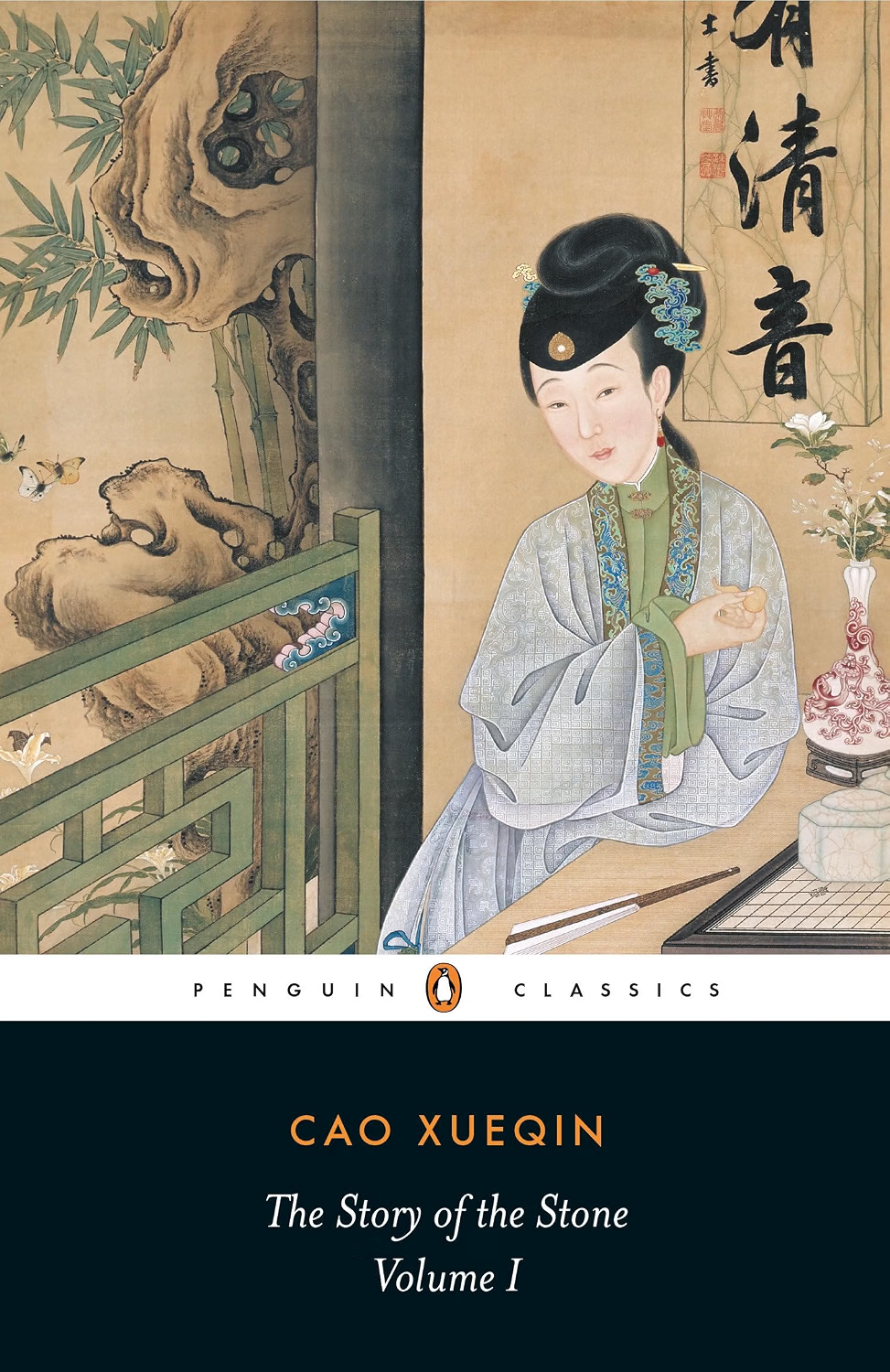
Without any doubt the one “China book” that has had the greatest impact on my life is the long 18th century novel The Story of the Stone (also called Dream of the Red Chamber). I first started reading it as an undergraduate at Oxford in 1967, and began translating its “conclusion” (the final 40 chapters out of 120) in 1970. I submitted my doctoral thesis on the subject in 1980, and finished the translation itself in 1986. I have collected just about every translation and edition of the novel, including facsimiles of all the early hand-written transcripts. But its influence has been far more than scholarly. The novel follows the rise and decline of a wealthy Chinese family through the tragic love and coming-of-age story of Jia Baoyu and the women around him, and its themes are universal. It is a book that changes people’s lives, and it certainly changed mine.
I Ching
易经
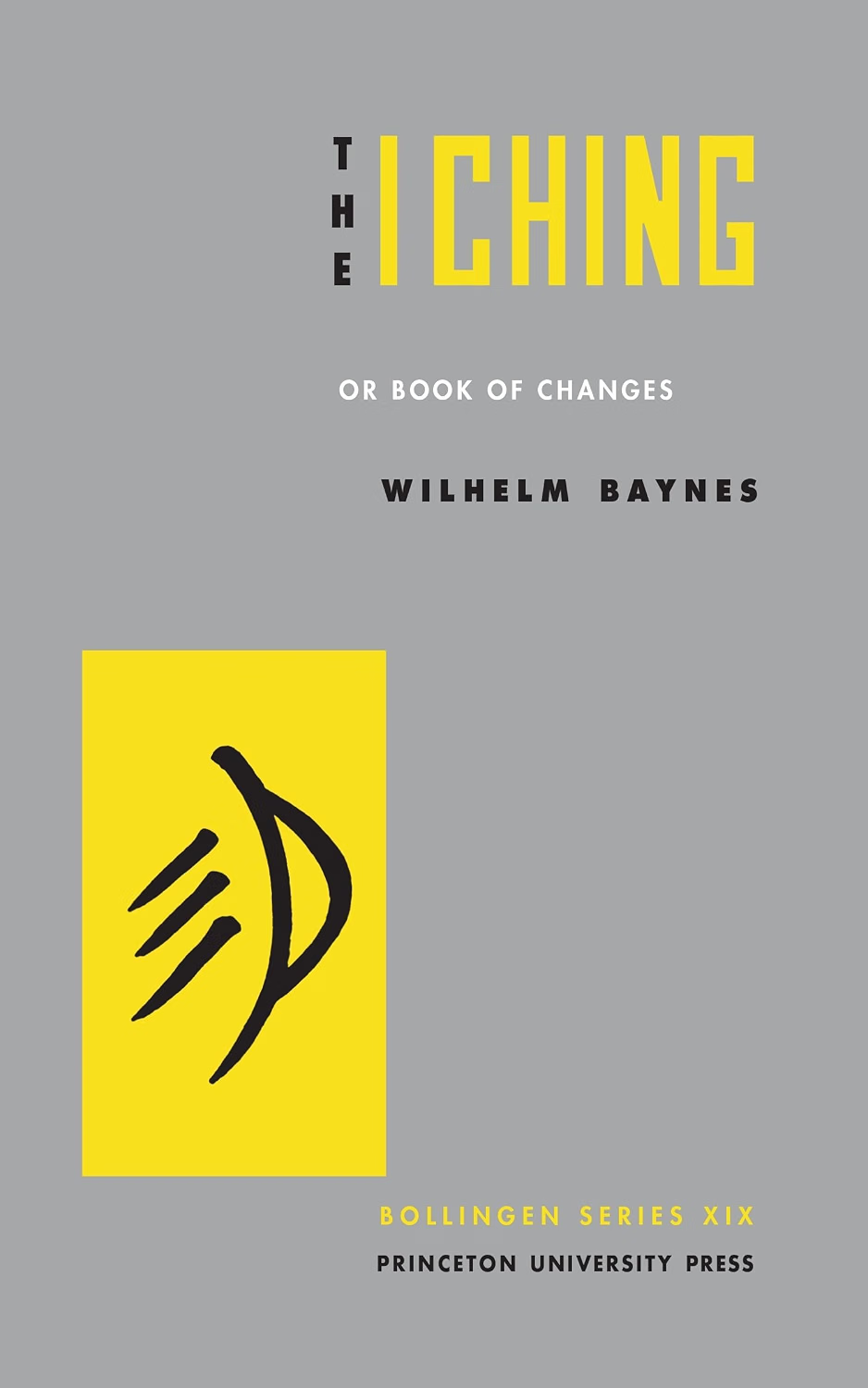
For the wondrous I Ching, I go to the translation by Richard Wilhelm and Cary F. Baynes, published in 1950 (from Wilhelm’s original German translation of 1924). I also refer to my much worn copy of the Zhouyi Benyi (周易本义) by Zhu Xi (朱熹), the 12th century Neo-Confucian philosopher, and indeed to the whole panoply of translations, editions and commentaries that I have collected on this remarkable and timeless divination text, not to mention my own 2014 translation of it. My own favourite commentary is that of the 18th century Taoist Magister Liu Yiming, The Taoist I Ching. The I Ching itself is, as Bob Dylan said in 1965, “the only thing that is amazingly true, period.” The great 11th century Chinese philosopher Cheng Yi (程颐) agreed: “The I Ching is grand in its scope; it is all-encompassing. To those who contemplate its depth and practice its discipline, the text will provide everything.”
The Glass Bead Game
(Magister Ludi) A Novel
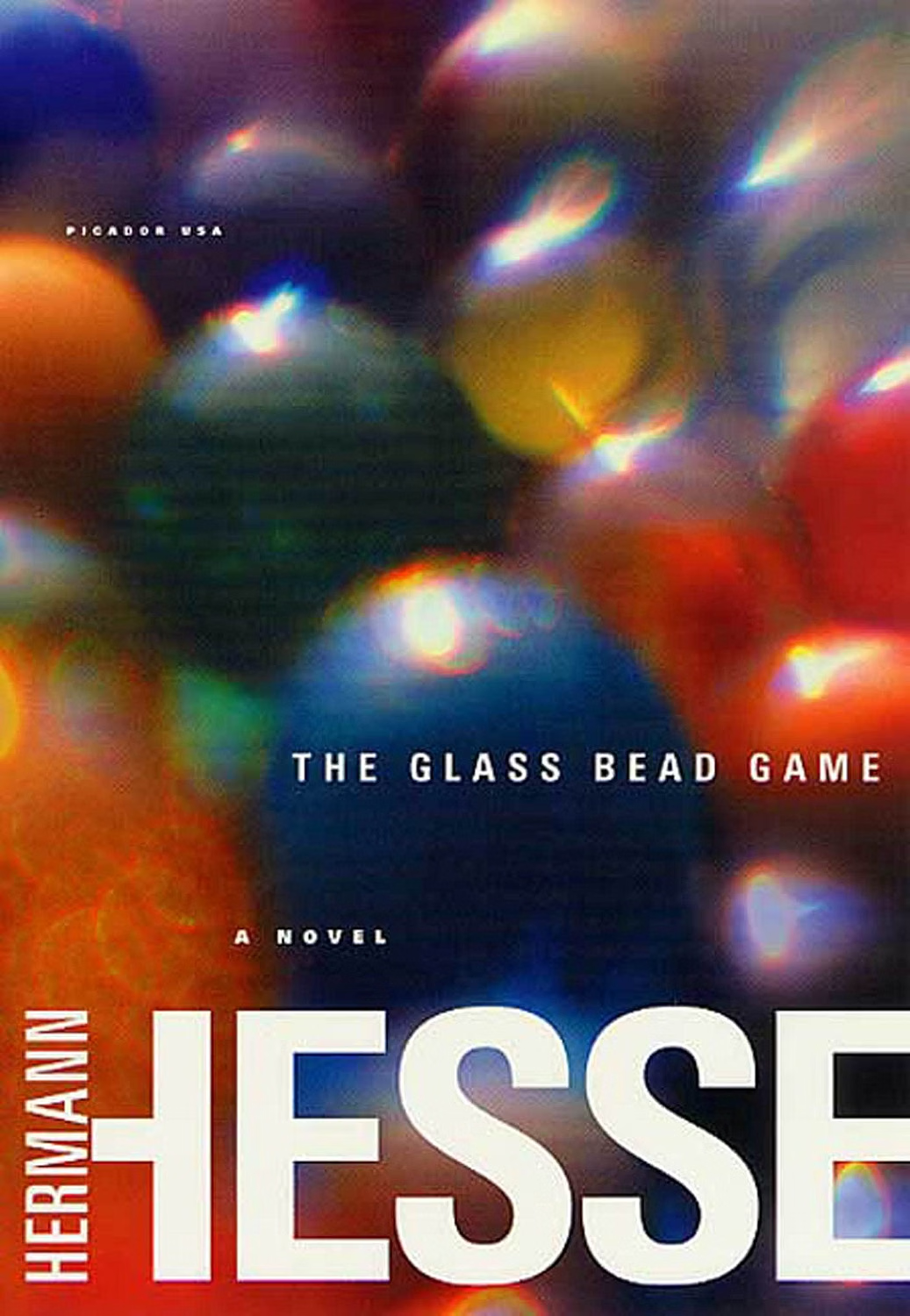
The 20th century German-Swiss novelist Hermann Hesse was deeply influenced by Indian and Chinese philosophy and religion. While that is most famously evident in Siddartha, his 1943 novel The Glass Beadgame — about an intellectual in a future scholarly order who masters an elaborate game synthesizing all human knowledge, but who questions the overly cerebral world it represents — was inspired by the I Ching. Since the late 1960s I have read and re-read all of Hesse’s writings, from the early novels through Demian and Narziss and Goldmund. I also listen again and again to the three Hesse poems set so lovingly to music by Richard Strauss, in his Four Last Songs. I always find comfort and nourishment in the works of this passionate pilgrim — as well as in the writings of Alan Watts, a prolific and inspiring teacher whose Myth and Ritual in Christianity I read in my twenties, followed by The Way of Zen and Nature, Man, Woman. As with Hesse, Watts treats subjects that are close to my heart.
Hsi K’ang and His Poetical Essay on the Lute
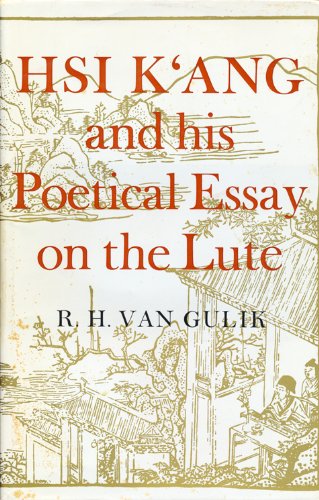
Fourth is the Dutch sinologist Robert Van Gulik’s Hsi K’ang and His Poetical Essay on the Lute, first published in 1941. I have the modern Tuttle reprint of this classic study, which combines the irresistible magic of the Seven Sages of the Bamboo Grove (竹林七贤, a group of 3rd century Chinese aesthetes who retreated to a bamboo grove to escape the political corruption of the Wei-Jin period) with the effortless charm of one of the last great European “orientalists.” The text describes the cultural, philosophical and musical significance of the qin (琴¸ the traditional seven-stringed Chinese zither, often translated as “lute”) through the eyes of the eccentric and brilliant Bamboo Grove member Hsi K’ang (嵇康). Van Gulik practised what he preached: he knew what he wrote about in a way that so many present-day China “scholars” simply fail to do. The presence of his books on my shelves (I have an almost complete collection) is deeply reassuring to me.
Tracks in the Snow
鸿雪因缘图集
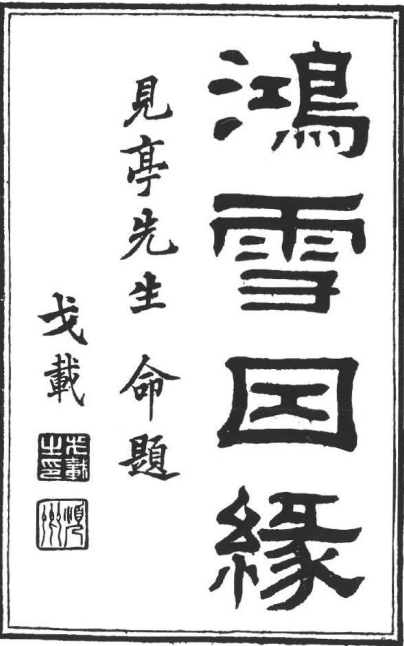
Last in my list is the memoir Tracks in the Snow by the Qing dynasty Manchu official and poet Linqing (麟庆). I first encountered this little-known work in 1979, when I was exploring the life of Gao E (高鹗), the scholar who edited the last 40 chapters of Story of the Stone). It so happens that Linqing was a friend of Gao, and among the superb 240 woodblock illustrations in Tracks in the Snow is to be found a charming representation of Gao E riding on a donkey! Somehow this memoir made its way into my life. In the 1980s in Hong Kong I was lucky enough to be able to commission a translation from the distinguished elderly Mongol prince Yang Tsung-han. Although he only completed 170 of the 240 episodes (his manuscript now sits in six yellow boxes in my study), many years later a talented young scholar in Australia, Christina Sanderson, completed the task as part of her PhD. One of my few remaining projects is to edit and publish, in a faithful de luxe format, the complete translation of this astonishing work, which offers an illuminating insight into the life of a cultivated Manchu gentleman of the 19th century. ∎