Sign up for our newsletter to be notified of new posts!
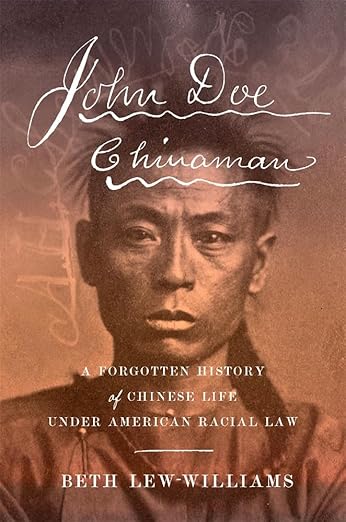
Reviewed: John Doe Chinaman: A Forgotten History of Chinese Life under American Racial Law by Beth Lew-Williams (Belknap Press, September 2025).
When I tell people that I grew up in Southern California, I often qualify it by saying, “But it wasn’t exactly the Southern California you think of nowadays.” In my childhood in the early 1980s, I lived in Grand Terrace, a small town in Riverside County about 60 miles east of Los Angeles. When I was three, my mother, a recent immigrant from Taiwan, put a down payment on a humble one-story, three-bedroom rambler with the small savings she’d accumulated working for the Veterans Affairs Hospital. She and I were probably the only ethnic Asians in the neighborhood. One afternoon, we were left a welcome gift outside our front door: an unpleasant stink bomb that radiated a noxious odor.
Little did I know then that the harassment we experienced as Asians was a pattern in California that went back for more than a hundred years. While we felt as though we were the only ethnic Chinese in this pocket of California, we were most definitely not the first — they had come much earlier and settled across the state, many of them outside of big cities, as chronicled in Beth Lew-Williams’ revelatory new book John Doe Chinaman: A Forgotten History of Chinese Life under American Racial Law. With the Trump administration’s current efforts to end birthright citizenship and crack down on immigration, the material she covers is highly relevant in today’s fraught political climate.
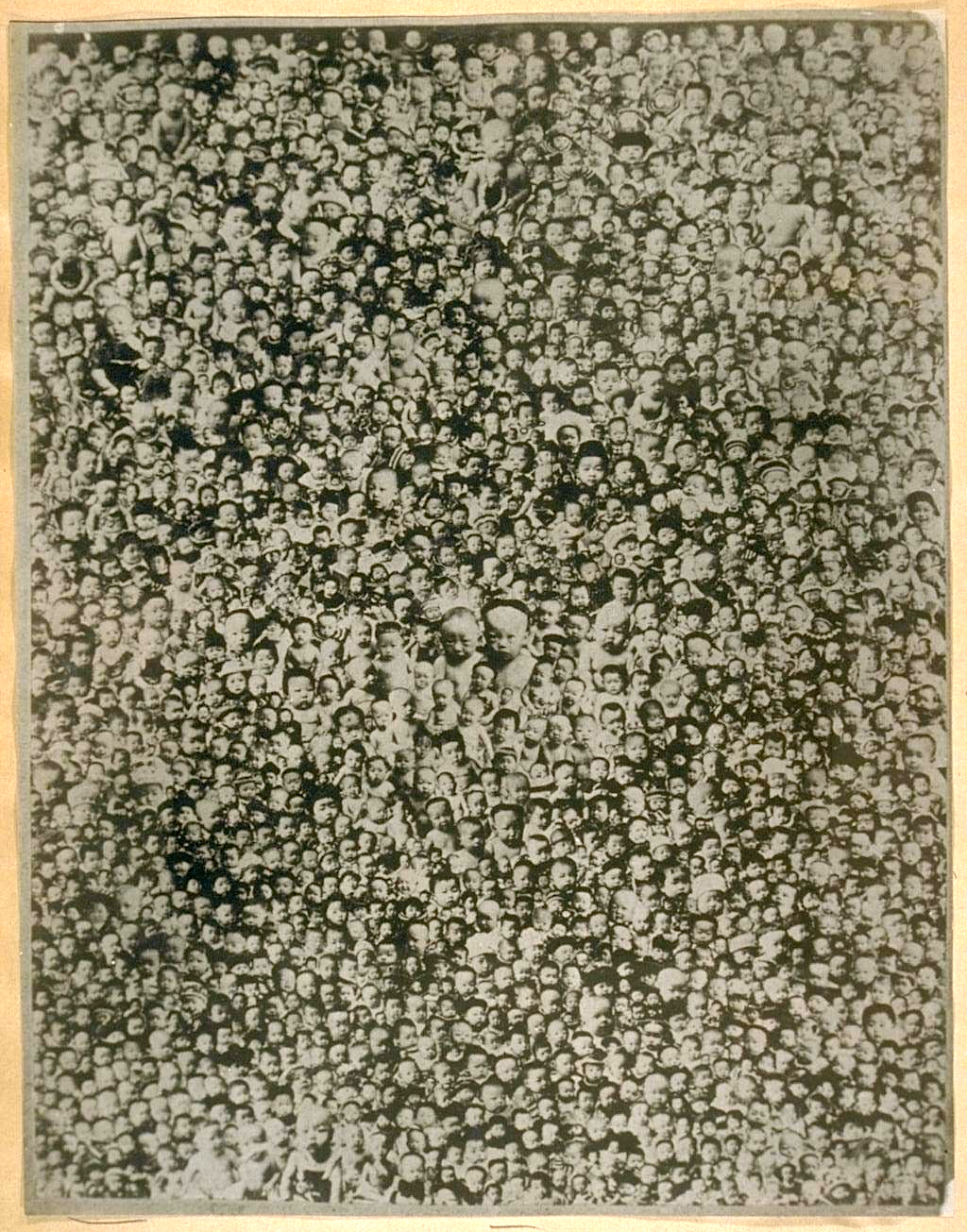
Lew-Williams begins with a story from her exhaustive archival research. While looking into the records of Jesse Brown Cook, the police captain of San Francisco’s Chinatown in the 1880s, she found a collage that Cook had perhaps hung in his office or home. The artwork consisted of roughly 2,700 cutout photos of Chinese baby faces; the sheer number created a kaleidoscopic and dizzying effect. To Cook, who was white, “these infants represented the contamination of the American citizenry,” Lew-Williams writes.
Around the time that Cook patrolled the San Francisco streets, the federal government began its efforts to stop Chinese immigration to the United States, most notably with the Chinese Restriction Act of 1882 and the Chinese Exclusion Act of 1888. But the effort to limit Chinese arrivals was not just a federal effort, argues Lew-Williams, a historian and director of the Asian-American Studies program at Princeton University. The tens of thousands of Chinese who had already entered the United States also dealt with discrimination and harassment, codified into local and state laws that aimed to regulate and profit from them.
Lew-Williams’ previous book, The Chinese Must Go (2018), details the expulsion of Chinese laborers from communities in the American West in the 1880s, when whites also massacred Chinese in a number of Western communities. Twenty-eight Chinese men were killed in Rock Springs, Wyoming, in 1885, and 31 were killed in the Oregon “Hells Canyon Massacre” of 1887. Much of this ground is covered in the existing, more generalized literature on Chinese-American history, which includes Iris Chang’s seminal work The Chinese in America (2003), Erika Lee’s At America’s Gates (2003), and Michael Luo’s recent Strangers in the Land (2025), as featured in this publication. What sets John Doe Chinaman apart is its intimate portrayal of how Chinese migrants negotiated lives under these terms.
The harassment we experienced as Asians was a pattern in California that went back for more than a hundred years.
Lew-Williams’ purpose in this book is to explore how the Chinese made an existence in the United States even as expulsions and anti-Chinese laws flourished. She coins the term “conditional inclusion” to describe early Chinese status in America, writing that “most local racial laws were not devised to exclude and expel. They were designed to control.” Through deep research into municipal and state archives in the American West, Lew-Williams discovers that more than 5,000 laws were created to limit Chinese activity and rights.
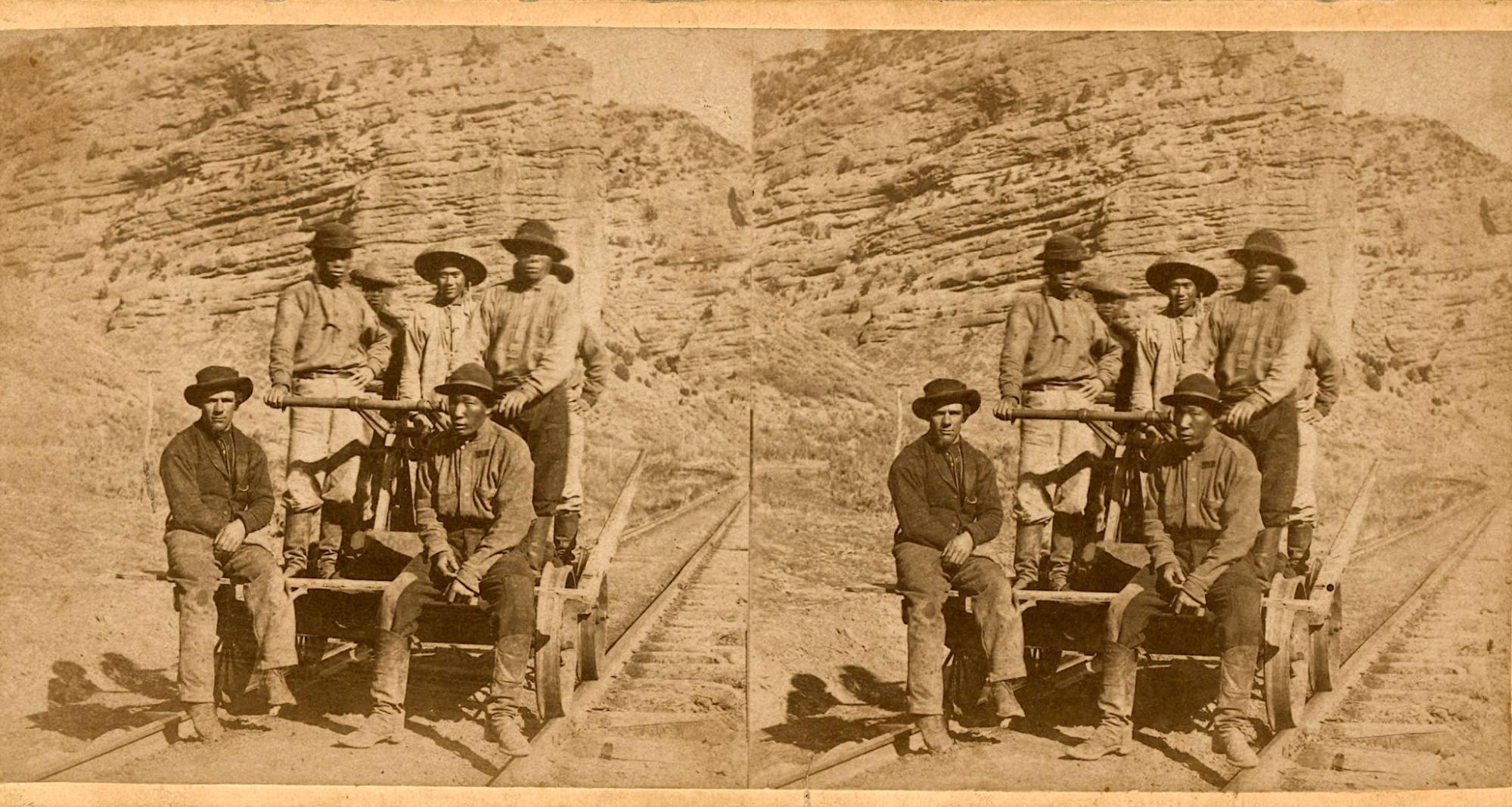
Most of these laws came into existence in the American West — California, Oregon and Washington state, where the vast majority of Chinese first settled. In 1860, 99% of the Chinese population in the U.S. lived in California. Chinese men had first begun to cross the Pacific to seek their fortunes in the California Gold Rush, which began in 1848. Records show that by 1850, 35,000 Chinese resided in the American West. Over the next decades, more came to work on the Transcontinental Railroad while other Chinese made a living as domestic workers, farmers and laundry workers, swelling the population to more than 100,000 in 1890. By 1920, federal exclusion policies and migration eastward shrank Chinese numbers in the American West back to 35,000, with about 25,000 living in the rest of the U.S.
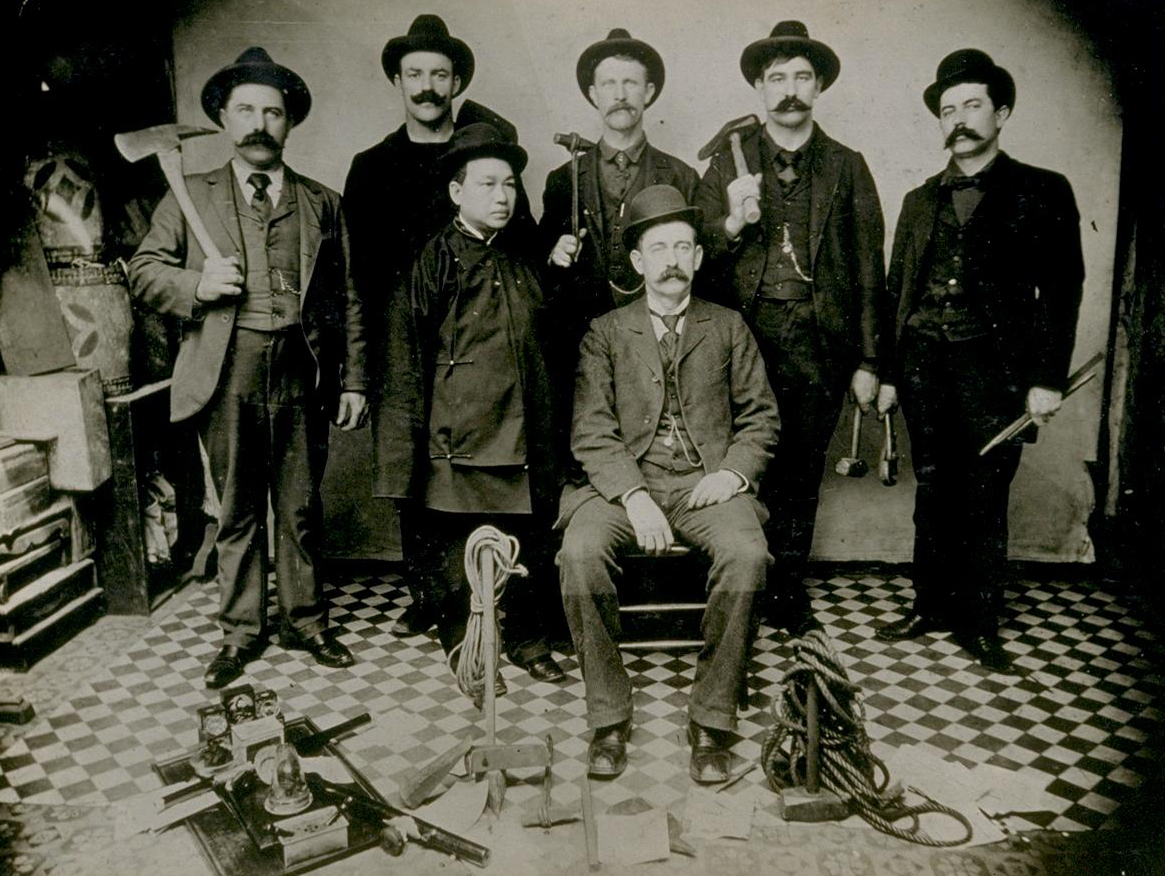
State and local lawmakers limited the Chinese ability to work, operate businesses, own property, testify in court, seek education and form families. Some policies dealt with the minutiae of daily life. For example, in the 1860s San Francisco banned the use of firecrackers, carrying baskets on poles, and the playing of gongs in theatrical productions. In the 1870s, Portland banned animal parts deemed “offensive” (such as chicken feet), required special licensing for gathering spaces like bathhouses, and specified a minimum of 550 cubic feet of space per person for residential living. (When Portland and other cities tried to enforce this living space law, Chinese were often thrown in jails that provided even less room.)
State authorities also profited off Chinese. Chinese laborers in California were forced to pay $4 per month to the state, called “a foreign miner’s tax.” Between 1854 and 1870, California collected $4 million from the tax, 99% paid by Chinese laborers, regardless of whether they mined or not. Lew-Williams tells of a white tax enforcer named Charles Egbert DeLong who “hunted Chinamen in the night” to collect the tax. In one entry, from March 1855, he writes in his diary, “shot a Chinaman.” He did not note whether the man survived. “For him, the violence appeared to be little more than a bad day at work,” Lew-Williams notes. She also describes how another white tax collector killed a Chinese man in a barber shop for not coughing up the tax. Though the tax collector was initially convicted, the California Supreme Court overturned the conviction; the case was called People v. Williams because investigators had not bothered to collect the name of the victim.
The namelessness of these and other victims gives the book its title. Rather than taking the time to transliterate Chinese names, American officials often identified Chinese men as “John Doe Chinaman,” and women as “Mary Chinawoman.” For example, one local California census counted 2,581 Chinese residents but only listed two dozen by their actual names. Lew-Williams notes that the word “Chinaman” became ubiquitous and “grew into a powerful agent of racialization, one that stripped the Chinese of their individuality.”
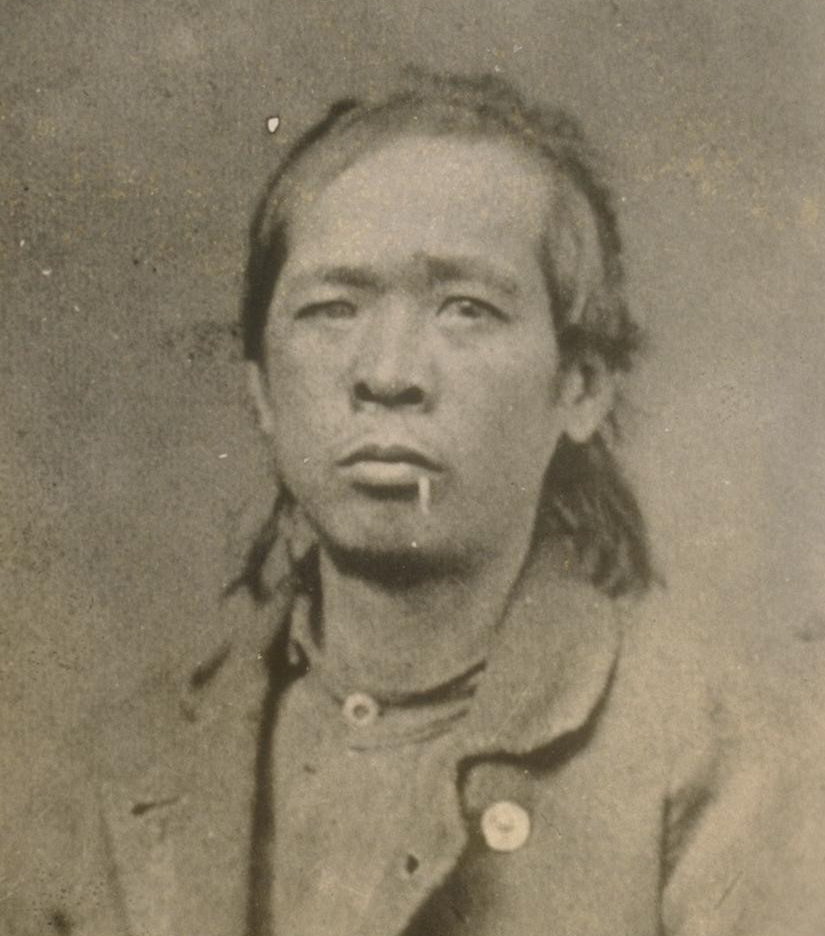
Though Chinese were regularly victims of crimes, they were often seen as perpetrators. Lew-Williams discovers that in 1880, the Chinese had the highest rate of incarceration of any racial group in the United States: 50 out of 10,000, as compared to seven for whites, 23 for Native Americans and 25 for Blacks. The cover of John Doe Chinaman features the image of one such prisoner, who was identified in records only as “Ah Chewey” and sentenced to two years in prison for stealing a box of tobacco. Little else was known about Ah Chewey, Lew-Williams writes. “But [his] stare speaks volumes. His eyes suggest open contempt for the man behind the camera and the justice system he represents.”
These local and state laws worked in tandem with federal laws that restricted Chinese immigration. The earliest such law, the Page Act of 1875, was focused on Chinese women — criminalizing the immigration of all felons and sex workers, which many Chinese women were perceived to be. “When Chinese women learned that migrating to America meant an elaborate, invasive and expensive investigation of their moral standards by the U.S. Consul in Hong Kong, many chose not to even make the attempt,” Lew-Williams writes. As a result, Chinese women hovered around 5% of the total Chinese population between 1860 and 1910, growing to a paltry 12.6% in 1920. The consequences included the separation of families, the stunting of generations, and the solidification of “the sexualized image of the Chinese woman.”
Meanwhile, some federal legislation helped the Chinese. The Burlingame Treaty of 1868 guaranteed Chinese equal protection under the law, as American politicians were aware of the growing economic prospects in China and wanted to maintain good relations with the Qing Dynasty. The 14th Amendment, ratified the same year, guaranteed birthright citizenship, though only after a Supreme Court case in 1898 involving a Chinese man born in the U.S. named Wong Kim Ark affirmed this right for Chinese families. While Chinese migrants themselves remained of questionable status, at least their offspring could now become U.S. citizens.
In contrast, northern and western European immigrants were essentially considered what Lew-Williams terms “Americans in waiting” (although southern and eastern Europeans were restricted by a 1924 law). Chinese continued to be denied the right to naturalization until 1943, when the exclusion laws were repealed, yet only a tiny number of Chinese were allowed into the country, just 105 per year. It was only after the 1965 Immigration and Nationality Act, which abolished the national-origins quota system, that Chinese became naturalized in meaningful numbers — and still they have remained a small minority, a legacy of anti-Chinese legislation. According to the 2024 U.S. Census Survey, 5.8 million Americans count themselves as ethnically Chinese, roughly 1.7% of the U.S. population.
Rather than taking the time to transliterate Chinese names, American officials often identified Chinese men as “John Doe Chinaman,” and women as “Mary Chinawoman.”
This story is more than a narrative of victimization; in the second half of the book Lew-Williams moves on to detail how Chinese fought against their repression. “What emerges is not a triumphalist story of civil rights progress,” she writes, “but neither is it a relentless story of victimization.”
For example, there were laws on the books that Chinese could use to their advantage. Some Chinese sued for discrimination and occasionally won. Lew-Williams details cases in which Chinese used the court system to advocate for their rights, including Tape v. Hurley in 1885, in which a Chinese family in San Francisco sued a school for denying their daughter access to public education. Ultimately, the city created another school for “oriental” students, and separate-but-equal applied until the late 1940s. Chinese occasionally challenged state anti-miscegenation laws, but these laws prevailed until the 1960s in many Western states.
The Chinese also resourcefully used the lack of individuality in their public records to their advantage. Local and state governments, after all, had rendered Chinese nearly indistinguishable with their use of the name “John Doe Chinaman.” Many Chinese seized on San Francisco’s great earthquake and fire of 1906, which destroyed the city’s birth records, to claim citizenship. As time went by, and more Chinese gave birth in the United States, it became “more difficult, if not impossible for federal immigration officials to differentiate between an alien and a citizen.”
John Doe Chinaman contains chilling historical parallels to what is happening in today’s America, with Immigration and Customs Enforcement (ICE) agents raiding communities across the United States. Deportations of Chinese have skyrocketed under Donald Trump: in June 2024, 41 people were deported to China; in June 2026, 296 were. Lew-Williams notes that in the early 1900s, “immigration inspectors needed only suspicion of unlawful residence to detain a Chinese person, and administrators could deport them without judicial review.” She also provides historical context for new state laws that limit legitimate Chinese economic activity in the United States. In 2023, Florida passed a law that restricts people who reside in China and lack U.S. passports or legal permanent residence from owning property in the state. Texas passed a similar law in 2025, broadening those restrictions to passport holders of several other “hostile countries” including Iran. And across the country, Chinese students and professors in science and technology are reporting increased scrutiny and limitations, even after the China Initiative was scrapped in 2022.
In her conclusion, Lew-Williams contends that Chinese-Americans are still confronting “conditional inclusion.” After World War II, she writes, Chinese have been granted “probationary membership in America as long as they adhered to certain ideals. [They] should be hardworking, self-sufficient, and uncomplaining. They should be family first, and all-American, a model minority for others to emulate.”
Recently, my family and I spent ten months living in the American West, in Utah. In Salt Lake City, we found a small but thriving Chinatown. At Golden Spike National Park, we visited an exhibit of Chinese artifacts that belonged to some of the 20,000 Chinese workers that raced to complete the Transcontinental Railroad, nearly a century and a half ago. On the anniversary of the Rock Springs Massacre of 1885, we also attended a ceremony to honor the 28 victims who perished in anti-Asian violence. That violence and prejudice continues today, as we saw during the Covid pandemic and beyond. John Doe Chinaman remind us of the through line that exists from then to now. ∎
Feature image: A photograph taken in approximately 1875 in the Sierra Nevada, titled “John Chinaman on the Railroad.” (New York Public Library)

Jen Lin-Liu is an author focused on Chinese cuisine and history. She has written two culinary memoirs, Serve the People (2009) and On the Noodle Road (2014), and is author of the forthcoming Formidable Mrs. Chao: The Story of China’s Julia Child. Lin-Liu is the founder of the Beijing cooking school Black Sesame Kitchen and has worked as a culinary consultant for the D.C.-based chef Peter Chang.