Sign up for our newsletter to be notified of new posts!

This is an episode of the China Books Podcast, from China Books Review. Follow us to listen to the pod on your favorite platform, including Apple Podcasts and Spotify, where a new episode lands on the first Tuesday of every month. Or listen to this episode right here, where we also post the transcript.
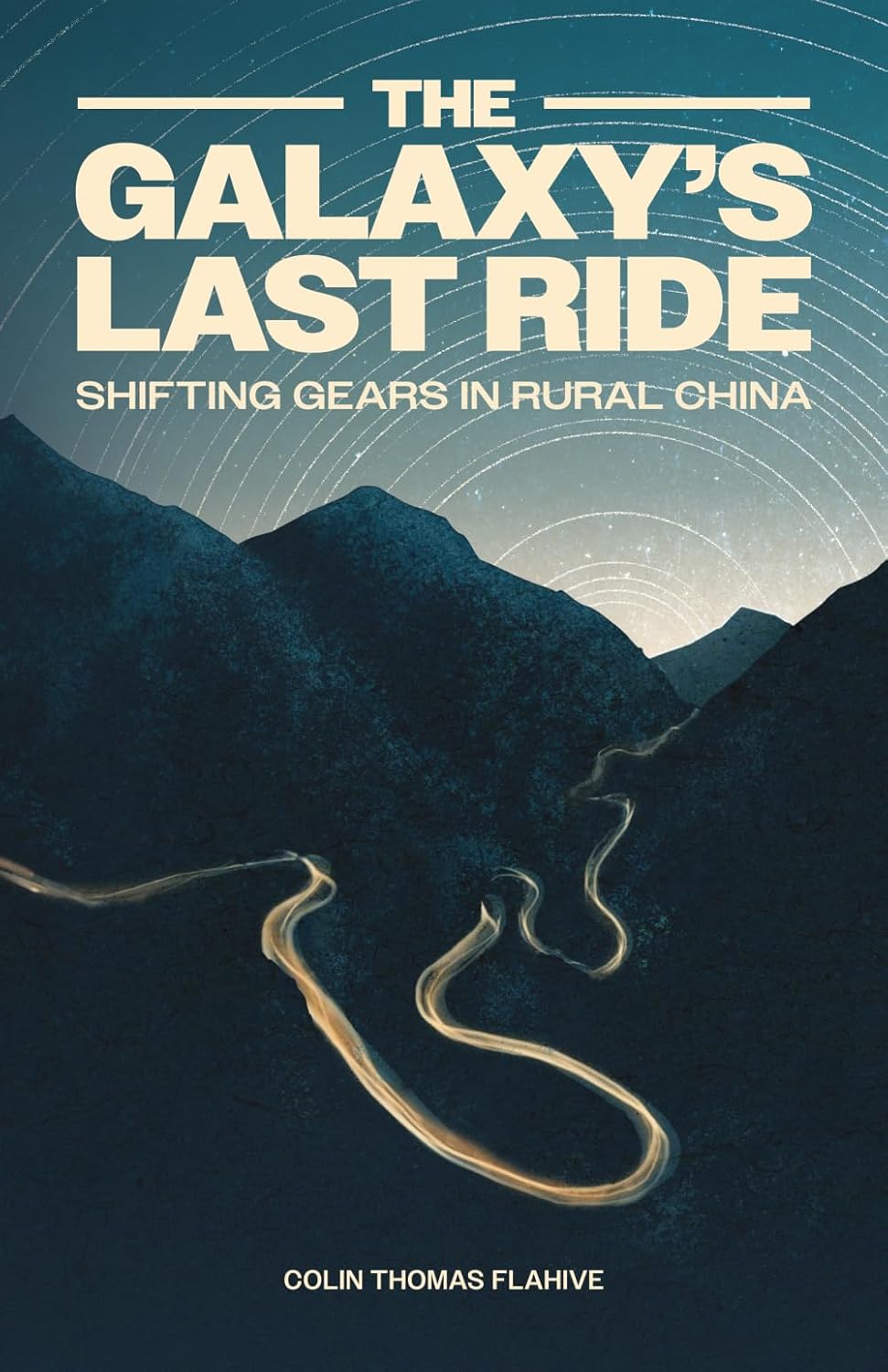
At the turn of the 21st century, around 64% of China’s population lived in the countryside. Today, that figure has fallen to 32%, reversing the ratio as hundreds of millions left their villages for urban centers. That mass migration, combined with rural development initiatives over the last decade, has transformed the countryside and its place in Chinese society. There are few provinces where that is more evident than Yunnan, historically one of China’s most rurally isolated regions, where I lived for four years, and which has gone through radical changes over the last decades. Few people know that better than Colin Flahive, a resident of Yunnan since the early 2000s, author Great Leaps (2020), about setting up his business in Dali and Kunming, and now a new book The Galaxy’s Last Ride: Shifting Gears in Rural China (Earnshaw Books, April 2026), about riding his Galaxy motorcycle 2,500 kilometers through the changing rural landscapes of western China.
We were delighted to be joined on the podcast this month by Flahive, to talk about what has been lost and gained in urbanization, and the changing face of rural China through the stories of those who left, those who stayed, and those who have returned:
Guest

Colin Flahive is an author and business owner who has been livingin China for 26 years. He is the author of Great Leaps (2020) and The Galaxy’s Last Ride (2026). He currently lives with his wife in Kunming.
Change has been so, so fast — adding subways, doing things that a lot of the world would struggle to get done in multiple decades — that Kunming and other cities around China just made it happen.
Transcript
This book, The Galaxy’s Last Ride, and your previous book, Great Leaps, are fundamentally books about how China — specifically rural China, specifically Yunnan province — has changed over the course of your time living there. So when was your first trip to China, and what was it like back then that’s so different to now?
Sure. 1998 — I had just turned 21, and spent a month and a half in Japan studying Chinese to get ready for this trip. I was so nervous about just showing up with no plans. But my plan was to take a year off of school and travel through northern China and make my way down into Nepal and India. And it was on that first trip, I was in a place called Xiahe [夏河], which is in the southern tip of Gansu. It’s a very Tibetan part of China, with what used to be one of the largest lamaseries in the world, I believe, and it still houses the longest prayer wheel circuit. So it was this very shocking cultural location to pull into. But it was a very rural area at that time. I was treated great by most people, but scammed a lot, and the difficulties of traveling in China in 1998 were pretty rough. But as soon as I got back to my studies in Boulder, Colorado, I just couldn’t stop thinking about it and finding a way to get back.
So I ended up changing my Asian Studies thesis to focus on the Three Gorges Dam relocation project. I went back again in 2000, wandered around these riverside villages, talking to families about what life was going to be like for them now that they were going to be moved out of their villages, up to the top of the hill into these brand new sparkling cities that were being built for them — and what life would be like for someone in that position, who for generations had been self-sustaining, to be forcibly urbanized into these apartment buildings. So early on I was fascinated with change in China, even back in 2000, and that’s kind of carried on with me till today.
And I moved to Dali in 2003. Sold all my possessions back in Denver, again having no idea what I was going to do, but I wanted to study martial arts. In Dali, there’s this mountain temple — it was one of the few kung fu temples in China that accepted foreigners. So that was my plan. But in the end, I ended up starting a cafe with a friend, and that has now turned into four restaurants in Kunming.
Indeed, I know you from that cafe — Salvador’s, or Sal’s, in Kunming, where I lived for a year in 2019. I was just around the corner, and it sort of became my office. I felt like I was there all the time for a quesadilla and a coffee. It’s a unique business in that so many of your staff are from the deep countryside of Yunnan, particularly this village, Bangdong [邦东], which is sort of halfway between Kunming and Pu’er. So they’ve really lived that urbanization story, thanks to your café.
Yeah. In those first ten years we were there, that part fascinated me more than anything. We went to countless weddings back in the countryside, and we tried to work on some development projects, trying to have them maybe grow something that Salvador’s could use. That ended up being a little too difficult, but we spent so much time back there that the idea of migrating from a part of the world that to me was the most beautiful, then to come work for us in the city — that was what fascinated me and kind of motivated me to write the first book, Great Leaps.
But those first ten years I was in Kunming, this city changed so fast, and it was just one of hundreds of cities changing just as fast. And it was all fueled by this migration from the countryside to the city, which wasn’t really new when we got here. But when I first came to Dali in 2001, it was mostly still the firstborn son maybe being sent from the village to the city to find work, to try to make enough money to send back to the family. The problem was that drugs, alcohol, gambling — different addictions — take a heavier toll on men than women. And it was right around the time when we started opening Salvador’s that some of these women, for the first time, were leaving their villages. Quite literally, a number of our staff had never left their village more than a 30-, 45-minute walk until they came to work for us at Salvador’s.
So they were entering this incredibly new world in Kunming, where — from my perspective at least — their transition from Bangdong village to Kunming, even though they’re in the same province, is more different than it is for me from Denver, Colorado, to Kunming. I know how cities work. There’s this sort of structure that I’m used to, where they’re coming into this world where everything was just new to them. So the fact that we were foreigners, and we were teaching them to make coffee — something they’d never seen before — and they’re making quesadillas and all this other stuff they’d never tasted, was quite a shock for a lot of them.
So can you tell us more about that period of China’s urbanization, and the change from rural to urban, which is our theme today? Of course, Yunnan is a little bit behind Beijing and Shanghai in terms of its urbanization. It’s historically been one of China’s poorest provinces. How did you see Kunming change over those two decades?
Kunming in 2001, the first time that I came here — a lot of people like to talk about it this way — Kunming was a giant city of villagers. It was a huge population, but in a lot of ways it was still run in the way a village does. And there were lots of satellite villages scattered around nearby Kunming, where farmland filled everything.
And these young women were leaving behind a life where, even from the age of four or five, they were basically told they have to take care of the household. They have to handle a lot of the farming, the cleaning, the cooking, taking care of the younger children. So these are young women who grew up with heavy responsibilities from a very early age, with very few opportunities beyond starting their own family, and the cycle continuing. So for most of our staff, I feel they would agree strongly that leaving gave them opportunities that they wouldn’t have had if they’d stayed behind. So I think Kunming was a bridge into a modern world that, at least 20 years ago, was sort of off-limits to people in the villages. But it’s a tough transition, and for a lot of people who made that transition, it didn’t work out.
But you would see these cities 20 years ago versus now, and it’s a totally different world. The parts that used to be farmland are all skyscrapers. The villages that used to be satellite villages are all joined together into this greater city now. There was never a mall. There was never a Starbucks. There was never even an Italian espresso machine until we brought one to Kunming. But change has been so, so fast — adding subways, doing things that a lot of the world would struggle to get done in multiple decades — that Kunming and other cities around China just made it happen so fast.
Yes, I see a lot of videos now of people going to China and just being astounded at the hyper-modern elements of Chongqing, and the flashing lights and the high buildings. And it just bears reminding that even 20 years ago, in many cities, none of that existed. This is very, very recent history, at the beginning of the urbanization process, which is now completed.
Yeah. And then for the last ten years, it’s sort of reversed and moved back to the countryside now. So this huge push towards modernization that rebuilt all these cities is suddenly moving into the countryside. These are people who have felt isolated from the rest of the world for most of their lives, and now this bridge is being built for them to sort of join the modern world, for better or worse. If you talk to a lot of the people coming from those areas, they feel like they have opportunities they didn’t have before. For a lot of them, if there was a medical emergency, it’d be a 24-hour tractor ride to get out of there along a bumpy dirt road, just to get to a place where they could get a car to a hospital.
Now, I mean, they have laid so much pavement. I’ll only speak for Yunnan, but it’s the whole country. Yunnan is just layered with pavement now, and all these roads that used to be horse trails, or motorcycle roads, or previously only accessible by tractor, are now beautiful, brand-new tarmac roads.
Yes. I mean, the Chinese countryside really is concrete now. That is the fundamental aspect of the Chinese countryside, romanticize it as we may wish. And indeed the reverse migration story is very real. I wrote a whole book about it — people going from the cities back to the countryside, leaving Beijing and moving to Dali. And it really struck me as such a paradox that the locals were, of course, still trying to get out of the countryside and move to the city, because that’s where their prospects are. So it’s a sort of double track, or two train tracks which pass each other in opposite directions.
Yeah, the grass is always greener, huh?
One dramatic story in Great Leaps was a bombing — a terrorist bombing — in the cafe, which happened on Christmas Eve 2008. Could you tell us that story briefly?
Sure. I mean, that’s also an interesting year for transition for urban China, so I think that story tells another story as well. But yeah, in 2008 — this was the year of the Olympics in Beijing — Kunming had had two bus bombings. Someone had put bombs on buses, and I believe a couple people died, maybe 12 to 20 people were injured, and this was a shock. Kunming had been — pickpockets aside back then — an incredibly safe place to live, so this news was huge for the local people. But nothing else happened, and we kind of forgot about it.
And yeah, the morning of — that would be December 24th, 2008 — I was just getting into the cafe, had probably just drunk my latte. We had some customers come visit, so I just left the cafe to take them on a little walk, and we heard this huge boom. We looked back and there was smoke billowing out of the restaurant. Originally my feeling was, you know, the gas line must have exploded or something like that. The idea that someone would have done something never even crossed my mind. But I ran back as fast as I could, ran into the restaurant, saw an incredibly bad, bloody mess on the ground right in the middle of the main seating area. I saw all of our staff who were there that day safely run out, but there was a body on the ground there. And it became pretty evident pretty quickly that this guy had had a bomb, and he had exploded sort of out of the bathroom. What it seems is that that day he was having breakfast and using our bathroom to set up another bomb, to put on a bus or somewhere else, and that we probably were not the intended target. But there’s no way to know for sure.
So when we heard about the bus bombings in Kunming — this was the same guy. And he admitted to it. Strangely, grotesquely, somehow he was still alive, and they used his phone to record his last interview before he died. But the thing was, that was when China started making this big push towards being a safer country. It’s when the very early beginnings of the cameras started going up, and the tracking, and all the other stuff that those of us living here are very used to. And in some ways they make everything easier. It’s scary for lots of reasons, but China’s an incredibly safe place to be right now. When we first got here, I used to set traps for pickpocketers. It was so common that people were having their bags stolen in our restaurant, and bikes stolen. That would never, ever happen now. You could leave your phone out on the bar all day and nobody would take it.
And you went back to the village where this guy came from. Was he a product of the countryside?
Yeah, he was from Yunnan — a coal-producing region of the province. And we did go there. I wanted to have some closure to it all. I mean, I struggled for a couple years after that to deal with things. So we wanted to find out where he came from, what would have turned him into something like this. But when we got to this town, it was just full of nice people. You know, there’s just bad seeds that come from places, and this guy had spent a stint in jail for starting fights. He had learned to become an electrician. So I think it was just sort of this bad seed, combined with the knowledge of how to do something bad, that is what happened. But that was a pretty special case, and that is definitely not the norm here. I mean, you’ve spent enough time in Yunnan — people are just so friendly and welcoming overall. It’s one of the friendliest places you can be.
It’s my favorite province in China, and as with much of western China as well, reading your new book made me very nostalgic for that particular region of China’s west and southwest. So what was it that gave you the itch to get back on the road in 2020?
Yeah, so in 2020 we had just been closed down for COVID, and there was again a feeling that we were going to lose our business. We were unsure about what would happen once things started opening again. And so yeah, in 2020 I packed up my Galaxy motorcycle — the Galaxy is the brand of off-road bike that I bought 15 years ago — and I took off from Dali and worked my way north. I had this plan to try to connect these two dots by land that I’d never managed in the past. And so it’s sort of arbitrary, but it gave me a direction to go in. I had been scouting these really narrow — more hiking trails than roads — that I thought maybe I could find a way to connect one dot to the other. And so yeah, I took off on this 2,500-kilometer adventure.
But on day two, I had seen on a map this Shangri-La Village, which was weird to me because I knew the area well, and I was like, “Shangri-La Village? That sounds like another rebranding opportunity for something.” But I was like, “I gotta go check it out.” I was in the middle of nowhere, so I did this long off-road day, but then I was met by a beautiful tarmac road — brand-new road — and I get up to the top of this hill. There’s this beautiful mountain off in the distance, these huge rock outcroppings, and then I go about one kilometer more, and suddenly on the left there’s this giant Hyatt being built, and you go a little further, there’s a Marriott. This was a village that they’d built an airport for, to try to turn into this massive tourism opportunity. So I was almost frightened by it. Just that much dramatic change, in a part of the country that used to be so isolated, kind of blew my mind. I hit the throttle and got out of there as fast as I could.
I mean, that’s quite emblematic of the theme of the book. Can you tell us a little bit more — paint us a picture of how development has changed the countryside of China in the 2020s, as opposed to the 1990s?
Yeah. So if you rode through these Tibetan areas in the past, they would either be these rammed-earth walled structures, usually single or double floors, framed by gorgeous wooden beams. But I’d also ridden through this area, I want to say ten years earlier, and we also found these villages built of this pink sandstone — just gorgeous, and just small. Everything was really relaxed. Again, if you’re a foreigner showing up in an area like that, you stand out so much, because they’re just used to being sort of isolated amongst themselves. But this time, not only were the roads all brand new, but basically every old home had been knocked down and replaced — most of the villages were replaced with concrete blocks. Two, three, sometimes four stories. Sometimes they’d get these sort of Victorian columns as a facade in the front to make it look special, or paint it all pink or lime green or something like that.
So, you know, these are areas where I had spent so much time just traveling and walking the trails, riding the motorcycle along trails to these places where I really felt like, this is the China that I really, really love. But that’s hard to find anymore. Even our staff — our staff have proudly built new homes for every one of their families. And for them, there’s nothing they’re more proud of than the fact that they accomplished what they set out for, which was to give their parents a better home and a better life. You know, they have hot water now. They can take a shower. They’ve got electricity — and most of our staff grew up without electricity. And so it’s a difficult perspective for me to handle, and it’s a constant battle in my head, about losing something so beautiful versus the idea of welcoming people into the modern world who really want to be a part of something bigger.
Yeah, and on that note, let me actually read out a few lines from your book which jumped out at me, in an early chapter. Quote: “For the last 10 years, I’ve watched as villages, no matter how remote, are remade in a massive poverty alleviation effort. The old traditional homes have mostly been scraped from the earth and rebuilt four times larger with rebar and concrete. Family farms have been consolidated by larger companies, and some villages have been relocated altogether to make way for dam projects, high-speed rail, and other infrastructure projects. The countryside I fell in love with won’t be around for much longer, and it saddens me to know that my son will never see things as I once did.” So, to pick up on your last point, isn’t that a sort of romanticization of the countryside? These mountains which we find so beautiful, and these remote villages in western and southwestern China — those are the same mountains that kept the local population poor. Isn’t development a good thing for them?
Yeah. And I’m so thankful I have the talks with my staff to sort of deepen my perspective on things, because there is no right answer to that — what’s good, what’s bad. But change is inevitable. That doesn’t mean you just step aside and let it happen. But I think preserving some beautiful old village so that I feel good and they feel trapped also doesn’t feel right. So, you know, I did meet some people along this road trip who really were looking for a middle ground, trying to preserve some of the old ways of doing things, but giving it a more modern twist. I don’t think any of these people want to go back to, you know, cold-water showers. They’ve all got phones and internet now. They don’t want to be cut off from the rest of the world anymore.
So it’s sad from the perspective that, yeah, my son won’t see the China that I fell in love with. But things are always changing. We were just talking about Dali, which for you I know holds a lot of meaning, and for me was really my first home in China. When I first showed up there in 2001, I remember people being like, “Ah, Dali’s changed. It’s all ruined now. You should’ve seen it ten years ago.” And I hear people saying the same thing now. And I think having this sort of nuanced perspective — about change not being good or bad, it’s just a part of life — really helps me appreciate places like Dali. I go back to Dali now and I love it. It’s also got one of the nicest cafes in Yunnan. There’s a really good bakery there. I mean, there’s all this great modern stuff, in addition to having the beautiful mountains and plenty of village areas you can escape to if you want to get out of the main town.
You can get a pretty good latte, and they’re growing their own coffee in Yunnan as well now. So it really depends on the perspective, right? And in your book, you intersperse your own road trip narrative with the stories of these staff members, and if you’ve witnessed the changing countryside, they’ve really lived it. So what did you find out about their attitudes to that rural development and change that we’re talking about, in your interviews with them?
Sure. I mean, these are all young women who came to work with us between the ages of 16 and 18. So they were still kids, really. But we’ve been working together for over 20 years now, so they’ve all got kids. They’re all adults. And talking to them about life in the past is really fascinating, because even amongst themselves they have differing perspectives about things. Some of our staff have decided to raise their children in the city, because they want them to have what they deem as better education and more opportunities. Some of them want to have their children raised in the countryside by their parents — the child’s grandparents — which is maybe the norm for most rural-to-urban migrants in China. They want their children to have this sort of connection to the land. They see these urban kids as being spoiled and badly behaved, and they want their kids to have more of that rural lifestyle. So I think that’s also a very important theme: there is no generalization for anyone when it comes to perspective. Every one of our staff thinks of things very differently from each other.
But a couple of interesting stories about what life was like for them as a kid. I was asking Pin Di what’s her earliest childhood memory — and Pin Di is one of our first employees. She worked with us in Dali, so she’s been with us for now 23 years. And she starts going off on: when I was seven, the old women came back. They had just gone to the next village over — she’d never been anywhere that far away before — and they brought these apples with them. And they watched the old ladies peel these apples and cut them up and share them among themselves, and it was the first time she’d ever seen an apple. And the old ladies were nice enough to give all the kids a little scrap of the skin. And so her fondest memory as a seven-year-old was her first time chewing on apple skin. Another one of our staff was telling me how she was born under a peach tree.
A lot of these stories really just connect me to this old time. But, you know, having — what is it, 26, 27 years in China now — I feel like that perspective has changed dramatically. I’ve spent enough time in villages to know that’s not the life for me.
And how about for them? Did you find that they all wanted to leave, and that the modernity of the city is what they desired? Or do some of them also wish that they could return to the life in their villages?
I can picture a lot of our staff’s faces right now, and what they would say to me — and everyone would say something different. I know Ali, who is one of our head managers, who’s been working with us for 22 years — she would never go back to the village. Xuemei, on the other hand — she’s got her two kids being raised by her parents in a really high mountain town. It’s still fairly isolated, even though they have nice road access now. She would definitely want to retire in the countryside and go back to farming her own crops. So it’s difficult for me to come up with a generalization, because I really think it probably splits about 50/50 overall. But I don’t know that anybody would really want to go back to how things were before, either.
So China officially declared its, quote, “complete victory” in eliminating extreme rural poverty at the end of 2020 — the same year as your road trip. So how did you see the effects of that campaign to alleviate poverty, and the rural revitalization campaigns, on the ground? And do you see them as successful?
So from the outside, you can see the most dramatic change being in everyone’s homes. I would guess 90% of all village homes have already been either abandoned, so that they can build a new place nearby, or leveled and built on the same old site. So that’s the most obvious thing from the outside. But when I was talking to my staff while writing Great Leaps — and that was when the villages were still relatively unchanged — they were really talking about how difficult it was for healthcare and for schooling. And these were huge limitations that they were not happy with about living in the countryside. But now, I mean, new hospitals everywhere, and the road access is a really big deal. I was talking about that 24-hour tractor ride — that was the norm. A lot of people just had to give up when they were sick or injured, and not even seek medical care. But now it’s a different world. People aren’t giving birth themselves at home as much anymore — again, for better or worse. I’m sure people have differing opinions on what’s better and what’s not. But there’s no doubt people are safer and have better access to healthcare than they did before.
Schools have been consolidated quite a bit. From the outside, again, this doesn’t feel great, because I loved those old wooden schools, where there were just maybe 70 children in a school. Now they’ve been consolidated, so that villages come from all over — and now that there’s good roads, they can get there easily — and these schools have between 200 and maybe 2,000 children in them. So this access to education and healthcare that has come along with the poverty alleviation campaign has made a huge impact, and given people much more opportunity and access to a modern world that they always wanted.
It’s not just economic development, it’s also cultural change. Yunnan is so ethnically diverse, but everyone’s leaving these villages and going to the cities. Do you find that these customs, these ways of life, are getting lost in rural Yunnan as well?
For sure. I mean, even among our staff, it’s funny how when we get a new employee — which doesn’t happen so often, but last year we took two in who are between 16 and 18 — our older staff are like, “We don’t even know how to communicate with them.” They’re coming from the same villages, but these are kids who grew up with cell phones and internet, different habits, a different way of speaking. And a lot of our staff have really heavy accents. They grew up speaking this sort of dialect of Yunnanhua [云南话], and they were complaining about, “She doesn’t even understand what I’m saying.” So culturally, things have shifted so much.
I mean, just the idea of leaving the farm behind is already a major transition. So a lot of these village areas — and maybe this will change because of the poverty alleviation efforts — have been basically abandoned by people between the ages of 16 and, I’d even go up to, like, 50. It’s mostly elderly, and then the elderly taking care of the children and taking care of the farmland at the same time. So I think a lot of this poverty alleviation effort is trying to fix that, and bring people back, and bring more opportunities to the countryside — because there’s some very valuable farmland, and there’s some lifestyle that’s worth keeping going. So my hope is that as that transition moves forward, we won’t see the loss of everything, and that there will be some happy middle ground of a modern world and a rural world sort of living together.
Hmm. Yeah, it’s kind of a classic story of social engineering, where China really swung the pendulum too far in pushing urbanization, and now found that the rural areas were neglected economically, and has started to push people back in the opposite direction and push money into the countryside.
Yeah, that’s right. And what’s going to happen next is very uncertain. But when it comes to at least our staff, I don’t see any of them moving back there until they’ve decided to retire.
So as a final thought, there’s a line near the end of the book — let’s see, quote: “Just as the America I grew up in is gone forever, so too has the China I first fell in love with become something entirely new.” So we’ve heard about the latter part, China becoming something new, but how about the former? What impact does it have on you to witness the changes in America, your home country, play out from a distance over the last 26, 27 years that you’ve been in China? And is there a point where America feels more alien to you than China does?
Yeah, that’s a good point. I mean, for the majority of the last 26 years, every time I go back to the U.S. to visit, it feels the same. But I think that’s just in relation to how fast things change here in China. So I go back to the States for a month or two, then I come back to Kunming, and suddenly there’s this brand-new road or new building that wasn’t there before. So the kind of contrasting swiftness of it all always had me feeling like, oh, the States is just stagnant. It’s not changing — it’s only happening here, at this pace.
But it was during COVID where I started juggling the idea around about my son: maybe he should go back to school in the U.S. Maybe he could go back to the same school I went to. He could have the same life I had. And once lockdowns were lifted and we could go visit my parents, it became pretty clear pretty quickly that the sort of old elementary school I was holding onto wasn’t a place at all. It was a time. And that the life that I had is long gone, and that’s not something I can offer my son. But also, I’ve been gone from the U.S. so long that my connection to it is really very thin right now, and it doesn’t feel like home anymore when I go back, other than my family. It’s too alien to me now, and I feel more comfortable in this crazy place that’s constantly changing.
I guess that’s one of the hazards of being an expat for so long. It’s not so easy to just go back home.
That’s right. That’s right. And our head manager, Ali, said something to me the other day that I really think contrasts the life that she grew up in versus where she is now, and I think it relates to what we’re just talking about. She said, “My parents never asked me if I’d done my homework. They only asked if I’d made dinner, fed the pigs, or put the corn out to dry.” And I love that quote, because it just shows the dramatic difference between the world we’re in now and the world that she came from.
I guess she can’t go home again, in the same way. Well, thank you for walking — or riding — us through the story of changing rural China over the last decades. Thanks so much, Colin, for coming on the podcast.
I really enjoyed it. Looking forward to the next time we meet up. ∎
Alec Ash is a writer focused on China, and editor of China Books Review. He is the author of Wish Lanterns (2016), following the lives of young Chinese in Beijing, and The Mountains Are High (2024) about city escapees in Dali, Yunnan. His articles have appeared in The New York Review of Books, The Atlantic and elsewhere. Born and educated in Oxford, England, he lived in China from 2008-2022, and is now based in New York.