Sign up for our newsletter to be notified of new posts!

This is an episode of the China Books Podcast, from China Books Review. Follow us wherever you listen to podcasts, including Apple Podcasts and Spotify, where a new episode lands on the first Tuesday of every month. Or listen to this episode right here, where we also post the transcript.
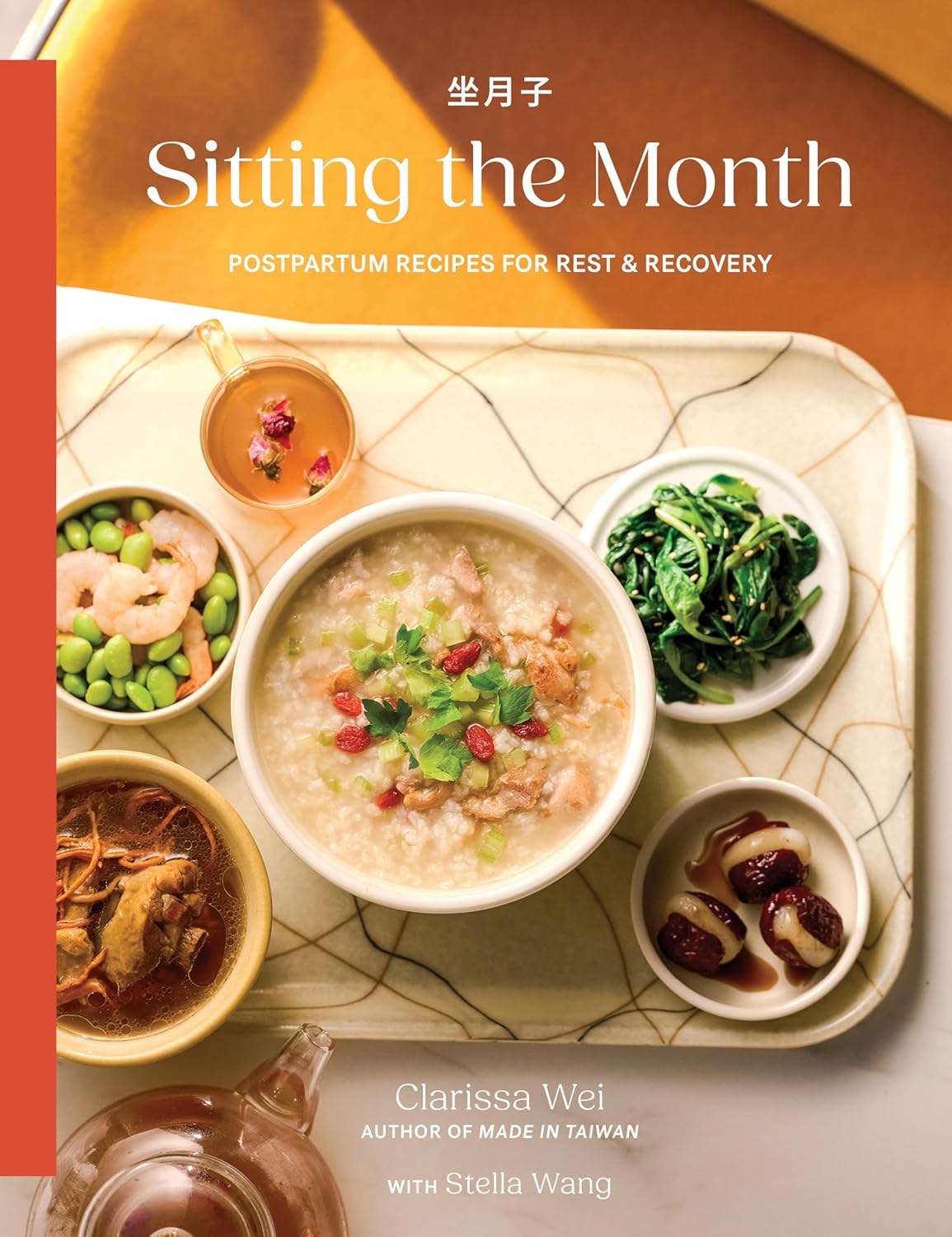
Stir-fried Amaranth. Salt-Fried Eucommia Bark. Ginseng and Astragalus Tea. Egg Drop Seaweed Soup. Coffin bread. Vegan blood cake. Grass jelly. Crystal meatball. These are just some of the recipes in the cookbooks of Clarissa Wei, a Taiwan-based journalist and food writer, and our guest on the podcast this month. She’s the author of Made in Taiwan: Recipes and Stories from the Island Nation (Simon & Schuster, September 2023), that celebrates Taiwan’s unique culture and cuisine, and of Sitting the Month: Postpartum Recipes for Rest and Recovery (W.W. Norton, September 2026), about the centuries-old Chinese cultural practice framing the month following childbirth as a sacred period for rest and recovery.
We were joined by Clarissa, over the line from Taipei, to tell us more about both of those culinary cultures, and about some of the recipes that came out of those traditions too:
Guest

Clarissa Wei is a food writer, born in Los Angeles and based in Taipei. Her reporting and essays have appeared in The New York Times, The New Yorker, The Los Angeles Times, Monocle and Foreign Policy, among other places. She is the author of Made in Taiwan (2023) and Sitting the Month (2026). Wei is also co-founder of Heydoh, a single-origin soy sauce brand based in Brooklyn.
In traditional Chinese culture, foods are categorized by temperature. So things like yogurt and salad are considered cooling, and ingredients like lamb and jujubes are considered warming and hot.
Transcript
Alec Ash: So you were born and raised in Los Angeles, but you have Taiwanese heritage, and you moved to Taipei in 2020, was it? Did you grow up with a close connection to Taiwanese culture and indeed food? Why did you move there, and did you always have an interest or intention in writing cookbooks?
Clarissa Wei: So my parents are from Tainan in the south of Taiwan, and since the age of two, they’ve dragged me and my brother back every single year just for the food. In fact, in my childhood, I remember them lugging back a styrofoam case of fresh fish from Taiwan to LA. And then I was a journalism major in college, and shortly after I graduated I just spent a lot of time in Taiwan and started writing a couple of freelance articles. 2013, 2015 was the age of the listicle, so I did a lot of listicles of where to eat in Taiwan, based on my experience there. And then in 2018, I moved to Hong Kong and was a reporter for the South China Morning Post, where I was covering the food and culture of China, and also traveling to Taiwan a lot. And when the pandemic hit, I decided I wanted to move to Taiwan and really focus on Taiwanese food and culture, and dive deep into the history of this country where my family is from.
And when you were visiting Taiwan as a kid growing up, and as an adult, what were the foods at the street markets or at the restaurants that really made you salivate?
Yeah, so my perception of Taiwanese food is really shaped by this southern Taiwanese food, and a lot of these dishes you don’t see outside of Taiwan. So like Ôr Á Tsian (蚵仔煎), which is an oyster omelet, or Bah Uân (肉圆), which is kind of a sticky rice meatball with pork inside. There’s this really common and famous dish called Hái Sán Muâi (海產糜), a seafood porridge soup. And it’s just old rice, and you put water and then seafood in it. And I used to think it was my mom being really lazy, but then I realized this is just a traditional way to use leftover rice, and then you use a lot of squid, oysters and fish filets inside. So that was kind of my perception of Taiwanese food, very southern. And then in my teens, I started visiting Taipei and then realized there was a lot of influence from mainland China in the 1940s and ’50s, and that’s when I encountered beef noodle soup and xiaolongbao. But prior to that, my perception was very much southern Taiwanese.
Right. It changes a lot geographically. In Taipei, everyone goes for soup dumplings at Din Tai Fung, and then when you get to the coast, it’s sort of oyster sauce and fishy. So you published Made in Taiwan in 2023. We reviewed it alongside a few other cookbooks, and part of the point of that book was to differentiate Taiwanese cuisine to Chinese cuisine. Indeed, you write in the introduction, “Our food isn’t a subset of Chinese food because Taiwan isn’t a part of China,” which is accurate, but there’s certainly overlap. So can you give us a few examples, or expand on that, on how the recipes and ingredients of Taiwanese food make it distinct?
Yeah. And I also want to caveat that Chinese food is a huge and important part of Taiwanese cuisine. But again, like I wrote in the book, it is not the only thing that distinguishes us. And one of the points I make in my book is that if you look at the building blocks of Taiwanese cuisine today — the way that we make soy sauce, the way that we make rice wine and vinegar — it’s very much today in the Japanese style, and that’s because Taiwan was a Japanese colony for 50 years. And this was something that I found out through old-school journalism, by calling up factories and asking them how they make their condiments. Because prior to me writing this book, you really could not Google this online. So if we want to get really into the granular, black vinegar, for example. Black vinegar in China is made by fermenting rice, and the Maillard reaction is what makes it black. In Taiwan, we have a black vinegar, but it’s actually regular rice vinegar that’s been steeped with fruits, kind of similar to how they make Worcestershire sauce, where they will steep it with fish and seafood. And then that’s a style that was brought over by Japan. Also, how our soy sauce is made is more Japanese. We don’t have shengchou (生抽) or laochou (老抽), which are styles common in southern China. In Taiwan, most people have an all-purpose soy sauce. And then we have something called jiangyougao (酱油膏), which is a soy paste, and that’s something that is very special to Taiwan. It’s very similar to oyster sauce, if you will, but it doesn’t have oysters in it. So if you just look at the building blocks of Taiwanese cuisine, you can see how distinctly different it is from our neighbors. And that kind of formed the thesis of my book, and it really took me calling up these factories and learning how they produce it to even realize it. It was kind of my eureka moment.
I love a good Worcestershire sauce. I never thought of it as Britain’s fish sauce until now. We should also probably plug your own co-founded brand of soy sauce, Heydoh, out of Brooklyn, New York, made from Taiwanese black soybeans, presumably using that recipe you were talking about.
Yeah, actually, so that style of soy sauce came before the Japanese. That was, I believe, the 18th century. When the first Fujianese immigrants moved to Taiwan, they brought black soybeans with them, and then they made soy sauce with black soybeans. When Taiwan became a Japanese colony, then the island transitioned to yellow soybeans, and actually yellow soybean soy sauce has the vast market share in Taiwan today. Black soybean is actually just kind of a niche subset. And interestingly enough, Taiwan is one of the few, if not the only, country in the world that still specializes in black soybean soy sauce. So from my understanding, in Fujian, even though they had this history of making soy sauce with black soybeans, it’s not a dominant industry anymore. But Taiwan has kind of preserved that. And so, growing up in LA, in America, where it is full of immigrants, you see how dishes are brought over and transformed with time. American Chinese food is a really great example. And when I started living in Taiwan and trying to formulate my thesis for Made in Taiwan, I really realized that even though Taiwan looks like a homogenous society from the outside, we really are a nation of immigrants, and with each wave of immigration has come a completely different new food culture. And Taiwanese cuisine today is a synthesis of all of these different waves of immigration, starting from the 16th century, to the Japanese influence, to when Taiwan was taken over by the Nationalist government. And then there was another change in the early 2000s when we transitioned to a democracy, and the food culture is so vibrant and different. And while we have overlapping dishes like xiaolongbao, these dishes have become a part of Taiwanese history. It’s not to say they aren’t Chinese, but they are also Taiwanese.
Yeah, it really is a book as much about Taiwan as it is about food, or about Taiwan through food. One of the earliest lines is that Taiwan is shaped like a sweet potato, so you’re certainly seeing things through that lens. I loved how you brought out the history of the island through the recipes with these overlapping influences and time periods, as you mentioned, from Hokkien and indigenous populations through Japanese colonialism, mainland migration, American influence even, all the way to modern street food and concepts like QQ, or chewiness. And Taiwan really is such a palimpsest in that respect. Its identity can feel like a moving target, to me at least. So through the research of these recipes, did you feel that you understood something, or that something clicked, as to what Taiwanese identity really is?
If anything, doing the book made me realize that no one truly understands what Taiwanese identity even is, because it’s such, like you said, a moving target, and because there’s been so many changes in our history. And just for people listening who don’t have that context, my grandmother, who I believe was born in the ’30s, grew up speaking Japanese and she didn’t speak Mandarin, and Taiwanese Hokkien was her mother tongue as well. My parents were told when they grew up, they were encouraged to speak Mandarin, and they know Hokkien. But they were told that they would one day return to China and Taiwan would be returned to China. And then my friends in Taiwan who grew up in Taiwan don’t identify with Japan or China at all. They just see themselves as Taiwanese, regardless of what their family heritage is. So with all of these generations, the identity of Taiwan has changed, and therefore the food has changed. And I think starting from the 2000s is when Taiwan has really been trying to carve out its distinct identity. And I think the island is still in the process of doing that, and if anything, increasing cross-strait tensions and regional conflict has kind of put a fire underneath that, and this discussion is really happening throughout society. But I don’t think there is as strong a national, or at least culinary, identity, because that’s what I specialize in, compared to our neighbors like Korea, for example. Everyone will say kimchi. Taiwan is kind of still figuring that out. What is our national dish? What are we known for? And that’s in flux because people’s identity has been in flux.
Well, you have bubble tea. That was a bigger export even than semiconductors.
That’s true. That is true.
So three years later, you’re now coming out with this new book, Sitting the Month, which presumably was long in gestation itself. This book is as much a paean to the act of childbirth and motherhood as it is a cookbook per se. So let me start by asking you how and why you decided to write about this as your next topic?
Yeah. So I gave birth to my son about three years ago, and I had asked my mom whether or not she would help me do my postpartum month, which is a concept that has been ingrained in me ever since I was a little girl, and a lot of the Chinese-speaking diaspora can attest to this. There’s a saying in Taiwan that is “when you are pregnant, you take care of the baby; after you give birth, you take care of your body” (产前养胎,产后养身). And the idea is that if you don’t properly do your month of confinement, or take care of yourself in postpartum, it will ruin your body for the rest of your life. And this was something that I knew and my mom ingrained in me, and she basically said to me, “Do you want me to die? It’s so exhausting taking care of a newborn. Why don’t you just check into a postpartum center?” Postpartum centers in Taiwan are very expensive. They’re not, contrary to popular belief, subsidized by the government. In fact, most Taiwanese couples will save up to 30% of their annual salary to pay for a postpartum center, but people do it.
Is that a common practice?
It is a common practice. 65% of new parents in Taiwan check into a postpartum center. [We have the most] postpartum centers per capita in the world, probably close to Korea, and that’s because our postpartum industry has been established for around 30 years already. Now, obviously, in China and Southeast Asia, Hong Kong even, there are postpartum centers, but a lot of these initial centers in these other places were established by Taiwanese people who got roped into helping them start it. So long story short, there’s a deep, deep culture in postpartum hotels.
So I checked into one. I wrote about the experience for The New Yorker, and I sort of realized that what I experienced was very different from what I, as a member of the Chinese diaspora, had thought postpartum was all about. So I think for my mom’s and grandmother’s generation, they subsisted on broths that were all rice wine, and they probably had sesame oil rice wine soup for all 30 days. And the older generation, the people that I have talked to, especially in my research for Made in Taiwan too, they complained about their postpartum month, because it was just bitter, disgusting soups with a lot of rice wine. But at the postpartum center, I noticed that most postpartum centers have a Western nutritionist and a Chinese medicine herbalist working in tandem to create a meal plan that is balanced, and they actually aren’t chock-full of Chinese herbs. They balance it, and it’s diluted a little bit, so it actually tastes good. And for modern Taiwanese women, pleasure is actually a big part of this hotel experience now. And then it sort of hit me that the way that Taiwanese women, or East Asian women, are experiencing postpartum today is very different from my mom’s and grandmother’s generation, because so much has changed, obviously, in the last 30 years. And I sought out to document that. So I spent the next two years writing this cookbook. But of course, I don’t have a background in herbalism, so I partnered with Stella Wang, who is around the same age as me. She also gave birth to her first kid the same time I did, but she’s a second-generation herbalist. And in most Chinese medicine apothecaries in Taiwan, they all have postpartum blends. You just go in and ask them for it, and then they have their own blend that they’ll give to you. So a lot of the recipes in the book are based on her herbal shop’s blends. And then I also just interviewed a bunch of people and kind of copied down the menu I was served, and adapted recipes based on that.
Great. And so before we get into the recipes, can you just explain for our readers what exactly is “sitting the month” (坐月子)? What’s the philosophy behind it, the history, and the science even, under this broader umbrella of traditional Chinese medicine (TCM)?
Sitting the month is the practice of staying home for 30 days after giving birth and keeping your body warm. And keeping your body warm manifests itself in different ways. It means, in a literal sense, that you’re not supposed to have the AC blowing on your hair. Traditionally, women were told not to wash their hair, because back then they didn’t have blow dryers and your head would get cold. You’re supposed to wear socks, keep yourself wrapped in blankets. That warmth also manifests in a food sense, if you will. So you’re supposed to eat foods that are thermally warm. So in traditional Chinese culture, foods are categorized by temperature. So things like yogurt and salad are considered cooling, and ingredients like lamb and jujubes are considered warming and hot.
So the basic idea is that childbirth depletes your energy, or your qi even, and then the goal is to sort of buqi (补气), to add these heated elements to restore the body to equilibrium on a TCM level, right?
Yeah, exactly. And because the woman after giving birth is considered cold, you’re supposed to eat hot foods. I thought that was the extent of it, but as I dove more into this tradition, you’re not supposed to just overwhelm yourself with hot foods. You’re supposed to eat a progression of hot foods. So in the beginning, you start off light and bland because you’re shedding. Your body’s really weak. You don’t want to overwhelm yourself. And I kind of use the metaphor of building a campfire to explain this in my book, where the spark is just kindling. You don’t want to add too much wood. And then the second phase is strengthening. Okay, now you have the spark going. You want to add a little bit of logs in, but not too much. This is the strengthening phase, and this is when you can start to introduce some herbs, but stay away from ginseng, for example, because that’s way too hot. And then after the strengthening phase, then you have the restoration phase. And that’s when you can go all out and have the ginseng and the cinnamon and all of these herbs that are considered, again, within Chinese medicine, to be very, very hot. So that’s the general practice. The history of it is kind of rooted in a patriarchal tradition. Originally, when a woman gives birth, she is bleeding a lot, and a woman’s blood was considered unclean, not just post-childbirth blood, but also period blood. And so she was advised to stay away from the family and confined literally for 30 days, because they didn’t want her to bring misfortune onto the family. And there were these crazy taboos, like you weren’t allowed to hang your dirty laundry outside because it would curse your family. And interestingly enough, for my second child — I just gave birth to my daughter four months ago — I sat the month at home using the recipes in my cookbook. And obviously, I’m born in the West. I will follow these traditions, but I’m also a little bit more lax. I think a week in, I went outside for a walk with my kid and my family, and my neighbors yelled at me. They were like, “Why are you out? This is so bad for you. Go back in.” These mentalities have stayed in Taiwan as well. I don’t think they meant it as I would bring them misfortune or curse them, but leaving the house is seen as very bad for your body.
I’ve been a guest in households in China where a woman was sitting the month, and sometimes it does feel a little ridiculous, the extent to which they’re basically forced to rest, sometimes just fully lying in bed, being told not to bathe or to go out, and it can seem a little patronizing or patriarchal, as if they lack the agency to kind of get up and go for a walk.
Yeah. What I discovered about this tradition is that it’s very, very subjective. There is no one exact way, and it really differs based on your family, or who’s telling you what to do, or what hotel you’re staying at. But there are dishes that repeat themselves throughout, and I just kind of wanted to distill the basic principles and point out these classical dishes, and sort of give people the tools, give women the tools they would need to make decisions for themselves. So with my first kid, when I was at the postpartum hotel, I actually developed postpartum anxiety, which may seem strange because I was pampered for 30 days. I didn’t have to do anything. All three meals were accounted for. My baby was taken care of by an army of nurses. And in retrospect, I think that anxiety came from following the rules and doing all of these things, but not knowing why I was eating this soup and not knowing why I had to stay in bed, and just kind of feeling trapped. It felt like a quarantine hotel, and I stayed in one because I was in Taiwan during Covid. They loved their quarantine hotels. And with my second kid, I basically just followed the recipes in my cookbook. I stayed at home, and it was night and day: (A) because I’m a second-time mom; but (B) I just knew what I was eating. I knew why I was eating this dish. I prepared the dishes myself, and I just felt so much more in control, and I could make decisions for myself.
So how do views of postpartum recovery differ in the West and the Sinophone world, and the wisdom of how long to recover?
Yeah, I actually interviewed an OB-GYN in the States, and she was saying that she doesn’t even know how to tell her clients about postpartum recovery, because that’s not something they learned in medical school. I think with this whole online trend of China-maxxing, there definitely is more awareness of this East Asian philosophy, Chinese philosophy, of sitting the month, but people don’t really understand how to follow it. And there are cookbooks on postpartum recovery, and a lot of them are just suggesting you eat a lot of protein, keep yourself fed, warm soups, things that are very standard. But this sitting the month, these dishes have kind of existed in a black box, being passed down from generation to generation, or just gatekept by the postpartum hotels and meal providers. And I really just wanted to distill that so that people don’t have to pay for a fancy meal service or a fancy hotel. So I am curious to see how this will be received, because it can be a bit difficult preparing some of these dishes, as these herbs are not common in the States. But I do think there’s a hunger for it.
Well, I certainly got hungry reading it. The recipes in the book look delicious, and there’s gorgeous food photography as well. So they’re organized into soups, protein, greens, carbs, drinks and desserts. Can you give just one example maybe of a recipe in there that you’re particularly fond of, or think is especially interesting or unique, to give us a flavor of that?
Yeah, so I’m really proud of my sesame oil chicken soup (麻油雞湯) recipe. In Taiwan, that is the banner postpartum dish. And traditionally it was a whole chicken boiled in rice wine and then finished off with black sesame oil. And I’ve tasted versions like that before, and it’s just too intense. If you’re boiling a whole chicken in rice wine, it’s going to taste bitter, and it will make you sweat, but it’s not nice. And I’ve also interviewed women who said that when they did their postpartum, they ate that dish for 30 days nonstop. So what I did in my recipe was I diluted the rice wine with water, and just added a little bit of sesame oil at the end, and I find that it’s very balanced. And also in that recipe, again based on interviews with herbalists, it’s really only recommended for your last week of recovery, to give yourself that extra boost. So I highly encourage, if anyone had to try any recipe from the book, it would be this one, because you can really notice the difference if you’ve had the traditional rendition.
Well, it sounds yummy, not just for new mothers. Besides these warming sort of soups and soft digestible foods, what else can and can’t you eat while sitting the month?
Yeah. So one of the biggest things that’s taboo is raw food. Salads are absolutely off the table, and that’s actually something that when I was pregnant and just going to my doctor checkups, they were like, “Absolutely do not have any salads after you give birth. Don’t do it.” And to medical practitioners in Taiwan, even if they’re not trained in TCM, this is just common knowledge. It’s just things they tell all of their patients. Even when pregnant, you get a list of things not to eat and what to eat. You’re not supposed to have watermelon. And some of these things I find a little bit too arbitrary, but it is interesting how ingrained these principles are in Taiwan.
So is that from the concept of being energetically cold, as you put it, the idea of sort of shanghuo (上火), giving internal heat, and quhuo (去火), removing internal heat? So raw vegetables, raw food, raw salads: can you explain exactly why that’s taboo in Chinese cuisine?
So it’s considered, yeah, energetically cold. But when I was in China and just doing a lot of research on the food, I realized that a lot of these taboos probably stem from common sense. I went into villages where the sewage system was intertwined with their farming system. So you obviously could not eat the vegetables raw, because you would get food poisoning and potentially kill yourself. So I think a lot of these taboos stem from sanitary conditions back in the day. And the whole concept of boiling a whole chicken in 100% rice wine comes from that too, because it’s probably a village where the drinking water was iffy at best. And rice wine, alcohol, when you boil it, you know that the mom won’t get sick. It won’t taste nice, but it’s better having boiled alcohol than boiled water, because who knows what was in the water supply. So yeah, a lot of it is these TCM principles, but the more I dug into it, I was like, wow, a lot of this probably just had to do with conditions generations ago.
You also write about how raw food in the earliest Chinese cuisines was considered uncivilized, but a marker of civilization and progress was to cook food. When I was first traveling in China as a 21-year-old, I was really surprised when I had my first ever hot pot and they put the lettuce in there. It didn’t occur to me that you would heat up your lettuce before eating it.
Yeah, I think it’s so ingrained in the culture. So even when I am in Sweden visiting my husband’s family, at the end of the day my in-laws will end with a glass of wine, and to me that doesn’t sound very appealing. I want a hot cup of tea, because that’s how we wind down, not with an icy cold white wine. A lot of these food cultures or food quirks are so ingrained in our culture, and just growing up we have these quirks that we don’t even think twice about.
Yeah, what is the deal with no cold or iced drinks? I feel like avoiding those is such a repeat refrain in TCM. Whatever the circumstance, everyone tells you not to drink cold water.
Yeah, so it just boils down to it makes your body cold. Cold water, icy stuff makes your body cold, and when you are sick, when you’re in need of recovery, you want warm things. And again, that applies literally in the temperature sense, but also thermally, and depending on how each food is classified.
Right. Where it slightly loses me is the thermal properties of food, because there are long lists of which types of food add heat or remove heat. So ginger and ginseng would add heat, mung beans and cucumber would remove heat. I think mandarin adds heat but orange removes heat, and they feel like such similar types of fruit to me. So how did the TCM doctors of yore figure out which foods add and remove heat, and how can you tell the difference?
Yeah, that’s a great question. So I think people who have my background, growing up with immigrant parents, we kind of know the basics, but when it gets really nuanced, most people don’t know the difference. And I’ve realized that some doctors contradict themselves too, because it also depends on how something is prepared. So for example, pork is neutral. Some of the vegetables in my book are neutral, but then when you pair it with ginger, it becomes warming. And it just becomes, again, with a lot of these things, when you go very, very deeply into it, it’s a little bit arbitrary. And I say that in my book, that I’m not a trained practitioner, and that’s why in the book I don’t say this helps your spleen qi or your kidney qi. I truly don’t know. I just picked the dishes that I saw repeat themselves over and over again in the cookbooks and in the menus, and that the herbalists talked about.
Yes, and you mentioned that these recipes often have a lot of herbs that might be difficult to source. Is that because a lot of the herbs, and sometimes the roots, that are involved in cooking these dishes are herbs that might be used in medicine?
No, so in the States these herbs are classified as food. There just isn’t a demand for a lot of these. But based on my research, I started interviewing a lot of herbalists in the States, and within the last couple of years there have been more people importing more of these. And they actually will import these herbs from China and Taiwan and do third-party testing. So interestingly enough, in Taiwan, when they import herbs in from China, they will do random testing. It’s very strict. These herbs are regulated more strictly than food. In the States, it’s not. It’s the same as food, so you don’t know if the herb has heavy metals or contaminants, or what the quality is. But there are some companies like Clear Source Herbs, where they do their own testing and they work with organic farms. And I just think we just need more people using them for more of these ingredients to be in the States. It’s not like they aren’t in the States, it’s just no one’s asking for them yet.
You use this phrase yaoshitongyuan (藥食同源), that medicine and food are from the same source.
Yeah, that’s a realization, again, I had while making this book. I think when I looked at these herbs, I got really intimidated. There was one day where Stella gave me a recipe that had 15 different herbs, and I accidentally put in the wrong herb for one of them, and I freaked out. I was like, can I eat this? Did I poison myself? And then I realized, it’s just food. It’s the same as when you put bay leaf in your pot. We’re not using medicinal levels, or powdered or distilled versions of these herbs. It won’t harm you. It’s like when someone makes a great chili, they’re putting all of these herbs inside. It’s the same with these soups as well.
And as you say in the book, it’s not just about eating your bitter medicine, it’s about delicious, yummy recipes which are pleasurable to eat, and all of those desserts with the longan and jujube. It’s about tasty dishes, which are good for the soul as well as the body.
Yeah. A lot of the herbal soups are sold in vegan restaurants especially, in Taipei in the winter. And it’s not geared just for postpartum women. So a lot of these formulas are just normal soup formulas that they will have in the winter, because it warms the body. So when I realized that, then I became less paranoid and just realized this is just another dish. It’s another soup dish, much like beef noodle soup. It has tons of spices inside. The difference between this and beef noodle soup is that people haven’t heard of these soups yet.
Did you get the impression that the practice of sitting the month is less common or dying out to any extent in Taiwan among the younger generation, or even in China, if you happen to know that as well?
So Taiwan has one of the lowest birth rates in the world. But again, 65% of all new parents check into a postpartum hotel. It is dying out in the respect that no one is staying at home and having their mother-in-law do their postpartum month, which is the tradition. Most people prefer to order in, or have the hotel provide all of their food. If they’re not in a hotel, they stay home and then order postpartum meal delivery services. And this culture is still very, very strong in Taiwan. But again, it depends on how you view that phrase, “dying out.” It’s not the same as it was in my parents’ generation, but it still very much is practiced in its own modern way today.
And I think that’s a thematic commonality in my work too, especially the fact that I’m based in Taiwan. I’ve realized that how the diaspora especially sees Taiwan or East Asia is very different from how we live in East Asia today. A lot of our perceptions are stuck in time, based on what our parents experienced. But how my mom and dad lived in Taiwan, that Taiwan doesn’t exist anymore. And a lot of my work is telling people in the States especially what life in Taiwan is like today. Yes, there are a lot of these traditional principles at play, but it has very much been upgraded by now. And even with Made in Taiwan, I know in 15, 20 years people will look back at it and be like, oh, this doesn’t reflect Taiwan today. But I say in my book that I wanted that cookbook to be a snapshot of the Taiwan I live in today. But because Taiwanese identity is constantly changing, the recipes, or what dishes are important, will change. And it’s the same thing with postpartum recovery. This concept of recovering after giving birth is still very strong in East Asia, in China, Korea and Taiwan, but how women are practicing it is very different. And I think it’s important for people in the West to know that, and especially the diaspora, because the diaspora in the States especially, they’re kind of the mouthpieces, they’re kind of the people telling folks in the West how these traditions are played out, and I just don’t think there has been enough awareness of what is actually happening in East Asia among their modern counterparts.
Yes, culture and cuisine are constantly in flux, but that also makes it so valuable for someone like you to record these recipes and these traditions and put them down for English speakers. I gather you’re working on a third cookbook. Are you willing to tell us what it’s about?
Yeah, so this is completely different from my other works. It’s called Chinese Barbecue at Home. I’m working with a chef in LA who has been cooking char siu and Hainan chicken. He’s kind of known as the Prince of Poultry, and we’re really trying to distill these grandiose recipes of roast duck and char siu and poaching a whole chicken down for the home cook, so that anyone can make restaurant-quality Hong Kong-style roast duck at home. So completely different from my cultural anthropology works, but it’s been a very fun project so far. We’re only a couple of months in.
Well, I’m salivating at the prospect, and I will get my blowtorch ready for when that book comes out. Clarissa Wei, thank you so much for coming on the podcast.
Thank you so much for having me. ∎

Alec Ash is a writer focused on China, and editor of China Books Review. He is the author of Wish Lanterns (2016), following the lives of young Chinese in Beijing, and The Mountains Are High (2024) about city escapees in Dali, Yunnan. His articles have appeared in The New York Review of Books, The Atlantic and elsewhere. Born and educated in Oxford, England, he lived in China from 2008-2022, and is now based in New York.