Sign up for our newsletter to be notified of new posts!
This is an episode of the China Books Podcast, from China Books Review. Follow us wherever you listen to podcasts, including Apple Podcasts and Spotify, where a new episode lands on the first Tuesday of every month. Or listen to this episode right here, where we also post the transcript.
In June 1931, the Shanghai Municipal Police arrested an otherwise unremarkable couple after receiving a tip from the British Secret Intelligence Service (SIS). They suspected they had apprehended two Soviet secret agents. But who exactly were the couple claiming to be “Paul and Gertrude Ruegg”? And what were they doing in Shanghai? Unravelling this mystery reveals a real-life spy tale of the highest order, one spanning the Far East, the Soviet Union, Europe and China in the tumultuous interwar years — one that embroiled leading lights of the 20th century, from Albert Einstein to Soong Ching-ling.
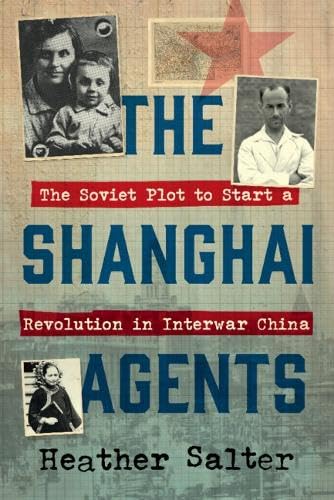
Joining us to tell this story is the historian Heather Salter, author of The Shanghai Agents: The Soviet Plot to Start a Revolution in Interwar China (Cambridge University Press, August 2026). We discussed the dangerous world of spies in 1930s China, how the Comintern fomented revolution worldwide, and how to forge a passport. Listen to the podcast, and read the transcript below:
Guest

Heather Salter is an academic focused on the history of imperialism and colonialism in the 19th and 20th centuries. She is Professor and Director of World History Programs at Northeastern University. Salter is the author of numerous books, including Martial Races (2004), World War One in Southeast Asia (2017) and The Shanghai Agents (2026).
The Far Eastern Bureau ultimately failed, but in this period between 1928 and 1931, without it, it’s not clear that Chinese communism could have survived at all.
Transcript
Alexander Boyd: First things first: what happened in June 1931 in Shanghai? How did the Shanghai police come to arrest this language instructor in his office?
Heather Salter: It actually starts in Singapore, because the Shanghai Municipal Police get a tip-off from the agent in Shanghai, who himself got a tip-off from the police in Singapore, who had been intercepting messages to known communists. One of the things that they got when they arrested this one man in Singapore was an address book, and in his address book was an address for a telegraph, and it was in Shanghai. So they sent this to the British-led Shanghai Municipal Police, and they were curious, because they had never seen anything like this. They tracked the telegraph address down, they tracked the address that was associated with it, and then they found this place on Sichuan Road. That’s how they ended up getting to Paul and Gertrude Ruegg.
Who did they think they had in their hands? And why were the Shanghai police so worried about communist activism in the Far East — worried enough to create this international cooperation in policing and, of course, in subversion as well?
One of the things I think people don’t quite understand about the interwar period is just how much the struggle between communism and anti-communism was already going on. The British in particular, the largest imperial power in the world, hated communism, because when the Soviet Union became the Soviet Union in 1917, one of the things that quickly happened is that they created the Comintern, or the Communist International, which was designed to help people who wanted to be free of colonial rule have communist revolutions. That’s not the only thing that the Comintern did, but that’s what it turned into in the 1920s. So for the British, communism was really an existential threat, because any anti-colonial person could theoretically get the help of the Soviets. This is why it was so threatening to them.
In Shanghai at the time, in the 1930s, this municipal police force wasn’t Chinese, right? It was a colonial body run by a consortium of international powers. The first thing that Ruegg does — he has extraterritorial protection — is insist on being tried by the international courts. Why did he want that, and why was he so afraid of being turned over to the Guomindang?
Many of your listeners might already know that even though China was technically independent in the interwar period, it was heavily influenced, and its sovereignty was very much impaired, by the European powers, particularly the British. Shanghai in particular is unique because it has a Chinese zone, and then it has two other zones that are fully functioning tiny little colonies. One is the French Concession, and the other is the International Settlement, which is run by the British and the Americans. One of the things that impeded the sovereignty of the Chinese government is that if you were a citizen of certain countries — there were 14 of them in the 1930s — the laws of China did not apply to you. You could get arrested for something anywhere in China, and you would be subject to your own laws. If you’re British, you’d be subject to British law and not Chinese law.
For communists, the reason this was very important is that the Nationalist Party, also called the Guomindang, had been in a partnership with the communists. But in 1927, Chiang Kai-shek turned on the communists, started murdering them, and then unleashed a period of White Terror, as they ended up calling it, so that it was incredibly dangerous to be a communist. It was illegal, and it was punishable by death. So when Paul Ruegg got arrested, he didn’t want to be imprisoned, and he certainly did not want to be tried by the Chinese, because this could have meant a death sentence for him.
Who were Paul and Gertrude Ruegg, really? Who were these two characters, and how did that story come to light?
That story took a long time to come to light. Nobody outside of the Soviet Union actually knew who they were until 1990, even though the British had spent thousands and thousands of dollars and labor hours trying to figure out who these people actually were — and so did the Chinese. But they had so many aliases. There were six or seven aliases that they had, and maybe four or five different passports. Paul and Gertrude Ruegg wasn’t even the first set of names they were known by. They were first Marie Vandercruyssen and Hilaire Noulens. Then there was another period when the Comintern tried to get them a different set of aliases. Eventually, I think by 1932, they were known all over the world as Paul and Gertrude Ruegg — but that is not who they were. Paul and Gertrude Ruegg were supposed to be Swiss. They were not Swiss. Paul was from Ukraine, and his real name was Yakob Rudnik, and Gertrude was from St. Petersburg, and her real name was Tatyana Moiseenko. It wasn’t until 1990 that a Swiss journalist who had been connected to the case through his father actually got their son, Jimmy Ruegg — also not his real name — to admit it. So it took, I think, 67 years to find out who they really were.
What were Yakob and Tatyana actually doing in Shanghai? What were their jobs?
Well, they were not innocent labor union workers. Both of them had a lot of time in grade as undercover agents. Tatyana had worked for the secret police before she worked for the Comintern, and Yakob had been in the military, and then he worked for the Comintern. They were both agents of the OMS [International Liaison Department], which was the logistical department and the most secret part of the Comintern, and they were the two OMS agents in Shanghai. The strategy was to have an office called the Far Eastern Bureau (FEB), and the goal was to help the Chinese Communist Party bring about a successful communist revolution in China in between the wars.
How did the Far Eastern Bureau do this work? In the book, you detail a lot of conflict between the FEB and the CCP, which was absolutely reliant on it for funding, and maybe some guidance, but also very resistant to FEB meddling in its internal politics. What did the FEB do to help the Chinese communists, and what was the relationship like between the Chinese Communist Party and the USSR at the time?
In theory, the goal was for the FEB to serve as mentors, financiers and weapons suppliers, so that the Chinese communists could bring about this revolution. In practice, no member of the FEB knew anything about China at all. That creates a problem when you’re trying to tell somebody how to run a revolution in a period when it’s incredibly dangerous to be a communist at all — when, if you get caught, you would get executed, especially if you’re Chinese and not European. So the relationship was, to put it mildly, extremely tense. Basically, what the Chinese communists wanted was money, because they had a really hard time financing what they needed to do. So they listened to the FEB enough to get the money, but they really tried to operate on their own. It wasn’t until 1931 that the FEB began to get a little bit more of an upper hand. That doesn’t mean they actually knew how to bring about a successful revolution in China, because oftentimes their advice was in direct contradiction to surviving, actually.
So how did this arrest impede that work? They’re arrested in 1931 — what happens next?
It basically tears apart the entire organization. Once Tatyana and Yakob are arrested, everybody else goes to ground. Nothing else happens for a while. The Soviets try to put it back together in 1933, ’34 and ’35, but it’s so dangerous, and there are not enough people on the ground. It basically falls apart.
As for what happens to them: the British arrest them, and they give them to the Chinese, hoping that the Chinese will kill them. The Chinese don’t kill them — it would have looked really bad, bad optics for a nationalist government trying to make itself look legitimate. They do condemn them to death, but then they commute the sentence. So they imprison them, and Tatyana and Yakob are imprisoned in China from 1931 until 1937 — and it would have been for life, except that in 1937, as we all know, something happens in China, and they end up getting released. They could hear the Japanese bombings coming in 1937, because they were in Nanjing.
At the time in Shanghai, amid this White Terror that you mentioned, there was another major spy case: the Gu Shunzhang case. What happened with Gu Shunzhang, and why did it matter so much for the atmosphere of espionage in Shanghai?
We already talked about how communism had become illegal and how the nationalists were murdering communists — they were literally trying to get rid of all of them. In self-defense, the remaining communists decided to take up the offensive themselves. The executive organization of the Chinese Communist Party, which was located in Shanghai, had a small unit that was responsible for assassinating nationalists and anybody who helped the nationalists. One of their main assassins was a guy named Gu Shunzhang. The British couldn’t catch him; the nationalists couldn’t catch him. But he ended up being caught in Wuhan, actually, and arrested, and he was brought back to Shanghai. And he turned from the communists to the nationalists, and he gave away all the names — I mean, he sang like a bird. This just created havoc among the communists in Shanghai who were trying to live in secret, and the Soviets who were trying to help them, including the Rueggs and their group. This happened in [April] of 1931, so everything was in disarray, because Gu Shunzhang was basically giving all of his secrets away — and he had a lot of secrets.
So Chiang Kai-shek, after four years of purging, feels ascendant, and all of a sudden he’s able to get his hands on these two Soviet agents and try them. But then something rather extraordinary happens: the case becomes a global media sensation, and Gertrude and Paul become heroes on the left. Albert Einstein writes in, but more importantly, Soong Ching-ling and Agnes Smedley lead a campaign to free them. Could you walk us through how they became these heroes on the left, and how this campaign worked? And how authentic was it? Because it was also an incredibly sophisticated Soviet propaganda effort.
Totally — and Soviet-financed. And it’s so funny, because Paul and Gertrude Ruegg were the most unlikely heroes: their entire lives before that, they had operated in secret. In fact, when they were becoming heroes in this public media campaign, they didn’t even know it, because they were already in prison and they didn’t have any contact. But the Comintern wanted them back really badly, so they used their biggest propagandist, a German communist named Willi Münzenberg. He had control of an entire media empire, and he had all these lists of people who would be willing to sign petitions — basically, they didn’t even care what the petition said. But he also had people who really did care about people who were imprisoned wrongly and things like that. So they made this case out to be the wrongful imprisonment of a hardworking trade union activist and his wife. Münzenberg got it out to all of his networks, and he had Soong Ching-ling in Shanghai and Agnes Smedley in Shanghai doing all the legwork in the city in order to get the story straight. I had a grad student do some research on where this turned up in newspapers, and it was every country in the world that he looked. Even in Brisbane, Australia, people in the smallest of towns were staging protests in favor of releasing Paul and Gertrude Ruegg.
The historian Frank Dikötter wrote a book earlier this year, Red Dawn Over China, which looks at the Party’s origins and Soviet support. In your book, you say something similar: the Comintern “was spending a small fortune, at least £120,000 to £150,000 annually,” to ensure the survival of communism in China. How does the story of the Rueggs — of Yakob and Tatyana — inform your perspective on how anti-colonialist the Soviet Union really was, if it was actually doing colonialism from below? Instead of imposing its will with a foreign army and foreign courts, it would fund secret organizations that aimed to take over a nation.
First of all, if I’m an anti-colonial activist in this period, I’m going to take seriously a country or an organization that’s actually going to give me money. It’s one thing to look at ideals, but in order to have a revolution, you need weapons, you need money and you need organization. From an anti-colonial perspective, I can see the appeal.
I do think that the Soviets were very condescending — and not all of them were actually Russian; many of them were other Europeans and even Americans. I do think that they were difficult to work with. They didn’t know a lot about China. But I don’t think the goal was ever to take over China by having a revolution. I think the idea, until Stalin squashed this later, was to have worldwide communism — and yes, the Soviet Union would probably have a central role to play in the international relations that would come from that. There are lots of contradictions, but the Soviets were the least systemically racist of the powers: they actually took people seriously for what they wanted to achieve. They gave training. They made things possible that no other power did at this time. So I don’t think it was just about “let’s see how we can someday really gain control.” I think it was part of this ideology. That changes over Stalin’s rule, but certainly when this all started, it was like that.
Speaking of how that ideology was attractive: a common theme in this book is that Western police completely dismissed women and their role as secret agents for the Soviet Union. They didn’t try to flip them, didn’t interrogate them, often let them walk — and completely whiffed on all the intelligence they could have gained if they had taken the role of women in espionage seriously. It’s a fascinating mini-history within the book. So, for our final arc: how did this plot presage the history of global intelligence cooperation between colonial powers — cooperation across bureaus that continues to this day, if no longer between colonial powers? Why did these disparate countries, which often had opposing interests, work so well with each other in the case of communist subversion?
I think this cooperation started in World War I. My previous book, World War One in Southeast Asia, talks about how colonial powers tried to diminish subversion in their colonies during the war by cooperating with one another, which did not come naturally to them. By the time you get to the 1920s and you have the Soviet threat — or the Soviet menace, as a lot of people talked about it — it was seen to be so much more threatening than anything a rival power could do that it was in everybody’s interest to try to get rid of it, and to share information to try to catch people across borders. Because in the 1930s, people were moving around, and they were moving around pretty easily. We think of our own times as the only time when people were moving around, but people were moving all over — even on airplanes, but especially on trains and boats and automobiles. So there was a lot of mobility, and a lot of reason to try to catch people who were moving across borders.
I thought it was fascinating to learn about all these cables going back and forth, asking people to check where passports were registered — that was a common tactic the Soviets were using. You break down how, in Basel, Switzerland, they had an agent on the inside who would use existing passports. Can you walk us through that? How did the Soviets create so many fake passports?
And I should say, too, it wasn’t just that people were moving. We think you have to have a computer to get information around. That’s really not true — people used the telegraph. Let’s say I’m a British policeman in Shanghai, and I need to know: are these passports legit? I can get in touch with my SIS agent in Shanghai, because there was one, and that agent can then cable to London and use all of the resources of MI6 and MI5 to go out to a place and interview people, to check records in a different city, et cetera.
You mentioned the agent in Basel. One of the passports that Paul and Gertrude each had was issued in Basel, Switzerland, and it turns out that there was a communist agent there who got paid so that whenever somebody needed an illegal passport, like Paul and Gertrude, that person would go through the legitimate passports and find somebody who kind of looked like them. They would take that photograph and that information, paste in the actual picture, and then process it with all of the other real passports. So if you weren’t looking carefully — if you didn’t have somebody cabling MI6 in London and then interviewing people — it would look totally official. That’s actually the only reason they got caught and were not able to use their extraterritoriality: the British knew that they were up to something, and they used every resource to make sure. They went and found the real person in Switzerland who had that passport and interviewed him, and he said, “I don’t know these people at all.” It takes real power and real command of resources to be able to do that.
Well, the British were able to find out who Paul and Gertrude were — but as you alluded to earlier, they had a son who fully believed that his name was Jimmy Ruegg. What happened to him after his parents’ arrest? Were they reunited, and where and when? And how did he come to find out that he was not Jimmy Ruegg?
It’s a sad but not tragic story — and I guess that will become clear in a second. When Gertrude is imprisoned in 1931, he’s three years old, and they thought they’d be out of prison quickly. But she doesn’t see him again as a free person for 13 years. Until 1936, he’s taken care of financially: the Comintern sends money, and it goes to Soong Ching-ling; later it goes to Agnes Smedley, and she’s the one in charge of the finances. They are responsible for all of Jimmy’s needs in terms of schooling, food, et cetera. They end up housing him with a very nice German family — Gertrude loves the mother. It turns out that they end up being Hitler lovers and fascists, which is a weird twist of fate, but they take good care of Jimmy, until Soong Ching-ling arranged for him to be taken back to the Soviet Union and housed in an orphanage, thinking that he would be there for the rest of his life.
Then, when Tatyana and Yakob were released in 1937, it took them a couple of years to get back to the Soviet Union. Once they did, there were a lot of hoops to go through, because we’re just at the end of the terrible purges, and there was a lot of testing and retesting them to see if they were loyal. Then it’s the middle of World War II, so they don’t actually see Jimmy again until 1944, just at the tail end of the war. He doesn’t know that his name is not Jimmy Ruegg — that his name is actually Dimitri Moiseenko — and that his parents are alive and coming to get him. So he’s 16 years old, and he goes to live with strangers. And she had been torn up by this for the entire time they were separated. It defines her captivity — she does very poorly, actually. I always think about how tragic it was that she missed his entire childhood, and then, when she finally did get him back, he was too old to be her little boy anymore.
It was a sad story for the Moiseenko family. But Jimmy’s orphanage wasn’t a Lemony Snicket-style terrible institution — it was this palatial thing, and he was there with Mao’s sons, right? Then he went to a much more shabby and modest lifestyle: in the heart of Moscow, sure, but not among the political princelings he’d grown up with.
Yes — in a tiny apartment in the Hotel Lux, which had been vacated mostly by people who were murdered during Stalin’s purges.
Those vacated rooms remind me of the historian Yuri Slezkine’s book The House of Government, about the original Old Bolsheviks — which both Tatyana and Yakob were. As you mentioned, they came back to these loyalty tests and had to go through their files, and it turned out that Yakob had been accused of being a Trotskyist, something he didn’t really deny. But it was okay, because the person who had testified against him the most had already been executed in the Great Purge. It’s really a stunning story of violence. How did researching this inform your opinion of the 1930s, and of these revolutionary interwar years?
A key takeaway is that we always talk about the Cold War starting in 1947, but honestly, if you don’t look back to this earlier period, you can’t really understand how it takes off and how it’s shaped the way that it is. The Cold War, of course, is between the U.S. and the Soviet Union, but this earlier period helps us understand why the U.S. ended up being the champion of the position that the British used to play. So I think it helps us understand the Cold War better, which fundamentally reshaped our world.
I also think it helps us better understand the deep antagonism that still exists between the Chinese communist government and the nationalist government that ended up in Taiwan. This is something that hasn’t gone away, and it has real historical roots in the terror that the Guomindang imposed on Chinese communists. People ask, “What’s the big deal about Taiwan? Why is it so important?” Well, that’s part of the reason why it’s so important.
And then there’s the story of the FEB. It ultimately failed. But in this period between 1928 and 1931, without it, it’s not clear that Chinese communism could have survived at all. They really propped up Zhou Enlai, who ended up becoming one of the most important leaders of the Chinese communist government after 1949 — and they actually keep him in his place. He wants to leave, because of all kinds of things, but they say, “No, don’t leave.” So it failed, but it also, for a crucial moment, might have helped the Chinese Communist Party survive and be able to fight another day.
It’s a really compelling argument that those crucial years saved the Communist Party. Ironically enough, of course, there’s a Sino-Soviet split just a few decades down the line, which causes all sorts of problems for the USSR and China — but Russia, at least, and China are back on good terms today.
Even though I think the Russians would like to see themselves in that mentoring role, from the Chinese perspective, it’s the Chinese who are very much in control of that relationship now.
Absolutely.
Thank you so much for talking about this story. It’s near and dear to my heart, and hopefully it will help people understand what happened after the end of World War II, because this period really is important for understanding that.
Fully agree. Thank you, Heather. ∎
Alexander Boyd is Associate Editor of China Books Review. He served as a Peace Corps volunteer in Guizhou, China, from 2018-20, and was a contributor to The China Project, Politico and the ChinaTalk podcast. He was previously Senior Editor at China Digital Times.