Sign up for our newsletter to be notified of new posts!
Anyone who has lived in or visited the U.K. will likely be familiar with the Blue Plaque scheme: circular signs on buildings across the country, commemorating the link between that location and a culturally significant person or event. To qualify for a Blue Plaque, nominees must be regarded as eminent within their field; that is, their achievements have made an exceptional impact or deserve national recognition. Nobody is quite sure how many Blue Plaques there are — it’s rather a hodgepodge system, administered locally — although London alone has about 900.
For decades, Britain only had two Blue Plaques commemorating the lives of Chinese people: one to the writer Lao She, and another to Sun Yat-sen, “Father of Modern China.” Lao She is remembered in London’s Bayswater, where he lived in the 1920s with the eccentric Orientalist Clement Egerton. There they worked together on the English translation of the Jin Ping Mei (金瓶梅, published in English as The Golden Lotus in 1939), which Egerton dedicated to his good friend “Colin Shu,” the name by which Lao She was known in London. Dr Sun’s plaque is slightly harder to find, in the Hertfordshire village of Cottered (population 634) on the wall of the former home of James Cantlie, who had taught Sun medicine in Hong Kong. When Sun was kidnapped by the Imperial Chinese Secret Police in London in 1896, Cantlie agitated for his release, after which Sun recuperated from his ordeal in the quiet environs of Cottered.
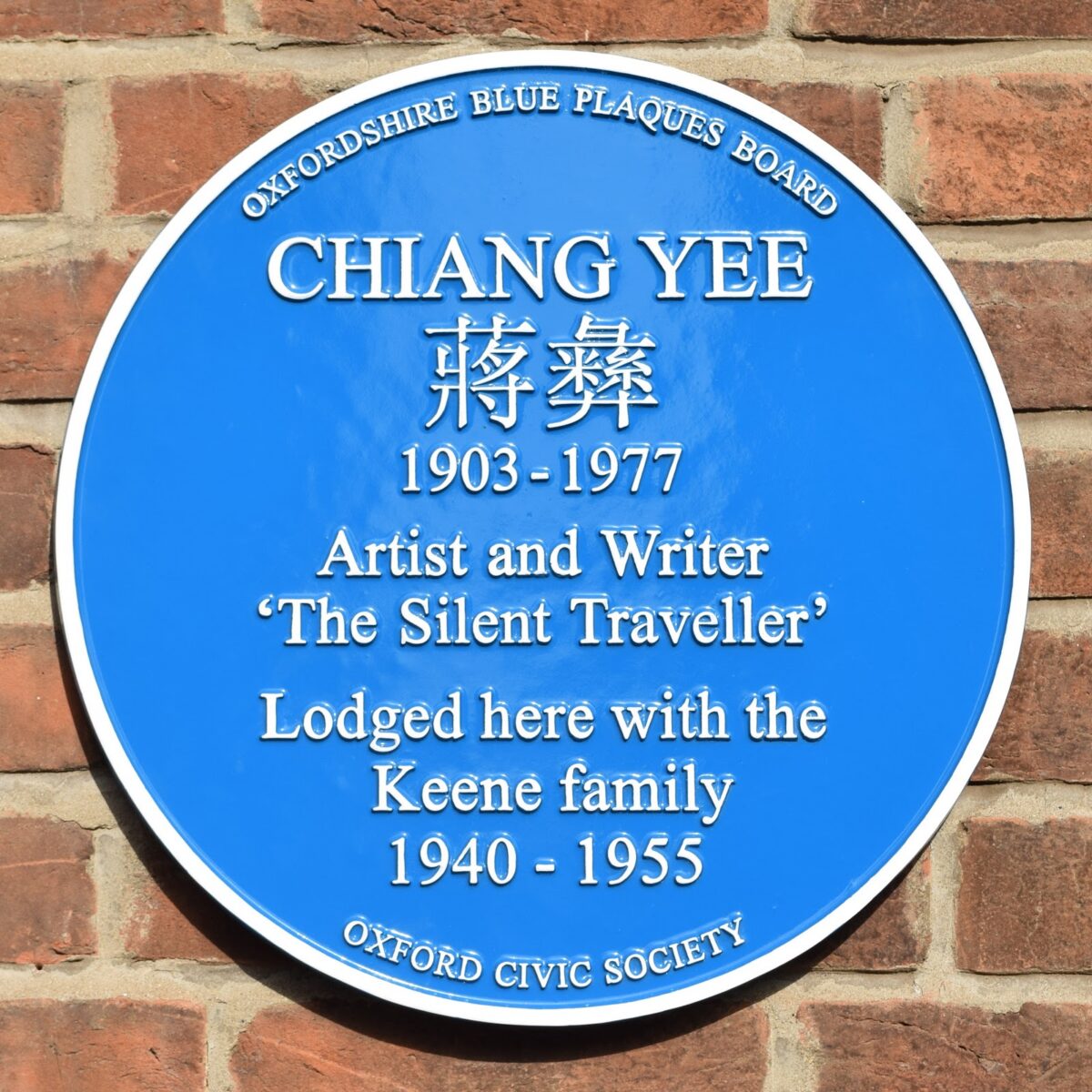
Both are worthy of Blue Plaques, but English Heritage (the charity that manages many historic monuments and buildings) wondered about the lack of diversity in the scheme. Why so few plaques for Black and Asian people? It takes a while for submissions to get through the vetting process from an initial application, requiring support from knowledgeable academics and experts as well as permission from the property owner. Yet in 2019 a Blue Plaque was successfully installed to commemorate a third Chinese luminary in Britain, the author and artist Chiang Yee (蔣彝), at his old residence in the university town of Oxford.
Chiang is best known for his Silent Traveller series, illustrated travel books much loved for their Chinese perspective on British cities, landscapes and people.
Chiang Yee was born into a wealthy family in Jiujiang, Jiangxi province, in 1903. He served in China’s National Revolutionary Army during its fledgling Republic, then worked as a chemistry teacher, newspaper editor and country magistrate. His father was a successful portrait artist who encouraged Chiang’s early interest in painting and calligraphy. Life in early 20th-century China was characterized by upheaval, as the country was torn apart by struggles for political power following the end of imperial rule in 1911. In the midst of this turmoil, calls for social change engendered a powerful movement to reinvigorate Chinese culture and establish a modern identity for the nation.
Following the end of World War I, many Chinese artists and intellectuals came to study in Europe and America. They learned about politics, law, science and literature from a western perspective in order to bring new ideas back home. Most of those who studied abroad, such as Deng Xiaoping, who studied in France in the 1920s, returned to live in China after a few years. But some, including Chiang Yee, stayed to make a life for themselves.
Chiang came to Britain in 1933 and stayed for the next 22 years. For the first seven of those, he became established in London’s artistic and literary scene as a lecturer and commentator, spending a great deal of time commuting between London and Oxford. His first major publication, The Chinese Eye: An Interpretation of Chinese Painting (1935), signaled the start of a period when Chinese intellectuals directly communicated their culture to western audiences. Throughout the 1930s and 1940s, Chiang was regularly invited to contribute to BBC radio programs to discuss Chinese art, poetry and literature. He published a series of children’s books and guides to Chinese calligraphy, and produced hundreds of sketches and paintings of London Zoo’s first pandas from China (Song and Tang with their baby Ming) that arrived at Regent’s Park in 1938, earning him the nickname “the Panda man.”
When Chiang arrived, there was already a small but significant Chinese community in Britain, established in the late 19th century and concentrated in Liverpool and London. In 1931 a census recorded 1,934 Chinese living in England and Wales. Many worked as sailors on merchant shipping routes, while others were employed in laundries, shops and restaurants. Popular perceptions of Chinese people in Britain at the time were commonly based on sensationalist press stories and caricatured stereotypes in novels and films. They were invariably portrayed as sinister characters who gambled, smoked opium and inveigled white women into prostitution, an image most notoriously embodied by Sax Rohmer’s villainous novel series character Dr. Fu Manchu.
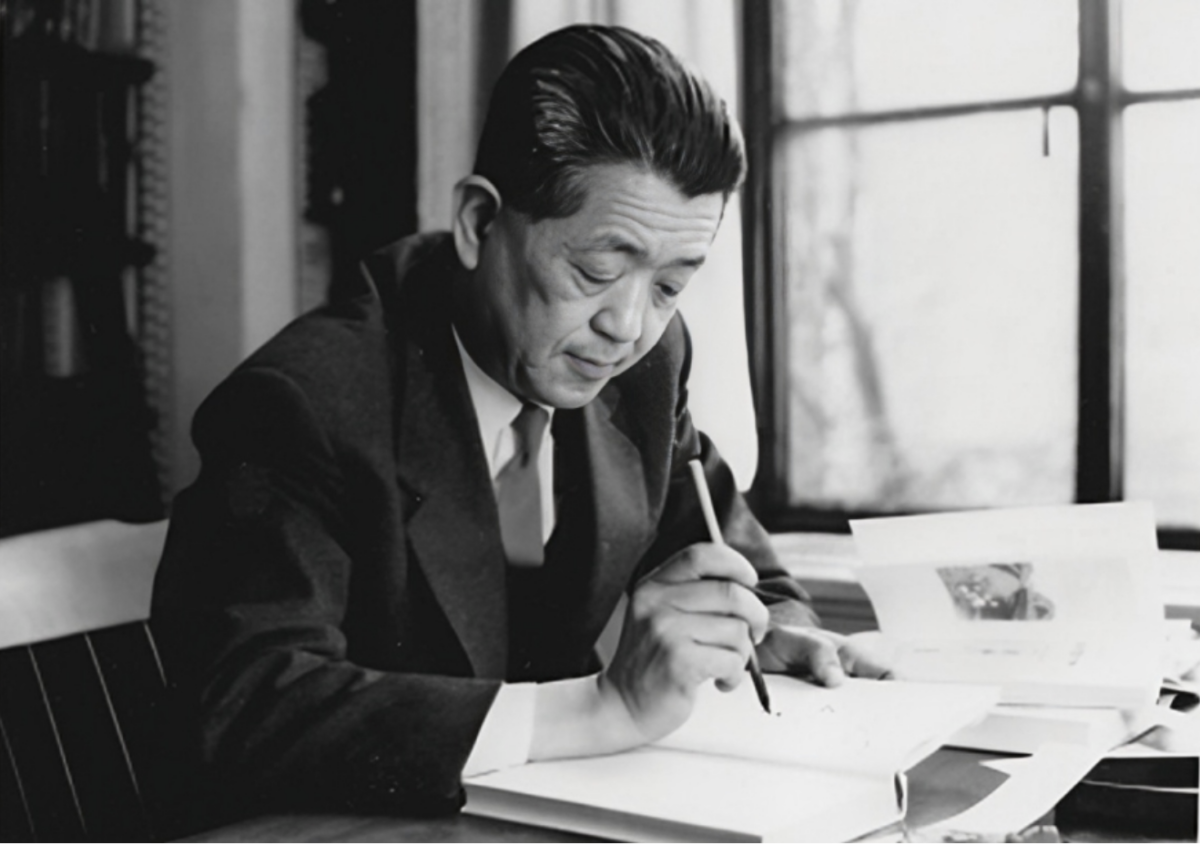
Chiang was also a key member of a small group of Chinese artists, writers and intellectuals living in London just before World War II. Compared to Britain’s early Chinese community in East London’s Limehouse and the post-war Chinatown of Gerrard Street in the West End, this group of Chinese literati has been too often forgotten and too little studied. According to Paul Bevan, author of Chiang Yee and His Circle: Chinese Artistic and Intellectual Life in Britain, 1930–1950 (2022), the group mostly lived in the Hampstead and Belsize Park districts of northwest London. At that time, the area was a mixed community of artists, writers and musicians, a large number of whom had recently fled from Nazi persecution in Europe.
For a time, Chiang Yee shared a flat in a house on London’s Upper Park Road with his friend Xiong Shiyi (熊式一), author of the popular West End play Lady Precious Stream, and Xiong’s wife Dymia, the first Chinese woman in Britain to write her own autobiography. Their circle of friends also included the literary translator Yang Xianyi (楊憲益), who studied at Oxford but regularly visited London, as well as Xiao Qian (蕭乾), an essayist, translator and newspaper reporter. Also living on Upper Park Road were the poets Wang Lixi (王禮錫) and his wife Lu Jingqing (陸晶清). With their partners, children and friends, this group comprised an important social and intellectual network of Chinese writers and artists in London before the war.
It was the war that effectively ended that community. Japan’s attack on China in 1937 meant that some of the group returned home, while others lent support to the war effort. Chiang Yee worked closely with Xiao Qian (who had returned to China to journey up the Burma Road from Yangon to Kunming on a reporting trip) and George Kung-chao “KC” Yeh (葉公超), who ran China’s wartime Ministry of Information Office in Bentinck Street, Marylebone. Together they, and others, worked to raise awareness of China’s plight in the U.K. Xiong Shiyi, Dymia and their children moved from London to Oxford when the war started. Chiang Yee stayed in London until a fateful night in 1940 when his house was bombed and he was rendered homeless.
Popular perceptions of Chinese people in Britain at the time were commonly based on caricatured stereotypes in novels and films.
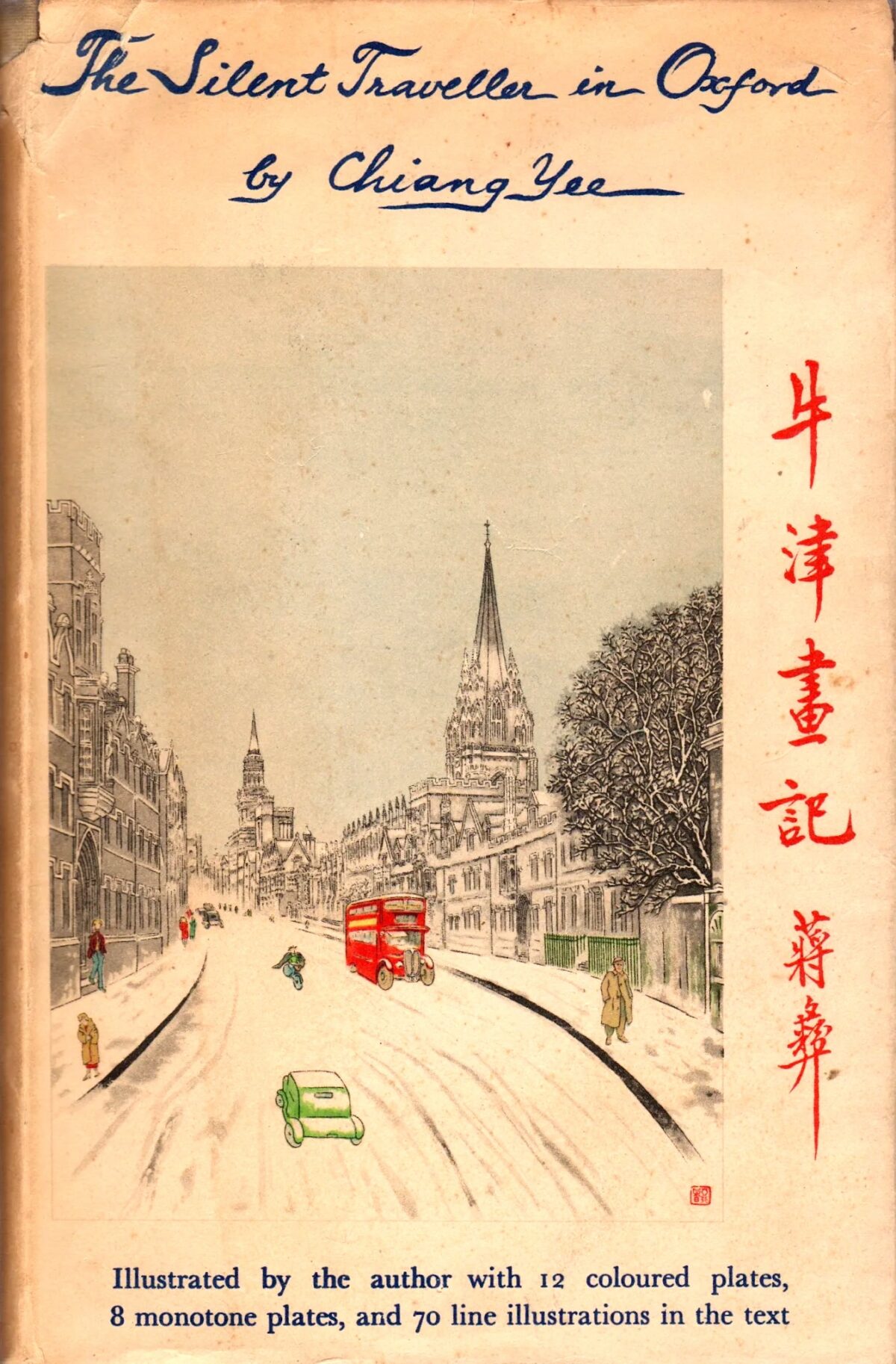
Chiang’s books and lectures on Chinese art and culture were designed to represent his culture in a fresh light to a foreign audience. Yet he is best known for his Silent Traveller series, illustrated travel books much loved for their Chinese perspective on British cities, landscapes and people. Their alternative presentation of Britain was an innovative attempt to synthesize two diverse cultures at a time when the Orientalist model persisted as a dominant influence in the collective British consciousness. The first, Silent Traveller: A Chinese Artist in Lakeland (1937), was an account of his visit to the Lake District in northern England, featuring his own paintings. Next came The Silent Traveller in London (1938), The Silent Traveller in the Yorkshire Dales (1941) and The Silent Traveller in Oxford (1944).
After his London home had been destroyed in the Blitz, Chiang Yee lived at 28 Southmoor Road in north Oxford for 15 years, renting a downstairs front room from the local Keene family. Almost 80 years later, in June 2019, a crowd including Oxford’s mayor gathered outside the house to commemorate the Blue Plaque. Unveiling the plaque itself was Rita Keene Lester, who was three years old when Chiang first arrived to lodge at Southmoor Road. Rita recalled her memories of “Uncle Chiang,” who, during the difficult years of World War II, would go fishing on the Cherwell River, come home with a carp and cook it Chinese-style, much to the delight of a family living on minimal wartime rations. An audience of around a hundred academics, Sinologists, art lovers, curious locals and some descendants of Chiang Yee who still live in the U.K. also gathered at the Ashmolean Museum in central Oxford, for a symposium to celebrate his life and work.
Chiang left Oxford in 1955 to move to the United States, where he was a lecturer in Chinese at Columbia University, and later a Fellow in Poetry at Harvard University, becoming a naturalized citizen in 1966. He continued writing and illustrating his Silent Traveller series, featuring cities including Edinburgh, New York, Dublin, Paris, Boston and San Francisco. In 1975, in his seventies after living for 42 years outside his homeland, Chiang returned to China. He died there two years later, and is buried near his hometown of Jiujiang.
In The Silent Traveller in Oxford, Chiang notes that Chinese people were not allowed to enter Trinity College. Now, Britain has three Blue Plaques commemorating the Chinese intellectual presence in England. The continuing diversification of the scheme is of crucial importance in recognizing the rich cultural mix of Britain’s heritage, how the U.K. has been influenced by the wider world, and the centrality of migration in shaping who we all are today. ∎
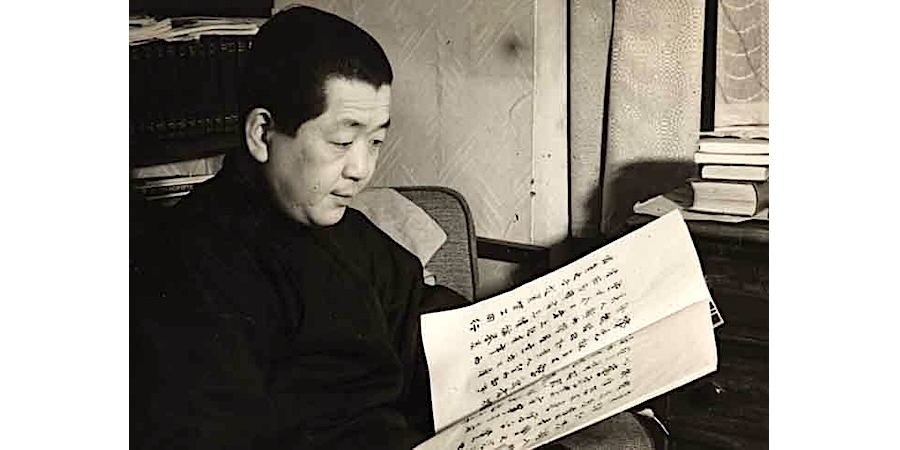
Header: Chiang Yee gives a reading in his London residence in the 1930s (Sam Edwards). This essay was adapted from a previous post at the LARB China Channel.
Paul French lived in Shanghai from the 1990s to 2014, running the market research publisher Access Asia. He is the author of Midnight in Peking (2012), a New York Times bestseller, City of Devils (2018) and other titles. His most recent book is Her Lotus Year (2024).