Sign up for our newsletter to be notified of new posts!
Reviewed:
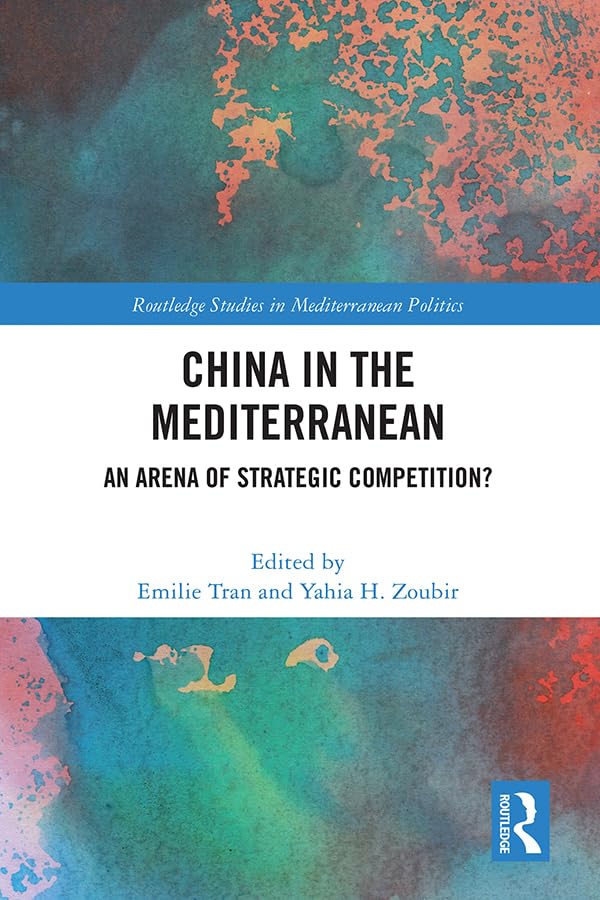
• China in the Mediterranean: An Arena of Strategic Competition?, ed. Emilie Tran, Yahia Zoubir (Routledge, November 2025).
• Navigating the Mediterranean Through the Chinese Lens: Transcultural Narratives of the Sea Among Lands, ed. Renata Vinci (Firenze University Press, June 2024).
At dawn on an autumn day in 1859, a 20-year-old Chinese man arrived on the island of Malta, then a British colony. In his diary, he recorded his first impression of the foreign town, with its charming architecture and courteous people:
In the city, soldiers and civilians were all surprised by the different colors and style of my clothes, and a crowd of children began to follow me very closely. … We then visited a garden with a stone lion spouting water. This garden has a coffee house (similar to our teahouse) and a reading room filled with amazing books from everywhere. … Seeing that I was from far away, the locals sat down and chatted with me.
The writer, Guo Liancheng (郭连城), had recently left China with an Italian missionary, Luigi Spelta, who was heading back to Italy with a stopover at Malta. Spelta invited Guo, a recent convert to Catholicism from Hubei province, to accompany him. In 1863, the young convert’s travelogue was published in Chinese as A Brief Account of My Journey to the West (西游笔略). Predating the first official Chinese delegation to Europe in 1866, it is considered one of the first and most exhaustive reports on the West by a Chinese traveler.
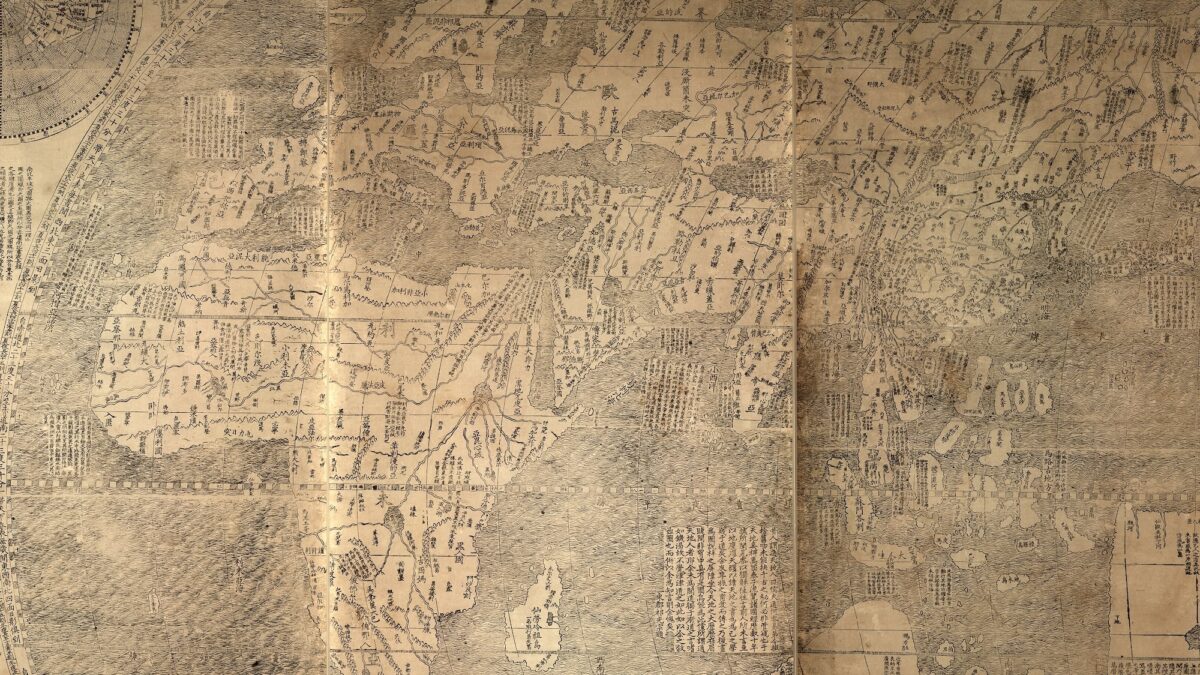
China and the Mediterranean had established contact long before Guo Liancheng set foot in Malta. While the Han dynasty emissary Zhang Qian (张骞) helped to establish the so-called silk road connecting China’s ancient capital of Chang’an (modern-day Xi’an) to what was then termed the “western territories” (西域), archaeological findings push the date of first contact further back. At the Majiayuan (马家塬) site in modern-day Gansu province, West Asian beads with dragonfly-eye motifs were found, proving material contact with the Mediterranean in the Warring States period. Scholars also debated whether the Terracotta Army, buried with China’s first emperor in c. 210 BCE, might have Greco-Roman influences, via the Greco-Bactrian Kingdom of Central Asia. It was not until the Han dynasty that the Mediterranean region was first mentioned in Chinese historical records as the “western sea” (海西) or “Great Qin” (大秦). The Chinese term “sea between lands” (地中海), the Mediterranean’s Mandarin name, was first featured on the Jesuit missionary in China Matteo Ricci’s world map in 1602.
By the time Guo Liancheng came to the Mediterranean in the late Qing dynasty, the colonial era had brought updated geographic knowledge to China as well as foreign aggression. In his account, Guo, who had learned Italian, displays a serene curiosity as he explores Malta. He emphasizes the importance of girls’ education on the island — perhaps envisioning China’s own modernization. Today, that modernization is well underway, and Beijing has deepened its ties with Malta and other Mediterranean countries through the Belt and Road Initiative (BRI). Roads and ports are dug together, and archaeological findings are jointly unearthed. China has worked with Mediterranean countries to build the world’s longest cargo railway line, ensuring the smooth delivery of a package from Yiwu to Madrid. There is even a Malta Research Center at my alma mater, Beijing Language and Culture University. Guo would be proud.
China and the Mediterranean had established contact long before Guo Liancheng set foot in Malta.
Two recent edited volumes explore the complicated relations between China and the Mediterranean. China in the Mediterranean, edited by Emilie Tran and Yahia Zoubir, evaluates Beijing’s increased footprint on both northern and southern shores of the Mediterranean. Navigating the Mediterranean Through the Chinese Lens, edited by Renata Vinci, turns to Chinese sources from the Han to Qing dynasties (including Guo Liancheng’s travelogue) to view the Mediterranean from a transcultural perspective. Addressing different disciplinary fields, the two books complement and contrast each other in their theoretical framework and transnational approach. Together, they demonstrate China’s historical and growing need to engage the Mediterranean region, including the Arab world.
China in the Mediterranean adopts the sociological concept of “role theory” to understand foreign policy behaviors. Role theory uses the analogy of theater to interpret an individual actor’s agency in relation to the larger social structure. For instance, while China’s own conception of its role as an opponent of hegemonism and a proponent of “peaceful development” (和平发展) has helped it gain trust from developing countries in North Africa who share similar historical colonial struggles, Beijing’s ambiguous political agenda and the discrepancy between its words and deeds (“inadequate role performance”) bring confusion and mistrust among its strategic partners.
The volume’s contributors contend that, contrary to the common belief that China threatens to subvert the U.S.-led international world order, Beijing’s priorities remain domestic, seeking not to challenge U.S. hegemony, but to overcome its disadvantaged position in global commodity pricing, the dollar-dominated monetary system and international human rights discourse. Moreover, they argue that despite its decade-long infrastructure diplomacy in the Mediterranean, China has not fulfilled its economic or political goals. Beijing’s economic presence in North Africa cannot match that of the U.S. or the EU, while even the few pro-BRI European countries see China as a systemic rival in North Africa, “Europe’s backyard.”
It is notable that Beijing is not only building roads and ports in the Mediterranean, but also cultural institutions, including the Association of Arab Translators and Sinologists (est. 2016), the Egyptian Chinese University (est. 2016) and a Sino-Egyptian joint archaeological team (est. 2018) that work together to elevate China’s visibility in Egypt. These soft-power initiatives have also spread to the northern shore of the Mediterranean. At the Chinese School of Classical Studies at Athens (est. 2024), plans for excavations in Aetolia are underway.
For all of Beijing’s enthusiasm to unite “ancient civilizations,” favorable views of China in Mediterranean countries, such as Egypt and Greece, remain low. The main reasons that the volume cites are trade imbalance, corruption, the Uyghur question and the perceived culturally insensitive behaviors of overseas Chinese employees. The book notes that local Algerians, for example, questioned the soundness of their government’s decision to build a $2 billion mosque, the world’s third largest, with an “atheist state” which “oppresses our Uighur brothers.”
Overall, the collection provides a timely overview of recent China-Mediterranean contact in economic and geopolitical terms. However, its top-down analyses overshadow the interpersonal interactions throughout history that transcend nation-states and political initiatives. Navigating the Mediterranean Through the Chinese Lens is a more timeless work, conducting close readings of Chinese sources to show that Chinese empires and individuals have had contact with the Mediterranean world since at least 200 BCE. While role theory reinforces national characteristics and expected behaviors through the lens of a significant other, this transcultural approach encourages multifold points of view, seeing modern nations as continuations of older civilizations in constant flux.
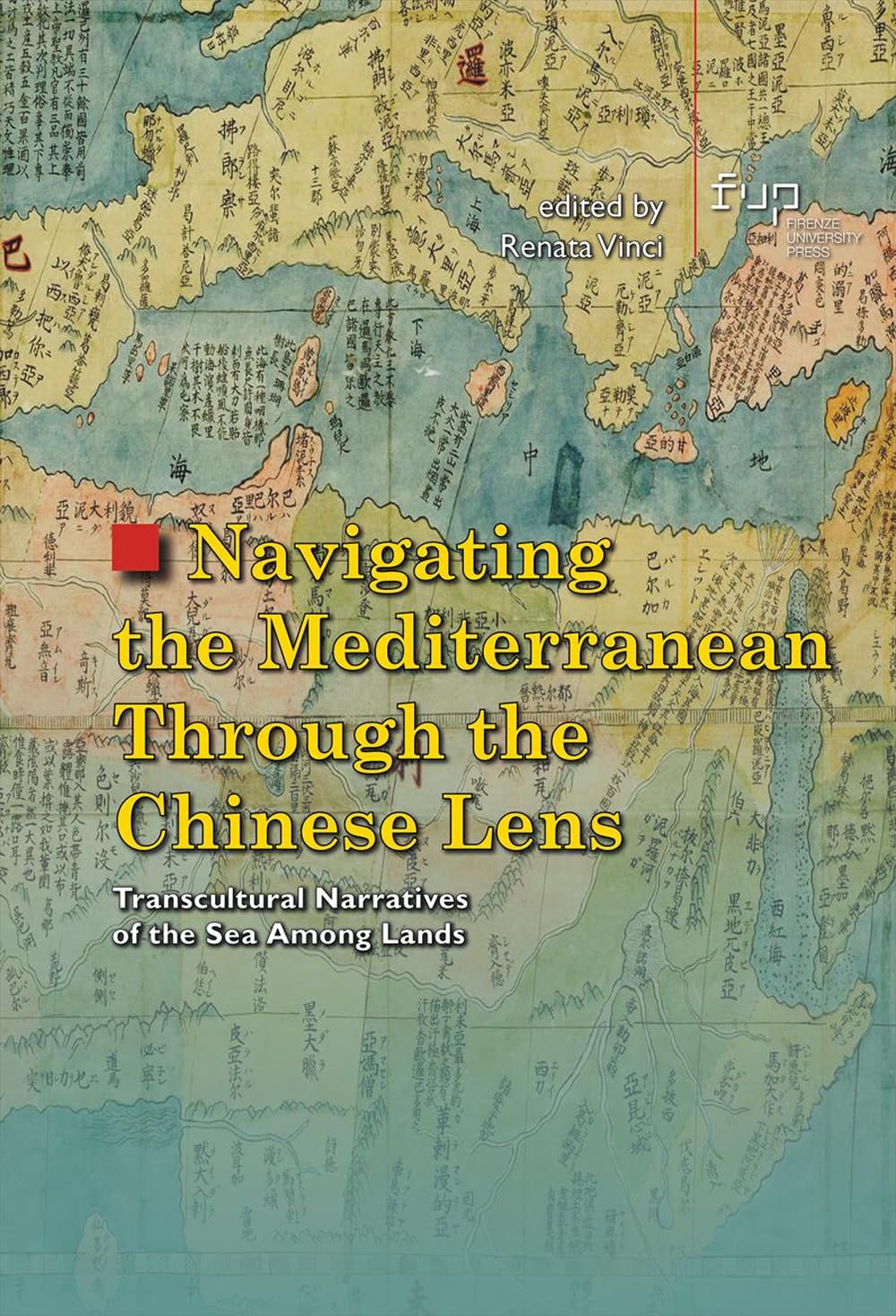
In this intellectual and historical milieu, Navigating the Mediterranean Through the Chinese Lens attempts to view the Mediterranean from the Chinese perspective. The chapters progress chronologically to introduce China’s perception of the Mediterranean from the Han to the Qing dynasties. Topics include the toponym “western sea” (海西), identifying it with Egyptian territory; transcontinental networks linking China to the Greek-Hellenistic world; a journey into the Arab-Islamic empire on the northwestern coast of Africa by a Tang dynasty soldier, Du Huan (杜环); how a Yuan dynasty Uyghur Nestorian monk, Rabban Sauma, may have been the first Chinese traveler to cross the Mediterranean Sea to arrive in Europe; whether Wang Dayuan (汪大渊) reached Morocco in his Yuan dynasty travelogue A Brief Account of Island Barbarians (岛夷志略); the role of Roman law in late imperial Chinese legal reform; and contemporary literature produced by Chinese-Italian writers. Ironically, none of the contributors are Chinese or scholars working in China, despite a growing presence of the Mediterranean Studies field within China, revealing the same structural imbalance the volume aims to ameliorate. Navigating the Mediterranean Through the Chinese Lens is still written from the European lens.
For all of Beijing’s enthusiasm to unite “ancient civilizations,” favorable views of China in Mediterranean countries, such as Egypt and Greece, remain low.
Contemporary Mediterranean Studies can be traced back to the 20th-century French historian Fernand Braudel, who saw the Mediterranean as a unified space, “a succession of seas” and overlapping civilizations. Since then, scholarship on the region has oscillated between its converging or fragmented identities, while post-colonial debates have invigorated scholars to study non-Western sources. Politically, the post-9/11 division between the Judeo-Christian and Islamic worlds brought a renewed appreciation of the Mediterranean as a moderating space for the coming together, rather than the clash, of civilizations. The Mediterranean has even transcended its own coastal perimeter to become a model for studying other histories of seas, such as the Caribbean and the Indian Ocean, steering away from a land-centric view of civilization.
One of the most important contributions of Mediterranean Studies is its inherent critique of modernity. In On History (1980), Fernand Braudel situates human history between “the instant of time and that time which flows only slowly,” noting the Mediterranean’s slow transformations against which current events (like the BRI) represent “surface disturbances, crests of foam that the tides of history carry on their strong backs.” Another scholar of the Mediterranean, the Italian sociologist Franco Cassano, also critiques these modern notions of progress, whose linear and industrial façades present a mere illusion. Real progress, he argues, lies in replacing the “tyranny of urgency” with the “singing of enduring time.”
State broadcaster CGTN lauds Chinese-Greek cooperation on an archeological dig near Athens.
If Braudel challenges the historical significance of a political initiative such as the BRI in the longue durée, Cassano targets its problematic conception. If countries from the Global South buy into the speed of modernization embraced by the Global North, isn’t that equivalent to adopting the “tyranny of urgency” to compete with the tyrant? People from China and the Mediterranean once lived according to the slow, cyclical turn of the earth and other celestial bodies. They produced everlasting monuments, gardens, music and poetry that still inspire us today. In our modern era, we are perpetually running on mechanical, monetized clock time. Personal wonderment is near obsolete, culture has receded to the background and AI is taking over.
The afterword of Navigating the Mediterranean Through the Chinese Lens quotes the Chinese writer Shi Yang Shi, who documents his experience of being an undocumented immigrant in Italy in his play Tong Meng (同梦). Shi and his dad used to sell Chinese red flower oil (红花油) on the beach to help locals ease their physical pains, but they had to dodge the police regulating street vending:
They caught us in the water.
Usually if you ran into the water they would stop, but not that time. They kept running even in the water. …
They took our mug shots, they took our fingerprints and they confiscated many remedies and ointments, a big economic loss for us. Then they gave us a deportation order, which is useless, because they don’t take you to the border, they just tell you that you have to leave the country by a certain day.
Unlike Guo Liancheng in 1859, Shi Yang Shi’s experience as a Chinese in the Mediterranean was filled not with wonder, but marred by dread. A dread of losing safety, livelihood, home. A dread of not belonging. While Guo’s foreign clothing invited curiosity from local Maltese, local Italians didn’t pay much attention to Shi, stripped down to a bathing suit to hawk cooling ointment. He couldn’t even find safety in the water of the Mediterranean — the sea that joins the south and the north, the east and the west without discrimination, but which has been claimed by political and economic forces beyond his control. Because his body, also made of water, has too been claimed by modern states. ∎
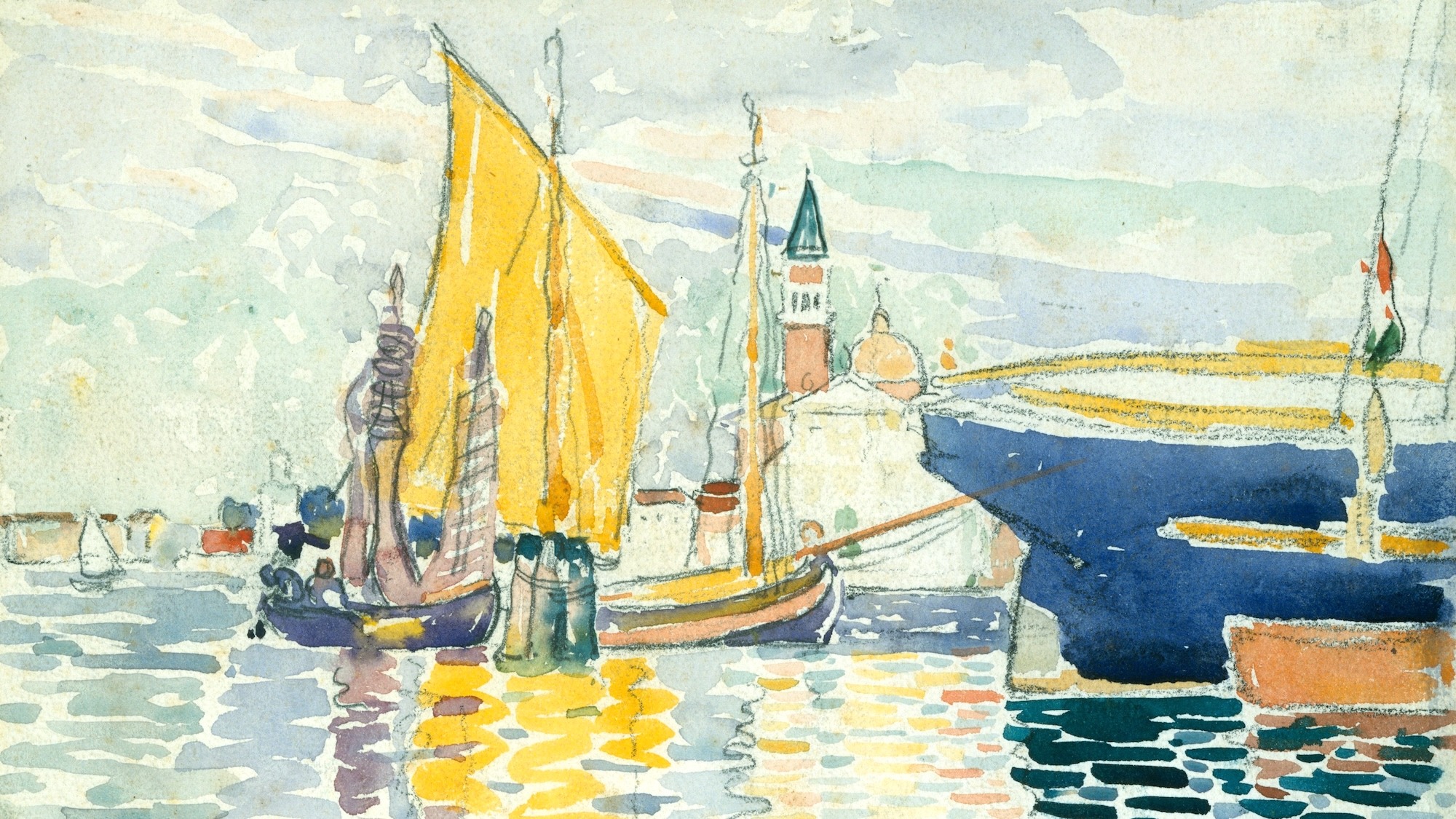
Feature image: “Venice-The Giudecca” (1903) by Henri-Edmond Cross. (The Metropolitan Museum/Robert Lehman Collection)

Liuyu Ivy Chen studies pre-modern Chinese literature and Mediterranean humanities at Columbia University. Her work has been published by Washington Square Review, Asymptote, The China Project and others.