Sign up for our newsletter to be notified of new posts!
Welcome back to What China’s Thinking, our interview column with Chinese public intellectuals, thinkers and creators on the ideas that impassion them.
Since Donald Trump announced his presidential bid in 2015, a curious phenomenon has emerged among Chinese public intellectuals: a wave of Trumpification. This embrace of Trump crossed traditional ideological divides, attracting liberals and anti-liberals alike. In a paper published online in 2020, political scientist Lin Yao (林垚) examined this trend, arguing that it was driven in large part by what he called “beaconism” (灯塔主义) — a tendency among Chinese liberal intellectuals to idealize the United States as a political and civilizational model. Now, well into Trump’s second term and with the midterm elections approaching, that enthusiasm appears to have faded considerably.

Lin’s own academic journey has taken him across disciplines and continents, from biology to philosophy, political science to law, and from China to the United States. Born in 1983 in Xiapu County, Fujian province, a poor county town by his own account, Lin had an unusual upbringing. Through his adolescence, he ate lunch and chatted almost daily with sex workers who lived in his neighborhood. Those encounters helped spark his interest in social issues and the lives of people often overlooked by mainstream society. He studied biology at Peking University, then switched to philosophy, completing a master’s degree there in 2007. He later moved to the United States, earning a Ph.D. in political science from Columbia University in 2016 and a J.D. from Yale Law School in 2021. Along the way, he has written extensively and appeared on podcasts covering philosophy, science, politics and public affairs, moving fluidly between academic scholarship and public debate. In 2024, he published Empty Talks (空谈), his first collection of essays, bringing together his writing on a wide range of public and intellectual issues. He is now an assistant professor of political science and director of the pre-law program at the University of Detroit Mercy.
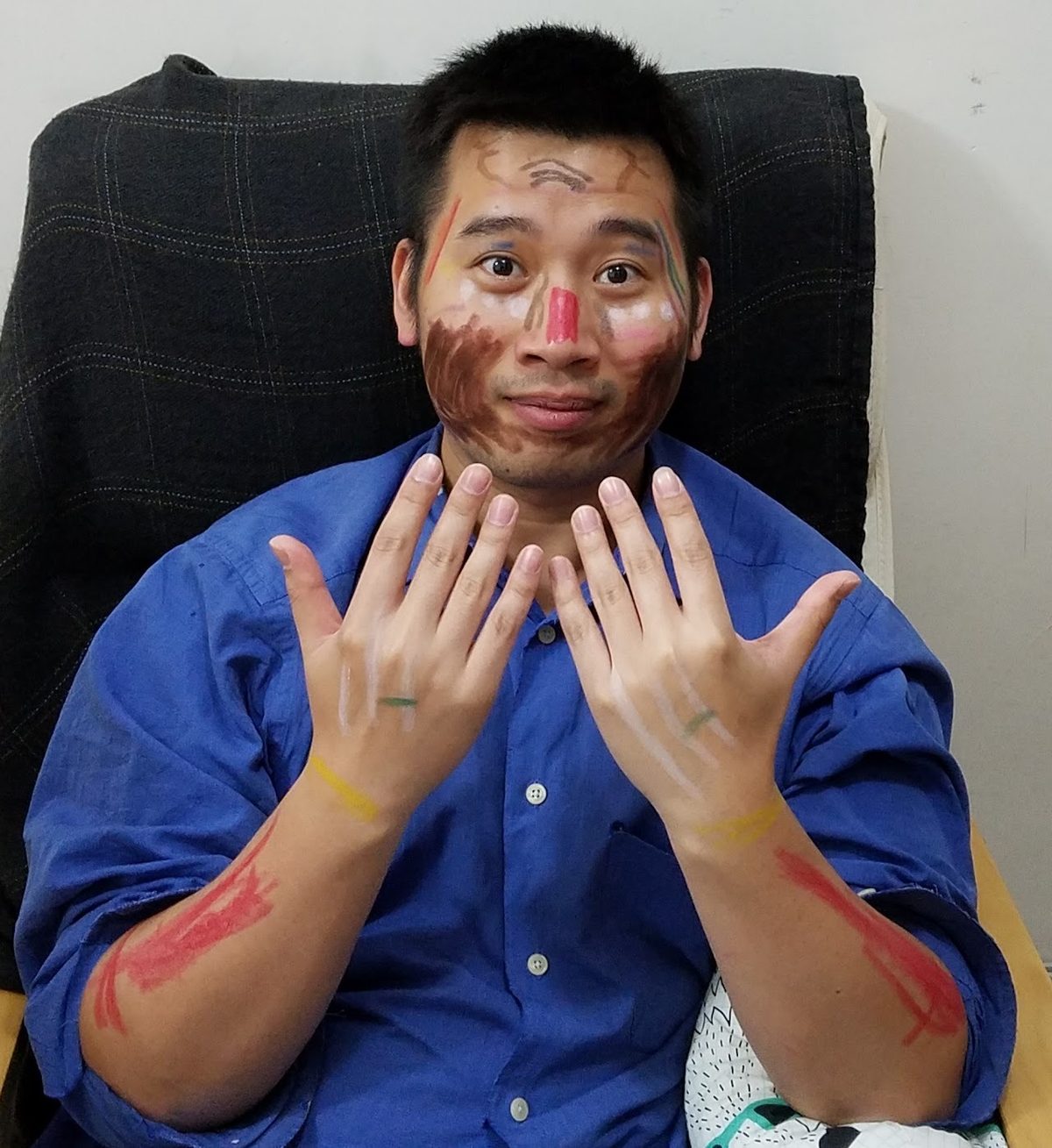
I met Lin earlier this year at a café near Columbia University. In person, he is quiet and reserved, a man of few words. He still dresses like a college student, in a plaid shirt and carrying a backpack. Over coffee, we talked about his childhood, his observations of China’s intellectual circles, and his experiences working at universities in both China and the U.S, as well as what might explain the changing attitudes of Chinese intellectuals toward Trump.
Yi Liu: You’ve earned several degrees, in biology, philosophy, political science and law. You’ve taught at top universities in China and the United States, and you’ve written for many media outlets. How did you come to study so many different subjects?
Lin Yao: When we were split into humanities and science tracks in high school, the thinking at the time was that boys with good grades went into science, right? Because the humanities meant politics and history, which were very dogmatic and ideological. Nobody liked studying the humanities. So naturally I went into the science track. Around 2000 was exactly when biology was the hottest field in China. So I applied to the biology department at Peking University, which had the highest admission cutoff. Once I got there, I found I was still interested in biology, but the questions I cared about more had always been social and humanistic ones. So in my senior year, there happened to be a chance to sit the philosophy department’s exam for direct admission to its master’s program. I went and signed up, got a place and went on to do a master’s in philosophy.
While I was an undergraduate and master’s student at Peking University, I started getting involved in a lot of public activities. That was exactly when Chinese civil society was becoming active, and there were many opportunities like that in Beijing. I did a lot of rights-defense work for migrant workers and their children. On top of that, discussions on online forums back then were very different. I took part in a lot of forum debates myself, so I wanted to do something more connected to reality. I also liked philosophy a lot, but philosophers are relatively far removed from reality. So when I applied for PhD programs abroad, I thought I would study something more relevant to China’s reality, which was political science — learning how political institutions should be designed, or questions like that. I hoped that one day I could have some practical impact on China. Of course, looking back now, I was too optimistic, too naive.

In college, I mainly wrote articles on online forums, and later some of them were republished by media outlets, which was a kind of public writing. That was the early 2000s, when online forum culture was thriving. Many people wrote long posts online and debated each other, and I took part as one of them. During the 2012 U.S. presidential election, when Obama ran against Romney, Southern Weekly invited me to write a column, so I wrote a series of articles on the election and the U.S. electoral system. From then on, I wrote for the media fairly regularly.
Next I went to Columbia University for a PhD in political science, then returned to China and worked there for more than two years, before coming back to the U.S. for law school. One reason was that my wife was doing her PhD at Yale at the time. We already had a child, and the challenges of family separation and parenting were constantly in our minds. The other reason was that, thanks to my commentaries on Chinese politics during that period, such as on Beijing’s “Cleansing the Low-End Population” (清除低端人口) campaign in late 2017 and on the Constitutional Amendment in early 2018, a course I had been scheduled to teach was cancelled at the last minute. So, I left China and went for a J.D. degree at Yale. After graduating from law school in 2021, I decided to go back and teach in China again, until I had to leave the second time last year.
You grew up in a small county town in Fujian Province. How did your upbringing influence your career path or academic interests?
I grew up in a working-class environment, a poverty-stricken neighborhood of a small coastal county, where I saw how people at the very bottom of society lived. I also had firsthand experience dealing with local law enforcement and witnessed aspects of China’s social and political realities that often go unnoticed. These experiences sparked my interest in these issues.
Before the massive construction of high-speed rails, our county was a bustling stop between Wenzhou and Southern Fujian, two regional business hubs. Apart from having a place to rest for the night, many business travelers also wanted to buy sex in the meantime. Sex workers abounded in the county, many of whom rented and lived in our neighborhood. Some of them came from local villages, some from nearby counties that were more mountainous and poorer than ours, and others from inland provinces. For years, I chatted with them a lot, learning about their family backgrounds, thoughts and sentiments, and got to observe their daily lives, especially how they navigated the challenges of difficult customers, police and gangsters. My experience of growing up poor, and interacting with sex workers, probably laid the foundation for my sustained interest in, and ideological leaning on, socioeconomic and political issues.
I hoped that one day I could have some practical impact on China. Of course, looking back now, I was too optimistic, too naive.
For the past four years you taught at NYU Shanghai. What was that experience like?
According to my colleagues, the university isn’t doing especially well at the moment. I’ve heard that the senior leadership wants to change direction, cut back on the humanities and social sciences and set up some moneymaking programs. The chancellor once raised at a faculty meeting the idea of training people for the tourism and hospitality industry. The financial pressure is partly related to the deterioration in U.S.-China relations. American students aren’t very willing to come to China. Chinese students will of course still come, and more and more students are coming from other countries, such as Vietnam. But the university probably still hopes to recruit more students from the U.S., and there may be some subsidy policies on the American side. Anyway, all of this costs money. It’s hard for the university to balance income and spending that quickly. Its returns haven’t been as good as first imagined, which may have heightened the administration’s anxiety. So they may want to change course sooner, and they feel the humanities and social sciences aren’t strong there anyway.
Which kind of student still wants to apply?
The university was small to begin with, admitting fewer than 500 students a year. Half the places are reserved for Chinese students and half for international students. Of the 200-odd international students, very few are American. In the first few years, there were more American students. After Covid, as U.S.-China relations deteriorated, fewer Americans came, but the international places still fill up. I think that’s mainly because many young people from elsewhere in Asia and other countries have a favorable view of China and want an English-language education, but don’t want to go to the United States, which they feel is too expensive to live in. And many Asian kids may have been to the United States before and experienced discrimination, so they don’t want to go again. A Mongolian student once told me the reason he didn’t go to NYU’s main campus in New York was that when he visited New York as a child, someone spat at him. So he didn’t want to go to America again. That’s why international enrollment has always been full.
In fact, many of the American students in the past were Chinese-American. The parents or the kids themselves wanted to come to China to find their roots and get some exposure to Chinese culture. But one year a problem came up. Many of these Chinese-American kids had been adopted to the United States, and when they later wanted to come back to China for school, the Chinese government refused them visas, saying they hadn’t renounced their Chinese nationality. When the adoptions were originally processed, there weren’t many requirements. Now, for instance, they say your hukou [ household registration] has to have been canceled — but think about it, how would an orphan have a hukou booklet? So now, looking back, they’re required to produce proof that their hukou was canceled. If they don’t have it, they can’t prove they’ve given up Chinese nationality. As a result, dozens of students suddenly couldn’t get visas and couldn’t enroll on time.
In 2020 you wrote an article analyzing why some Chinese intellectuals supported Trump during his first term. Can you explain that to us?
There’s political beaconism and there’s civilizational beaconism. Political beaconism means that many Chinese liberal intellectuals mostly face oppression at home, and their political knowledge comes mainly from domestic experience and trauma. So when they understand and imagine America, they project their own political experience and political vocabulary onto it, constructing an illusory, whitewashed America that serves as a psychological anchor for their own political struggle. If someone then criticizes this ideal of America — saying how bad it is in reality, with plenty of structural racism, sexism and other problems — they feel resistant. Then they side with whoever claims to defend a more perfect image of America.
Civilizational beaconism refers to how, in the late Qing dynasty, when China first came into contact with the Western world and felt its impact, Western scientific racism and social Darwinism were at their height. These currents of thought also came into China, so the origins of Chinese liberalism were actually accompanied by strong undercurrents of social Darwinism and racism. In the 20th century, for various political reasons, the humanities and social sciences in China stagnated for a long time and didn’t keep pace. When China encountered Westernization again in the reform era, the discourse of racism and Western-centrism flourished again.
In many Chinese intellectuals’ frame of reference, there is a default assumption: if you want real liberal democracy, there has to be a civilization behind it similar to the West’s — that is, white Christian values. So if Muslim immigrants, Black people and so on pour into American society in large numbers, or their populations grow, that would shake the civilizational foundations behind it, leaving political democracy like water without a source. So, like the Western right, they oppose immigration from the Third World and oppose giving Black people more rights.
So it sounds like this comes from misunderstanding about the American ideal of liberty and democracy?
Misunderstanding, and also a mismatch between their own experience and the experience of the outside world. I think behind this misunderstanding there’s a bigger social structure. You live in an authoritarian society where all knowledge production is controlled and very distorted, and some of the leading figures in intellectual circles in particular have actually had problems updating their knowledge. During Trump’s first term, these people were liberal Trump fans.
On beaconism — do you think the problem is that they overidealize America, or that their understanding of liberalism itself is different?
People certainly understand concepts like liberal differently. But this isn’t unique to China. The word liberalism isn’t understood in exactly the same way even in America and Europe. In the United States, liberalism sits on the left of the political spectrum. But in many European countries, like Spain or Austria, a liberal party may actually be right-wing or center-right. It’s the Democratic Party, the Social Democratic Party or similar parties that may be the left-leaning camp. This has to do with each country’s particular path of political development, and with how these words spread. China is the same. For a long time, and this is still the case now, if you’re not in the [Chinese Communist] Party, there’s basically no room to take part in politics. In practice, organized, distinct parties can’t emerge from society.
In many Chinese intellectuals’ frame of reference, there is a default assumption: if you want real liberal democracy, there has to be a civilization behind it similar to the West’s.
In Trump’s second term, with the midterms coming up, how many of these people have changed their views? And why?
I’m not sure about the proportion. In the second term, people have gone different ways. Some have nakedly become full-on conservative Trump fans and dropped the liberal label. Others, perhaps because of some of Trump’s conduct, really can’t keep praising him, so they’ll say they aren’t Trump fans and criticize him. But in their everyday commentary, certain narratives of the American far right that they’ve absorbed have seeped into how they assess the outside world, day to day.
Other Chinese intellectuals are now mainly praising Israel rather than America. Because they’re embarrassed to keep praising America directly, their target has shifted. Or they just criticize Europe or Canada, saying they epitomize the white left [a derogatory online term roughly equivalent to “woke”]. So if you go looking for what these people say about Trump, you may not find much, because they don’t bring it up anymore. But they can apply the same line of thinking elsewhere. Overall, you could say they’re moving more and more clearly toward the far right in the Western sense. But in China, has everyone given up the liberal label? Not necessarily. Some still consider themselves liberals. Qin Hui (秦晖) [a historian, formerly of Tsinghua University], for example. In a lecture, he said that the Palestinians are always saying they’re oppressed by Israel, but Palestinians in Israel live very well [Ed. note: In his talk, Qin Hui is discussing Arab citizens of Israel, many o whom identify as Palestinian, rather than Palestinians in the West Bank or Gaza.]. Then he asked why they only have rights and no obligations, and don’t even have to do military service, and so on. When commenting on American politics and Trump’s first term, Qin Hui would say that Trump might indeed damage American democracy, but that his election broke through the siege laid by America’s big capital and the media. Because Hillary controlled the media and was close to capital, and Trump broke through that — so although it was a defeat for the Democrats, it was a victory for democracy.
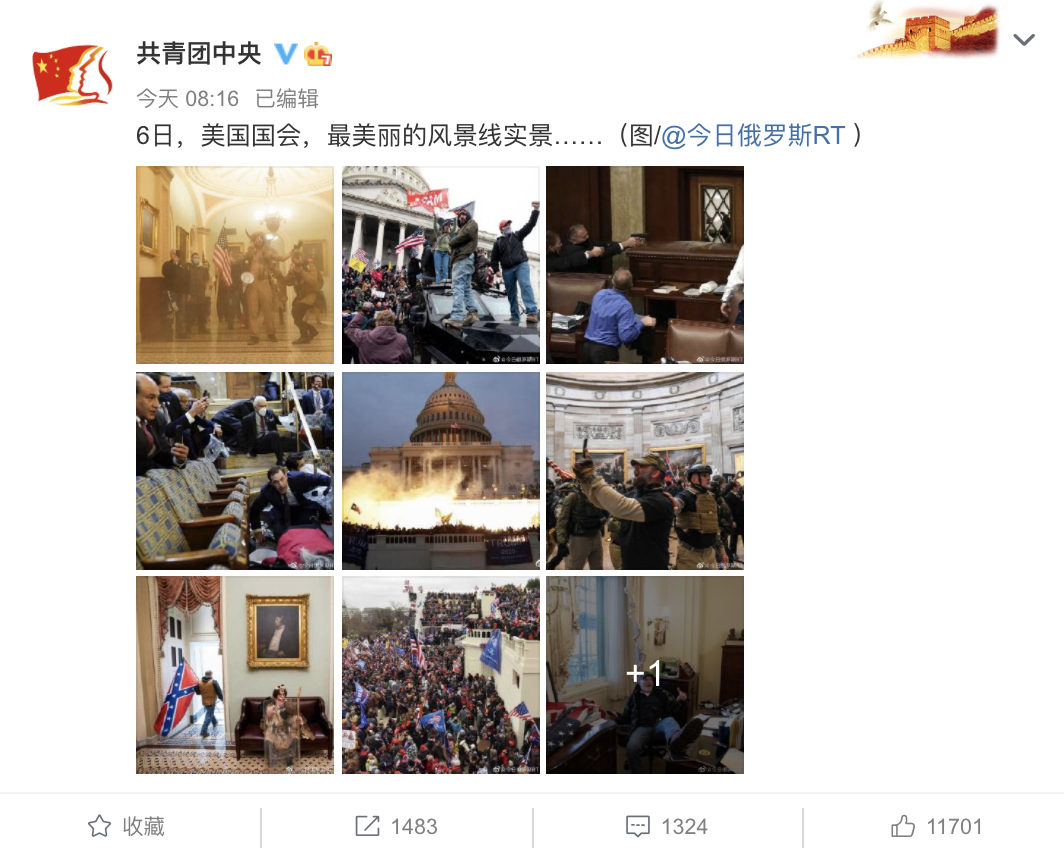
I think the reasons for the change include Covid, the Capitol riot in 2021 and Trump’s more brazen corruption in his second term. I think the Capitol riot probably had the biggest impact on liberals, because it was a direct assault on the democratic system. Other things could still be explained away. Take Covid: for a while, Covid controls in China were terrible — there was too much control, so China’s problem was the exact reverse of America’s. So back during the pandemic, if someone criticized America’s handling of Covid, you could still find an angle from which to defend America. But with the Capitol riot, there was no way to do that.
These three types of people you’ve described — some have abandoned their liberal identity, some are embarrassed to keep supporting Trump, and some have shifted to, say, praising Israel. Are these all real examples you’ve seen around you?
Yes, from commentary I’ve observed online. Many people write WeChat public accounts or give lectures online and so on, so you can generally see it. Take Professor Sun Liping (孙立平), a sociology professor at Tsinghua and a well-known scholar. During Trump’s first term, he was very supportive of Trump. But now he’s fairly critical of him. Still, sometimes you can feel that he’s occasionally influenced by some of his earlier ideas. On the other hand, there are also many who still support Trump unwaveringly, such as Cong Riyun (丛日云) [a professor of political science at China University of Political Science and Law] and Wang Jianxun (王建勋) [an associate professor of law at China University of Political Science and Law].
You said some Chinese intellectuals have abandoned their liberal identity. Can you explain that?
Now some people may no longer call themselves liberals, but say outright that they’re conservatives, like Liu Junning (刘军宁) [a political scientist]. They feel that label no longer represents them. They may slide further toward civilizational conservatism (文明保守主义), or identify more as pure conservatives.
I don’t want to oversimplify how these people express themselves, because their actual position isn’t that they’ve become Trump fans. But at the same time, their criticisms are placed within a larger framework that reinterprets American politics. This reinterpretation says: You people who criticize Trump are different from me. You say American democracy is in crisis, but that’s overblown. Because actually, look at many things before Trump — they should be blamed on Hillary, on the Democrats, not on Trump. And so on. I’d say a large part of China’s intellectual world is made up of people like this. They don’t openly say they’ve become Trump fans. Take Qin Hui now. Of course, the share of criticism these people direct at Trump is surely growing, because the bad side of what he does is becoming more and more obvious. Even if you wanted to whitewash him again, it would be hard.
They transplant the same logic, the same framework for seeing the world, to other parts of the world. Take Israel: we keep hearing that Palestinians are being bullied, but if you look at the historical context, didn’t Hamas do bad things first? Aren’t the Arab countries just not civilized enough? And so on. In this way, Israel becomes an imagined country that kept giving ground until it was finally forced to hit back. For those of us who study politics, what we care about most is what’s underneath — that is, how far you identify with the political discourse, the political logic and the ideology behind it, rather than how far you identify with any one person. That’s what I’m more interested in.
Other Chinese intellectuals are now mainly praising Israel rather than America. Because they’re embarrassed to keep praising America directly, their target has shifted. Or they just criticize Europe or Canada, saying they epitomize the white left.
You were born in the 1980s, and intellectuals born in the 70s, 80s and 90s all grew up with the idea of America as a beacon. Back then, people were still debating whether China should learn from America, whether it should be more like America. But young people in their 20s now, who grew up after 2008, never lived through an era when America was a beacon. Could you say the idea of America as a beacon is gradually being forgotten or abandoned?
Yes. They’re the generation that grew up after the Beijing Olympics. Their default assumption is that China is getting stronger and America is in continual decline. Their statist and nationalist sentiments tend to be stronger. Of course, it depends on the person. Many people are vaguely aware of their dissatisfaction with everyday life in China. When the economy is good, that dissatisfaction may be masked, but when the economy is bad, it shows.
In the past two years or so, you increasingly see people saying that working in China means toiling like a beast of burden, that they can’t go on, that they want to go abroad and see the world. But a few years ago, around 2018 or 2019, voices like that were rare. At that time, China’s economy may have been right at its peak, and people felt they had more money than they could spend. And America happened to be in a rather absurd state, with Trump in his first term. But after Covid, especially in the past two or three years, I think some voices have started to appear again: people with a lot of disappointment in China who don’t know how to say it out loud, so they want to leave everything behind — there’s nothing worth staying for anyway — and go see what it’s like abroad.
What questions have replaced that debate over whether China should learn from America?
Most people don’t discuss politics now. If they do, some might ask whether China should look to the Nordic model, or learn from some Western or Northern European countries. It’s very difficult to discuss political issues in China without a point of reference. Many issues in China can’t be raised directly, so people more or less look for a substitute point of reference.
For example, when people discuss China’s social security and welfare systems, or various other issues, they may talk about how things are done in the Nordic countries or in Canada. But I think one reason these reference points haven’t caught on is that, in Chinese eyes, the Nordic countries are all small. China is a big country, and Chinese people feel it needs to be compared with another big country, right? That’s why people always used to compare China with America — they felt America’s experience was similar to China’s and had points of comparison. But with the Nordic countries, Chinese people will say that China has such a big population and different problems, so how can you compare them directly?
It sounds like China has always misunderstood America. What do you think is the biggest misunderstanding of America in Chinese public discourse right now?
Last year the kill line (斩杀线) was popular — that’s a big misunderstanding. Of course, the American economy has plenty of problems, and there are lots of poor people. But young Chinese nationalists distort the current situation in very exaggerated ways. Take this kill line idea — that if your annual income falls below a certain amount, you’ll definitely end up dying on the street, that kind of thing. So whether it was overpraising America in the past or overly disparaging it now, both are tools for supporting certain political agendas at home.
For example, if you make a video on Bilibili, you don’t want it to get blocked. You’ve finally built up a lot of traffic, and then one day it’s suddenly censored because they say it’s inappropriate, and all that work is wasted. So you definitely have an incentive to predict what kind of content is safer, less likely to be reported, less likely to be censored. If criticizing America to an extreme, distorted degree is relatively safe in China’s current political climate, and gets traffic more easily, then they head in that direction. So it’s the result of several factors working together.
And what about American misunderstandings of China?
Take Chinamaxxing, which imagines China as an especially efficient machine. People think that with this machine, as long as China wants to do something well, it can do it well right away. But actually, China isn’t like that. In China’s political system, whether information and commands flow from the top down or the bottom up, there’s often a lot of breakdown and distortion along the way. Its bureaucracy is huge and often doesn’t know what it’s doing. So of course China does some things very well, but the things it does well are often in areas where the government hasn’t yet gotten deeply involved.
So a Chinese misunderstanding of America is to belittle it, while an America misunderstanding of China is to think it’s great. That’s very different from a few decades ago.
Right. Because American development has hit a serious bottleneck — Trump coming to power twice, plus many long-standing problems. For example, infrastructure in America has lagged for a long time. California has been talking about building high-speed rail for 20 years, and it still isn’t built. These problems really do exist, so they’ve caused a lot of anxiety. Many people in America wonder why, when China says it will build high-speed rail, it gets built in a few years. But people forget things like the Wenzhou train collision [in 2011].
Chinamaxxing imagines China as an especially efficient machine. But China isn’t like that. … Its bureaucracy is huge and often doesn’t know what it’s doing.
Individualism is a concept that arguably originated in the West. Intellectuals generally say it was a cultural change brought about by the Enlightenment and, later, the Scientific and Industrial Revolutions. But China has also gone through these changes in material conditions. So is China still collectivist? Does China have individualism?
In premodern times, in every civilization and society, people lived more within their own small communities, such as clans and villages, and the state didn’t provide much social security. What would you do when a great disaster struck? You’d mostly need your clan or village to support you. And in premodern times, most people were tied to their native soil. It wasn’t possible, as it is now, for lots of people to go off as drifters in Beijing or Shanghai, or to work elsewhere and cut ties with their old networks. So it was hard for most people to really have a spirit of individualism, because their lives depended on a web of relationships.
After the Enlightenment, thinkers began to criticize the church and the old small communities, arguing that people should use their own reason more rather than blindly obey particular cultural and social norms. On the other hand, the Industrial Revolution brought rapid urbanization and industrialization. Many villagers came to the cities and became factory workers, their ties to their old village communities weakened, and they entered a new kind of urban life. This also provided the material basis for the rise of individualism. People increasingly felt that it had become possible to leave their old small communities and start a new life centered on the individual, the nuclear family or just themselves. And gradually this became the default — people came to see it as normal.
China is the same. For example, after the urbanization of the past two or three decades, the younger generation living in cities and the older generation still in small villages and towns have very different attitudes, right? The older generation certainly feel that young people are too individualistic. But young people, however much they miss home, will definitely find it harder to adjust when they go back to live there for a while, because their relatives’ and friends’ attitudes differ from theirs. So I think these changes are also happening in China, though the degree and speed may differ. The West may have taken 200 or 300 years to complete this transformation, but in China it only began in the reform era [50 years ago].
You’re an interdisciplinary public intellectual. Do you think intellectuals have a responsibility to awaken a spirit of reason in others? Is there such a responsibility at all?
I think intellectuals should take on some social responsibility. It may differ from person to person. Everyone’s temperament, energy and what they’re good at are different. Some may feel that focusing on research and teaching is enough. If they have energy to spare, some may share their research with the public — a kind of popular science, which is also good. Others may take part more in current social and political debates, which is fine too. But I think being an intellectual does come with some extra demands. After all, you’ve gone through so many years of academic training and gained resources and knowledge that others can’t easily get, so you should take on a corresponding responsibility. But that doesn’t mean you have to be involved in these things every day. Everyone is limited by their time and energy. Do a little if you can, and if you can’t, that’s OK too.
So do intellectuals have a responsibility to awaken a spirit of individualism in individuals?
I think putting it that way is a bit condescending, as if ordinary people are all waiting for you to save them. But you could say that some people take part in public discussion and talk with others, and with the public, as equals. They hope to use what they’ve learned to help raise the quality of public dialogue, so that society’s understanding of and participation in public affairs can improve.
In the current political climate, how likely is it that intellectuals can do these things?
Very unlikely. That’s why my book is called Empty Talk (空谈). First of all, I admit that most of what I do is empty talk, because it doesn’t have much real effect. But in any case, the effect isn’t something you can control, whereas whether you do it or not is.
The midterms are coming soon. Do you have any predictions about the attitudes of Chinese intellectuals?
People in China don’t care much about the midterms, because even in America the midterms don’t draw as much attention as presidential elections. I think the people who are still following America closely are generally those who are fairly worried about its current state. They think Trump’s second term has been a mess and want to see whether the midterms can rein it in — that is, whether the quality of American democracy will keep falling or if that decline can brake a little. Every presidential election, the number of people who care suddenly goes up. They care once every four years, like watching the World Cup.
Trump’s corruption is now completely out of control. And there are all kinds of bizarre bills and policies, going after H-1B visas one moment and doing this or that the next. If the Democrats control Congress, they can at least restrain these things a bit and block certain bills from passing. But if the Republicans keep control of Congress, there will be nothing left to restrain Trump. Recently someone wrote a new piece on Substack that calculated, using UN corruption indicators, that Trump’s second-term corruption index, on a scale of zero to 100, has reached 91. That’s higher than the vast majority of dictators in history. Not even Suharto, Mobutu and Putin scored as high as Trump. ∎
Translations by Alexander Boyd and Claude.

Yi Liu is a bilingual journalist from Chongqing, based in New York. She is a staff writer at China Books Review, and previously worked at The Wire China, The New York Times and The Beijing News. Her articles have also appeared in The China Project, Initium Media and other outlets.